



Rural Modernization "14th Five-Year" Plan Released, Mulching Film Top-Level Policy Welcomes Key Shift!
China’s annual use of plastic mulch film is approximately 1.38 million metric tons, with the total mulched farmland area reaching about 300 million mu. As an important agricultural input for stabilizing and increasing yields in dryland farming, fruit and vegetable cultivation, cotton production, and other crops, its massive scale of application has compelled the continuous iteration and upgrading of policies governing plastic mulch film management.
On June 2, the State Council issued the “ Accelerate the "15th Five-Year Plan" for Agricultural and Rural ModernizationCompared with the 14th Five-Year Plan for Advancing Agricultural and Rural Modernization, the state has made a clear shift in both the top-level policy framing and the implementation pathways for plastic mulch film management. Coupled with the continued expansion of demonstration and promotion efforts and the launch of revisions to the national standards for biodegradable mulch films, China’s mulch film governance has entered a new stage of full-chain, science-based regulation and control.
Shift from "R&D Promotion" to "Full-Cycle Closed Loop Governance"
The 14th Five-Year Plan for the prevention and control of agricultural non-point source pollution proposes accelerating the widespread adoption of standard-compliant plastic mulch films, strengthening the R&D and promotion of biodegradable agricultural films, and advancing the mechanized collection and specialized recycling of used mulch films. The wording focuses on both ends of the process: at the front end, promoting the adoption of standard mulch films and facilitating the application of biodegradable mulch film R&Dat the back end, emphasizing the recycling of used mulch films. The overall approach is to begin with pilot projects and R&D, and then advance implementation and promotion step by step.
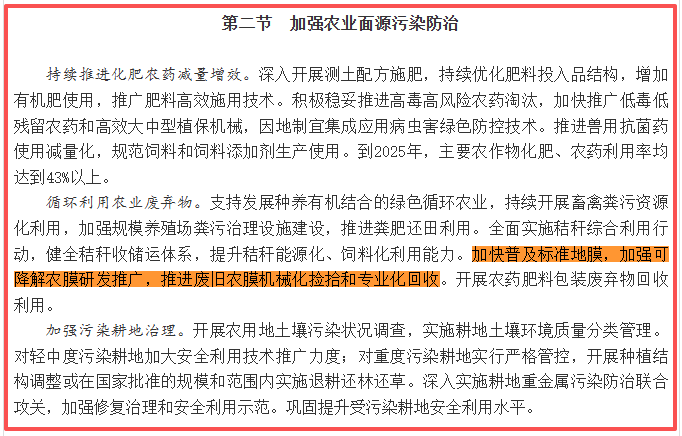
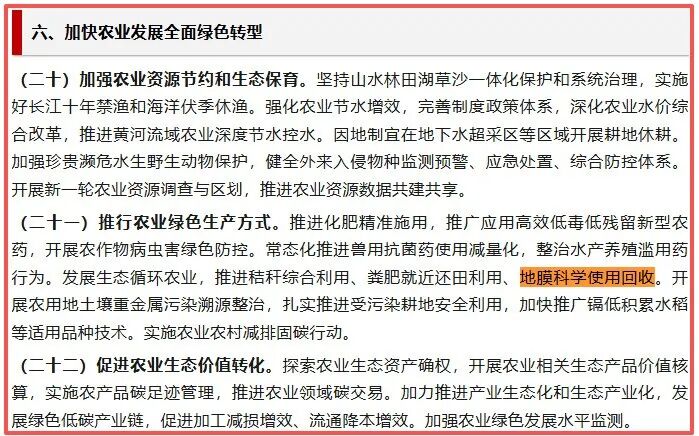
The "14th Five-Year Plan" has optimized the chapter on agricultural green production to: Promote the scientific use and recycling of plastic film. In just ten characters, the connotation has been comprehensively upgraded, transitioning from the previous "standard film + degradable film + separate promotion of recovery" to an integrated approach that encompasses source selection, field use, and residual film recovery. It incorporates both thick, weather-resistant film and fully biodegradable film into the scientific application system, reflecting a shift in governance thinking from itemized pilot projects to systematic closed-loop management.
2. The promotion scale of the two types of plastic mulch has expanded substantially year after year.
The implementation data of the project for the scientific use and recycling of agricultural mulch film provides a direct reflection of policy guidance being put into practice. When the project was launched in 2022, the annual targets were 50 million mu for thickened high-strength mulch film and 5 million mu for fully biodegradable mulch film. By 2025, the two indicators had increased to 96.94 million mu and 11.53 million mu, respectively, totaling 108.47 million mu, accounting for 36% of the country’s total mulched area of 300 million mu.
In just a few years, the adoption area of thickened high-strength plastic film and biodegradable mulch film has increased substantially, continuously squeezing the application space of ultra-thin substandard plastic film, and steadily optimizing the product structure of agricultural plastic film nationwide.
3. Synchronize revisions with national standards to address gaps in industry regulation.
As industrial scale-up accelerates, the supporting standard system is also being improved to address shortcomings.
The current GB/T 35795-2017, *Fully Biodegradable Agricultural Mulching Films*, has been implemented since 2018 and has long supported the industrial development of biodegradable mulch films. However, the current standard also reveals certain shortcomings: the provisions on biodegradation performance need to be better aligned with and more applicable to international standards; the material categories of biodegradable mulch films need to be updated and improved; and it is necessary to establish traceability methods to combat counterfeit biodegradable products.
In February 2025, the country's standard revision plan was officially approved and initiated.Coordinated by the National Technical Committee on Biobased Materials and Degradable Products and led by Beijing Technology and Business University in drafting.
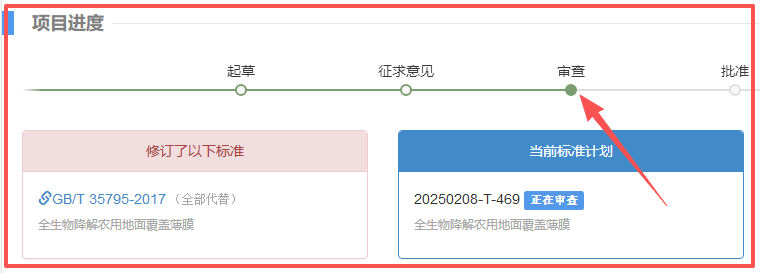
The new standard plans to add key provisions such as the category of ultra-long-term degradable films for agricultural use, degradation testing of 180 days under normal soil conditions, ecological toxicity testing, and infrared spectroscopy screening for petroleum-based plastics. This will strengthen the technical barriers for product access and ensure the wide promotion of degradable films during the 14th Five-Year Plan period.
From adjustments in planning language to the increase in application area, and the iterative improvement of industry standards, multi-dimensional policy collaboration is driving the domestic plastic film industry to shift from end-of-pollution management to green and standardized lifecycle control, aiding the steady advancement of green modernization in agriculture and rural areas.
【Copyright and Disclaimer】The above information is collected and organized by PlastMatch. The copyright belongs to the original author. This article is reprinted for the purpose of providing more information, and it does not imply that PlastMatch endorses the views expressed in the article or guarantees its accuracy. If there are any errors in the source attribution or if your legitimate rights have been infringed, please contact us, and we will promptly correct or remove the content. If other media, websites, or individuals use the aforementioned content, they must clearly indicate the original source and origin of the work and assume legal responsibility on their own.
Most Popular
-

Layoffs, Divestments, Plant Closures While Pouring Billions: BASF Undergoes Major Transformation!
-
Ascend Adipic Acid Hit By Force Majeure, Market Expects Supply Resumption In Mid-September
-

Raw Material Supply Shortage! INEOS Phenol Declares Force Majeure on Phenol and Acetone Businesses
-
South Korea initiates anti-dumping investigation against Chinese PVC suspension resin! The target is Tianjin Bohua and Wanhua Chemical. How to break through?
-

Sixth national procurement set to be implemented: A “Reshuffling” Moment for the $10-Billion Medical Device Market


