



New energy vehicle sales in february: Zeekr and Li Auto Top Two, Xiaomi and Huawei’s Avatr Hit Hard
On March 1, new energy vehicle makers successively announced their February delivery figures.
Let's first look at the rankings of the top six new forces. Leapmotor, with 28,067 vehicles, maintained its position as the champion among the new forces. Lixiang followed closely, delivering 26,421 vehicles, with the top two differing by less than 2,000 vehicles, and Lixiang's month-on-month decline was only 4.5%, the smallest among the top six; NIO's three brands combined for 20,797 vehicles, ranking third, with the main force still being the NIO ES8.
The gap between the fourth and sixth places is notably wider: Xiaomi delivered over 20,000 units, ranking fourth. AITO delivered more than 58,000 vehicles cumulatively in January and February, implying approximately 18,000 units in February. As of publication, Harmony Intelligent Mobility Alliance (HIMA) has not yet released its overall delivery figures. XPeng delivered 15,256 units, placing last among the top six. All three brands saw month-over-month declines exceeding 20%, with some nearly halving.
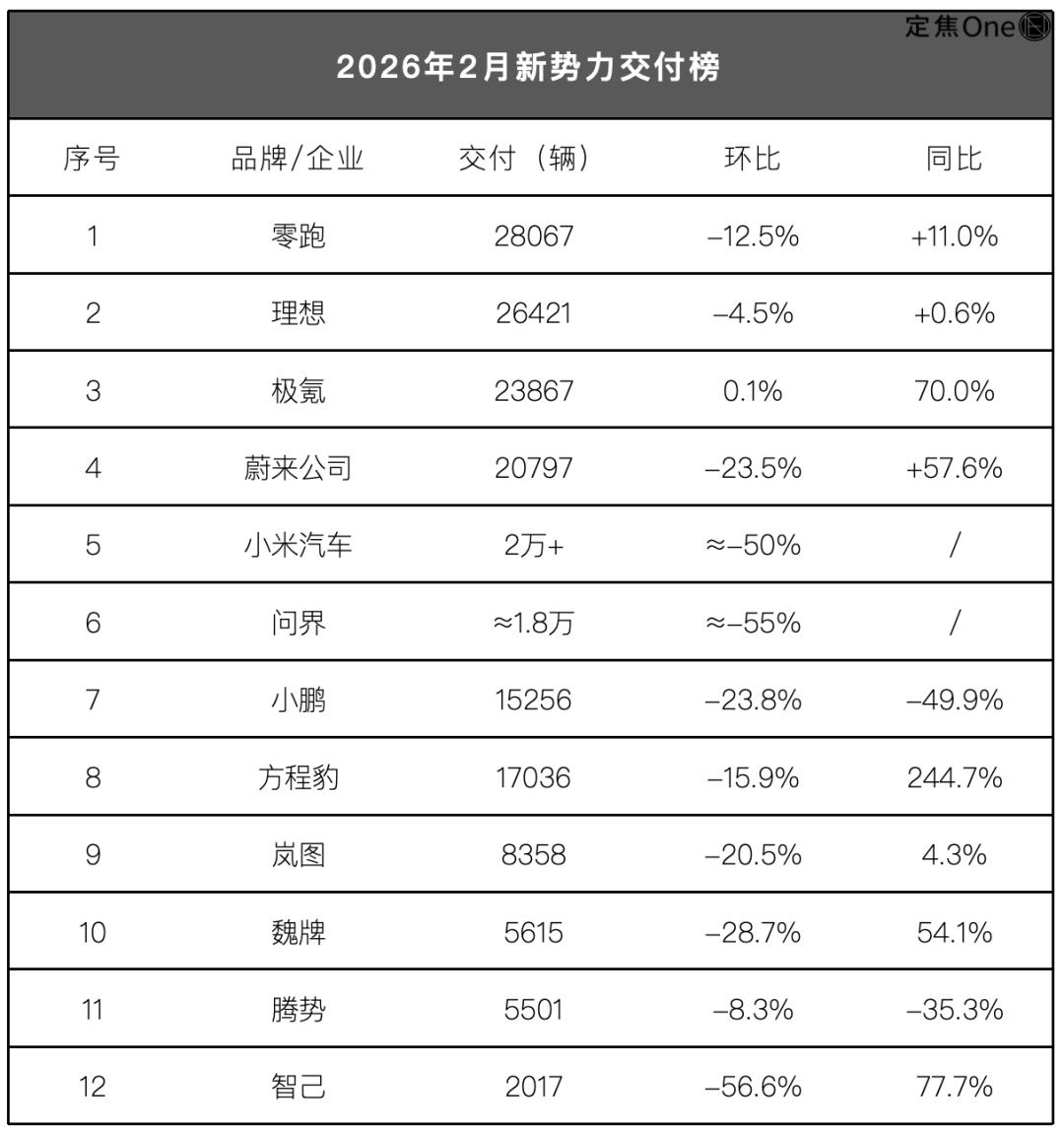
Next, examine the sales figures of traditional automakers and their new-energy vehicle (NEV) brands: Geely Auto sold 206,200 units, including 23,867 units for Zeekr; BYD sold 190,200 units, including 17,036 units for Fangchengbao and 5,501 units for Denza; Great Wall Motor sold 72,600 units, including 5,615 units for Wey; additionally, Voyah delivered 18,873 units cumulatively in January and February, representing an 18% year-on-year increase—implying approximately 8,358 units delivered in February; and IM Motors delivered 2,017 units.
The widespread decline in February deliveries was due to both seasonal factors (the Lunar New Year sales lull and policy transitions) and the fact that many automakers are in a transition period between old and new models. To address sales pressure and prepare for a potential market rebound in March, multiple automakers are focusing on:Clearing inventory, awaiting new vehicles.
In the sales sector, "7-year interest-free" has upgraded from a differentiated strategy to an industry standard, even evolving into "purchase tax guarantee." Since March 1st, companies such as Leap Motor, Tesla, BYD, Harmony Intelligent Driving, and Lede have simultaneously launched or updated their car purchase benefits.
What truly determines the long-term competition among companies is still the new cars. Leapmotor's A10 and D19, Li Auto's new L9, NIO's ES9 and Lado L80, Xiaomi's new SU7, Xpeng's range-extended new car, and AITO's M6—most of these new models are scheduled for a concentrated release in March and the second quarter.
Consumers generally prefer "buying new over old," and the market response to this batch of new cars will directly determine each automaker's sales performance for the rest of the year. Therefore, the real battle begins in March.
1
Leapmotor and Li Auto
One seeks stability, the other shifts gears.
Zheye delivered 28,067 vehicles, ranking first among the top new energy vehicle manufacturers. It recorded a 11% year-over-year growth but a 13% month-over-month decline. This decline is not significant for a February month. Additionally, Zheye is one of the few automakers that did not follow the "7-year low-interest" financial policy. The fact that it still maintains this sales position indicates that Zheye has established certain user loyalty in the price range of 100,000 to 200,000 yuan.
Investor Chen Liang, who focuses on new EV makers, noted that the C-series (C10, C11, etc.) and B-series (B01, B10, etc.) vehicles priced between RMB 100,000 and 200,000 still account for the vast majority of sales. February's monthly export figures were not disclosed separately, but given Leapmotor's continued expansion into overseas markets such as Australia, exports likely contributed significantly.
Leapmotor’s stability relies on its extreme cost-effectiveness; however, delving deeper, it ultimately boils down to cost control. According to Huachuang Securities’ estimates, full-domain in-house R&D enables Leapmotor to achieve approximately a 10% reduction in overall vehicle costs. This is precisely why Leapmotor can equip vehicles priced at RMB 150,000—or even below RMB 100,000—with advanced features such as LiDAR and Qualcomm’s 8295 chip. Chen Liang added,Compared to BYD, Leapmotor has advantages in the pure electric field. In the hybrid field, BYD's DM-i technology has deeper accumulation and stronger brand recognition, while Leapmotor is still catching up.
Leapmotor's goal for this year is to achieve one million sales, which means in the remaining 10 months, it needs to reach an average monthly sales volume of 95,000 units, and this depends onThe volumes of Series A and Series D, whether Series B and Series C can maintain last year's volumes, and the performance of overseas markets.
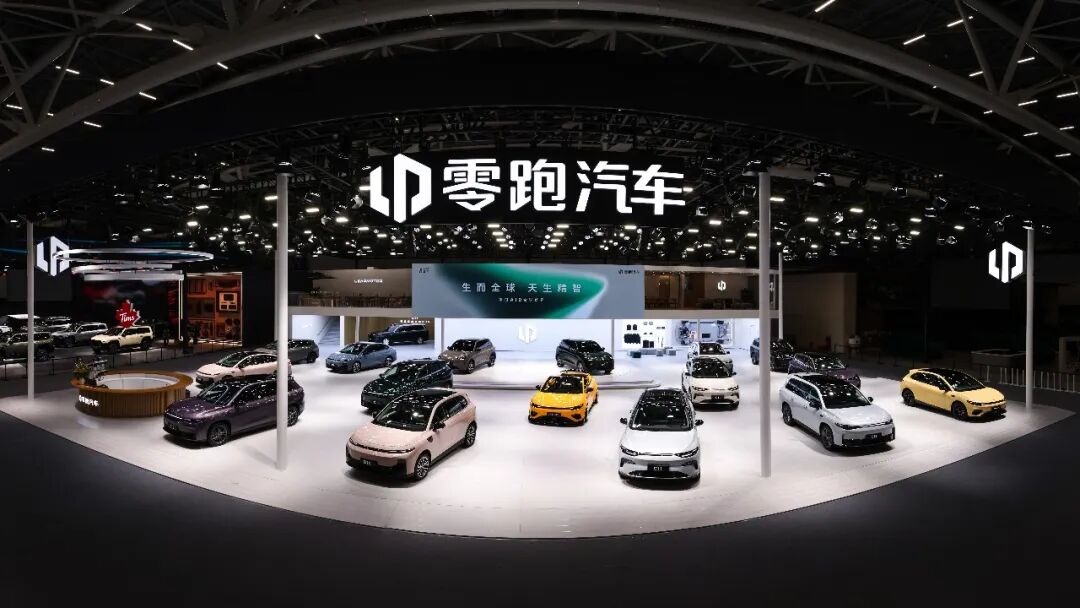
Image Source / Leapmotor Automobile Official Weibo
The A10 is Leapmotor’s latest new model currently undergoing pre-launch promotion. Positioned below RMB 100,000, it is expected to launch around the Beijing Auto Show and is tasked with succeeding the T03 to reposition Leapmotor in the entry-level small-car market. While Leapmotor is no stranger to this price segment, whether it can replicate the T03’s high-volume sales success in today’s more intensely competitive market remains to be validated by the market.
D19 is positioned in the 250,000 to 300,000 RMB range, with a planned launch in April, aiming to enhance the brand image and increase gross margin, directly competing with brands like Aito and Li Auto; D99, however, is still in an earlier preheating stage, with an unclear launch time. However, the market is concerned that Leaper's main focus is on the mainstream price range of around 150,000 RMB, and whether the D series can truly break into the high-end market remains to be seen.
At present, Leapmotor's path is clear, but the challenges in supply chain, production, channels, and organizational capabilities are significant.
Li Auto delivered 26,421 vehicles in February, down only 4.5% month-over-month—the smallest decline among leading new energy vehicle makers—and up slightly by 0.6% year-over-year.
From the data, Li Auto’s delivery pace in the first two months of 2026 has been relatively stable, particularly for the i6 series, which has demonstrated steady performance.
Li Auto had two main moves in February.First, the sales defense campaign; second, the brand upgrade campaign.
First, the sales defense campaign—centered on price cuts for the L-series. Ideal’s previously successful product formula—“range-extended powertrains to eliminate range anxiety, plus refrigerators, large touchscreens, and premium sofas”—has been rapidly replicated by competitors. Meanwhile, Huawei’s Aito is siphoning off customers with its strong reputation in intelligent driving, while XPeng and other brands are capturing potential range-extended vehicle buyers with larger battery packs.
More importantly, the L series (L7/L8/L9) is about to undergo a major facelift. "Fixed Focus One" recently visited dealerships and noticed that salespersons mentioned that now is a "clearing inventory" large-scale promotion. When introducing the L8 model, salespersons directly presented a set of strategies: first, a 40,000 yuan cash discount, plus a 10,000 yuan Beijing license plate trade-in. In addition, some regions (origin and delivery location) offer a total of 6,000 yuan in local subsidies. If the customer has an old car for trade-in, they can also enjoy an additional 15,000 yuan trade-in subsidy, resulting in a total discount of over 70,000 yuan.
Besides price reductions and subsidies, Li Auto continues to promote the "7-year low-interest car purchase plan." Sales personnel said, "This is the end phase of the L8 model, and the price has been reduced to the lowest level, as the new L8 will be launched in the second quarter with further improved range to cope with the competitive pressure from large-battery range-extended vehicles in the industry."
In the short term, the L9 Livis is unlikely to contribute significantly to sales volume; rather, it serves more as a strategic move to enhance the brand's technological image and counteract market pessimism, thereby buying time for the ramp-up of its BEV models and paving the way for future price increases with L-series facelifts.
2
NIO is propped up by the ES8.
Xiaomi's SU7 is on the road
NIO’s three brands—NIO, LERX, and Firefly—delivered a combined total of 20,797 vehicles in February., down 23.5% month-over-month but up 57.6% year-over-year.
Of these,The monthly sales of NIO's main brand were 15,159 units, and the all-new ES8 sold 11,260 units.Same as last month, the new ES8 with a price over 400,000 yuan accounted for the majority of sales. It is evident that the sales of the Lede brand, which is supposed to handle volume, are not optimistic.
Goldman Sachs noted in its research report that the ES8’s sales share surged to 32% in Q4 2025, up sharply from just 2%–5% in the previous three quarters. NIO’s current growth is concentrated in a single premium SUV model—this underscores the product’s competitiveness, yet intensifying competition in the premium SUV market, with new entrants continuously emerging, poses risks; any volatility in ES8 demand could impact profitability progress.
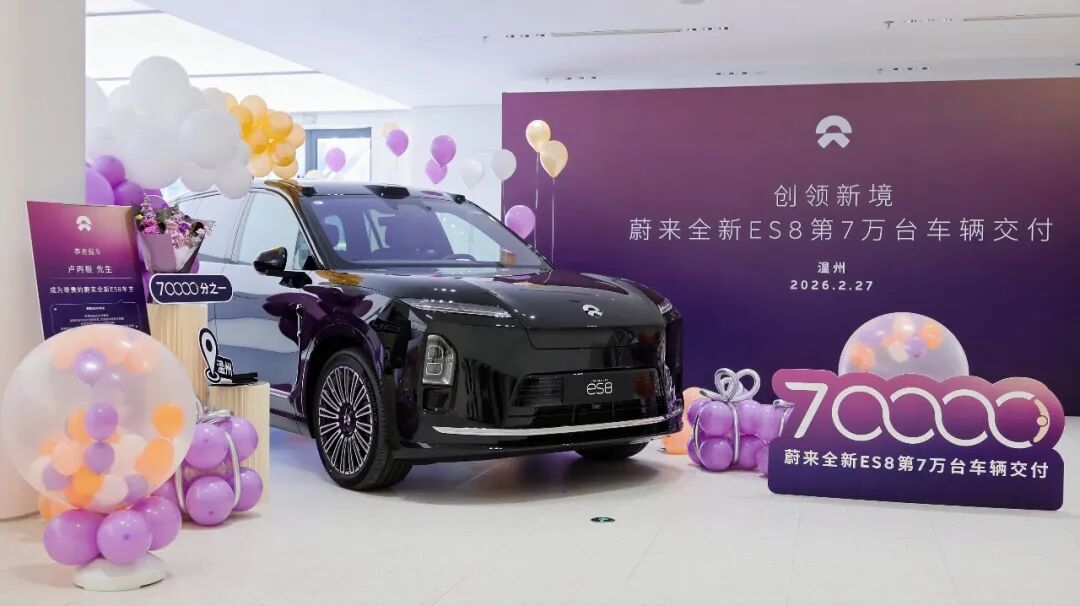
Photo source / NIO Weibo Official Account
It is precisely against this backdrop that NIO, after the Spring Festival holiday,Sales EndA series of preferential policies has been launched. Currently, NIO’s main brand offers a RMB 10,000 purchase tax subsidy for the ES8. The ONVO brand provides even more substantial incentives—not only a “7-year low-interest” financing plan, but also an additional purchase tax guarantee (available only when purchasing via the Battery-as-a-Service, or BaaS, model). For the ONVO L60, the down payment threshold has been lowered to less than RMB 30,000, with a daily payment of just RMB 69. During our store visits, sales staff consistently positioned the ONVO L90 as a direct competitor to the Li Auto L8, emphasizing its advantages in energy efficiency and lightweight design.
The logic behind these actions is to maintain the current market momentum and buy time for the NIO ES9 and L08.
Meanwhile, rising prices of upstream raw materials—such as lithium, aluminum, copper, and memory chips—increased NIO’s cost pressures.Supply Chain EndWith the move, NIO has signed a comprehensive strategic cooperation agreement with Bosch, covering core technology areas such as wire control chassis, battery management, brake control, and steering systems, spanning across the three brands NIO, Lada, and Firefly. Binding with a global leading automotive parts supplier has two meanings for NIO: one, in the joint R&D, it optimizes costs and stabilizes supply, which is substantial help for NIO, currently striving for cost reduction and efficiency improvement; two, it provides a technical endorsement for Lada and Firefly, these two sub-brands that are still in the process of establishing their influence.
Overall, whether ES9 and Ledi L80 can successfully take over will be key to NIO moving out of its current growth predicament and entering a healthier development phase.
Xiaomi’s February sales volume exceeded 20,000 units, representing a roughly 50% month-on-month decline, indicating that the impact of the product transition was further amplified in February. Its first-generation SU7 officially ceased production in January, meaning that virtually all vehicles sold and delivered in February were the YU7 SUV.
Sales pressure is in place,Xiaomi’s market activities in February revolved around two initiatives.
First, Xiaomi's 7-year low-interest financing policy for the YU7 has been extended into February, further lowering the purchase barrier and stabilizing the YU7's core customer base. According to a Deutsche Bank research report, this policy played a crucial role in boosting YU7 orders in January.
Second, the factory production lines are going full steam ahead to prepare for the mass production of the new generation SU7, which is set to hit the market in April. Meanwhile, by continuously preheating product details, market attention is being increased, guiding the decision-making cycle of potential buyers to after April.
Therefore, Xiaomi's situation in February will continue into March, still relying on the YU7 model to carry the load, while the financial policies of competitors like Tesla continue to exert pressure. This means that Xiaomi's sales in March are likely to struggle to return to the high level of January.
Xiaomi's real test is in April. The new SU7 is priced between 10,000 to 14,000 yuan higher than the old model, but it comes with a comprehensive upgrade in specifications. Whether consumers are willing to pay more for the upgraded product is key to testing Xiaomi's brand premium and product strength.
3
AITO slashes prices, Xpeng finishes last,
Everyone is waiting for the new car.
On the evening of March 1, Harmony Intelligence (AITO) announced that the total new vehicle deliveries for all models reached over 58,000 in the first two months. Combined with its delivery of 40,016 units in January, it can be calculated that...AITO’s delivery volume in February was approximately 18,000 units., down nearly 50% from the previous period.
In February, SERES made a key move: it10-15“” In February, SERES made a key move: it stripped off its own brand "Landian Auto" positioned in the 100,000 to 150,000 yuan market. This indicates that SERES is putting all its resources into the high-margin AITO brand. After stripping off the low-end business, the financial statements will look better.
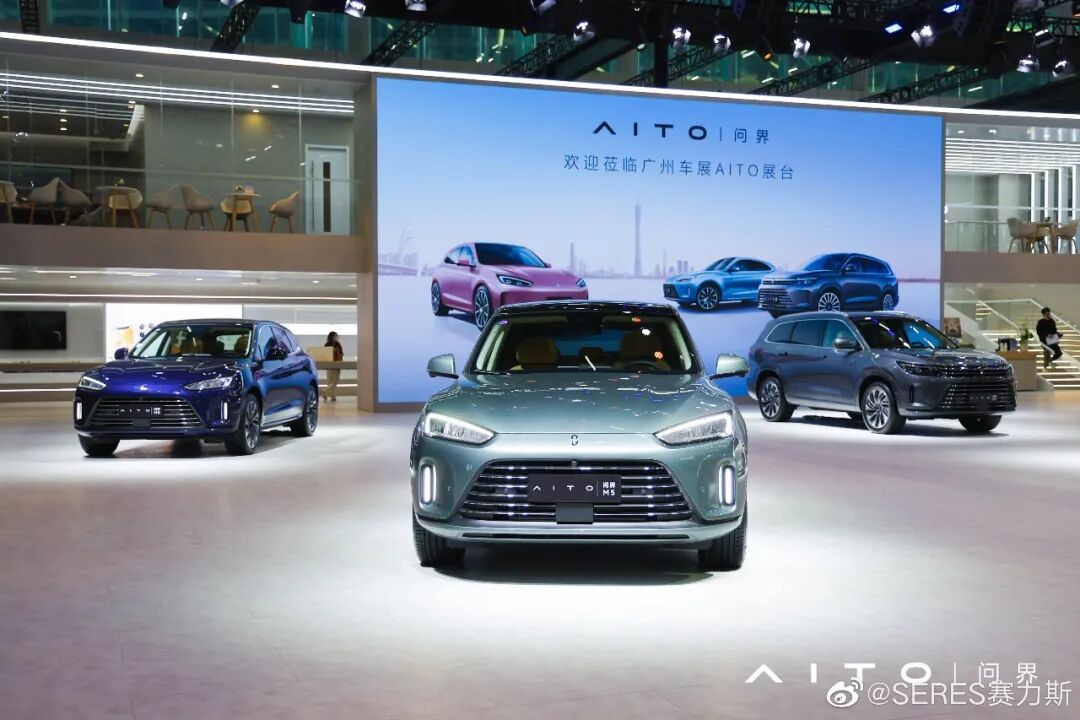
Image Source / Huawei Aito’s Official Sina Weibo
While Aito focuses on the premium market, the Harmony Intelligent Driving Ecosystem brand itself is simultaneously maintaining its presence and credibility in the market.
February, Harmony Intelligent DrivingContinued to appear on the Spring Festival Gala for the third consecutive year.A channel source said that this is not just an opportunity for the brand to be seen, but for the traditional car buyers in third- and fourth-tier cities, the trust from the Spring Festival Gala is more effective than many ads.
In terms of data,As of the time of writing, Hongmeng Zhihang has not yet announced its delivery volume for February.
Xpeng delivered 15,256 vehicles in February, ranking at the bottom among the leading new energy vehicle brands, with a year-on-year decline of 49.9% and a month-on-month decline of 23.8%, continuing the downward trend from January. The core issue is the same as "a lack of new products to take over," although the flagship MPV X9 has performed impressively, its volume is too small to boost overall sales.
Xiaopeng’s February strategy, besides actively following Tesla’s 7-year low-interest financing plan, primarily focused on addressing product lineup gaps by introducing such core models as the P7+ and G7.Range-extended version.The demand in the extended-range market is real, as proven by Li Auto and Wenjie. Xpeng also wants to seize the market share in the extended-range segment by entering late.
4
Entering March, three dimensions deserve close attention.
Image source / pexels
The third is cost control and operational efficiency. The pressure of rising raw material prices has already become apparent, and competition at the terminal level does not allow for easy price increases. Whoever can maintain their gross profit margin in this situation will have more room to maneuver in the second half of the year.
Over the next 10 months, the true competitive edge will lie in whether automakers can not only “sell units” but also “sell healthily.” Only by jointly examining gross margin, cash flow, and market share can we accurately assess an automaker’s true condition and the overall market landscape.
【Copyright and Disclaimer】The above information is collected and organized by PlastMatch. The copyright belongs to the original author. This article is reprinted for the purpose of providing more information, and it does not imply that PlastMatch endorses the views expressed in the article or guarantees its accuracy. If there are any errors in the source attribution or if your legitimate rights have been infringed, please contact us, and we will promptly correct or remove the content. If other media, websites, or individuals use the aforementioned content, they must clearly indicate the original source and origin of the work and assume legal responsibility on their own.
Most Popular
-

Middle East Tension Spikes Global Energy Pattern, Crude Oil and Plastic Industries Face Multiple Challenges
-
Middle East Tensions Escalate Sharply: How Polyolefins Respond Amid Soaring Risk Premium
-

Middle East Polymer Export Hub Hit in Sudden Attack, Global Supply Chain Sounds Alarm
-
[Forward-Looking Analysis] Impact of Escalating U.S.-Iran Tensions on Domestic Chemical Market
-

Futures Surge Violently, Polyolefin Spot Prices Rise Sharply in Tandem


