



Multiple automakers increase investments in the U.S., a major victory for Trump's tariff policy?
Officially taking office for more than two months, President Trump's tariff policy has achieved a significant victory.
Hyundai Motor Group Unveils Largest-Ever Investment in the U.S.
On March 25, Hyundai Motor Group, a South Korean automaker, announced that it would invest $21 billion in the United States from 2025 to 2028, mainly to expand production in the United States.Capacity productionIt will strengthen the future mobility ecosystem, advance future technology development, and enhance energy infrastructure in the United States. This not only marks the largest investment ever made by Hyundai Motor Group in the U.S. but also exceeds the group's cumulative investment total since entering the U.S. market in 1986 ($20.5 billion).
Of the total investment of 21 billion USD, 9 billion USD will be used to enhance the production capacity of Hyundai Motor Group, increasing its annual production capacity in the U.S. from 1 million to 1.2 million vehicles and improving existing production facilities. Currently, Hyundai Motor Group has three plants in the U.S.: Hyundai Motor Manufacturing Alabama, Kia Autoland Georgia, and the newly opened Hyundai Motor Group Metaplant America (HMGMA) in Bryan County, Georgia.
Three years ago, Hyundai Motor Group announced that it would invest $5.54 billion to establish its first manufacturing plant in the state of Georgia, USA.electric vehicleA dedicated factory and battery production facility, with the hope of becoming one of the top three electric vehicle manufacturers in the U.S. by 2026. According to the plan at that time, the new factory is expected to start commercial production in the first half of 2025, with an annual capacity of 300,000 vehicles. Thanks to the latest $9 billion investment, the annual capacity of the HMGMA factory will be increased to 500,000 vehicles.
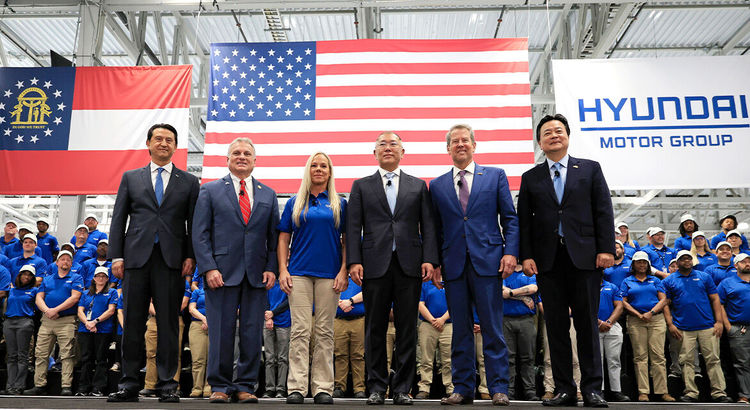
HMGMA factory opening ceremony; Image source: Hyundai Motor Company's official website
To ensure supply chain security, Hyundai Steel Company, part of the modern automotive group Hyundai, plans to invest $5.8 billion in building a steel manufacturing plant in Louisiana, USA, which will be its first factory overseas. According to information on the official website of the Louisiana state government, the factory in the state by Hyundai Steel is expected to begin construction in the third quarter of 2026, creating 1,400 direct jobs with an average salary of $95,000, and will indirectly create 4,100 new jobs.
Hyundai Steel stated in a press release, "We will supply steel produced at U.S. factories for strategic models manufactured by Hyundai and Kia in the United States, while also exploring supply agreements with automakers in Latin America and Europe." Euisun Chung, Chairman of Hyundai Motor Group, said that the factory "will serve as the foundation for the group to establish a more autonomous and secure automotive supply chain in the United States."
Multiple automakers increase investments in the US
In fact, before the Hyundai Motor Group announced its new investment plan, several automotive manufacturers had already indicated that they would increase or consider increasing their investments in the United States.
Just two days after Trump officially took office as president, Stellantis announced the restart of its Belvidere, Illinois plant, which will begin producing a new mid-size truck starting in 2027. Stellantis also committed to producing the next-generation Dodge Durango SUV at its Detroit Assembly Plant in the U.S.; investing in its Toledo, Ohio plant to provide additional technology and robust product enhancements, as well as increasing automotive parts production at the Toledo Machining Plant.OutputProvide operating funds for the factory in Kokomo, Indiana, to produce the new GMET4 EVO engine.
At the end of January this year, foreign media reported that German automaker Volkswagen Group was considering establishing production bases in the United States for its premium brands Audi and Porsche to avoid the impact of Trump's tariffs. So far, these two brands have not produced cars in the U.S., making them highly vulnerable to American import tariffs.
In February, Makoto Uchida, then CEO of Japanese automaker Nissan, hinted that Trump's tariffs might prompt the company to move its auto production out of Mexico. According to information on the White House website, Nissan is considering shifting production to the United States.
In early March, another Japanese automaker, Honda Motor, was reported to be producing its next-generation Civic hybrid model in Indiana, USA. The model was originally scheduled to start production in Mexico in November 2027, but under the pressure of tariffs, Honda decided to begin production of the new Civic model in Indiana in May 2028, with an expected annual output of approximately 210,000 units.
In mid-March, Volvo Cars' CEO Jim Rowan stated that the company might relocate the production of some models to the United States depending on the U.S. tariff policies. Currently, Volvo Cars manufactures its all-electric flagship SUV, the EX90, at its Charleston, South Carolina plant in the U.S., but it also imports hybrid and electric vehicles from Europe.
In addition to automobile manufacturers, many large companies have announced increased investment efforts in the United States. According to data released by the U.S. government website, since Trump took office, both domestic and foreign companies have pledged trillions of dollars in new investments, such as Project Stargate, Apple, NVIDIA, TSMC, and others.
Trump is very proud.
During the campaign, Trump consistently claimed that he would adopt tariff policies to strengthen domestic production in the United States. Since taking office, Trump has announced multiple tariff policies, including a 10% tariff on products from China and a 25% tariff on all steel and aluminum imported into the U.S. On March 26, Trump officially announced that starting from April 3, a 25% tariff would be imposed on imported automobiles and light trucks.
Several companies have successively announced increased investments in the United States, both in timing and scale representing a direct response to U.S. government trade policies, aiming to mitigate the risks brought about by Trump's imposition of comprehensive tariffs.
For example, Hyundai Motor Group built a steel plant in the United States to reduce the impact of import tariffs and expand in the U.S.Car productionIt is the same. In 2024, Hyundai Motor and Kia Motors sold 1.7 million vehicles in the U.S. market, a 3.4% increase from the previous year, making them the fourth-largest automotive group in the U.S. According to Edmunds, 52.3% of the vehicles from the three brands under the Hyundai Motor Group were imported from South Korea.
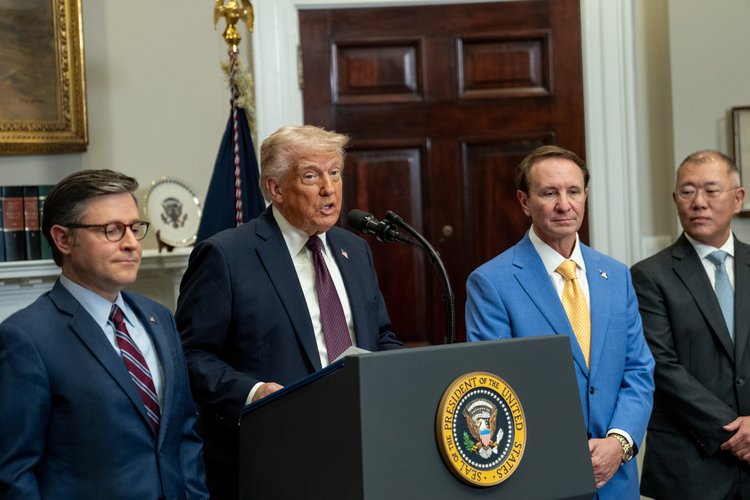
Image source: White House X account
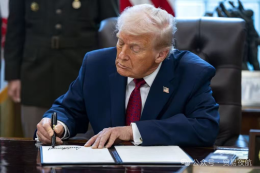
Regarding Hyundai Motor Group's investment plan in the United States, Trump proudly stated that it is "obvious" that his tariff policy is "very" effective. To highlight this achievement, Trump specifically announced Hyundai Motor Group's plan for additional investment at the White House. The White House also emphasized this "victory" in a press release, stating that this investment is another success of President Trump's "America First" initiative, further proving that President Trump's decisions are having an impact.
Trump stated, "Tariffs have brought their (investment) to unprecedented levels. Hyundai will produce steel in the U.S., and manufacture cars in the U.S. Therefore, they won't have to pay any tariffs. That's why so many people are coming." It is unclear whether Trump is conveying a message supporting localized production or hinting at exempting Hyundai Motor Group from specific tariffs. However, Trump's remarks suggest that the group's proactive investment commitments may receive preferential treatment under the U.S. government's new trade policies.
Trump also stated that Hyundai Motor Group is a "truly great company," adding that "there are other great companies coming, and some companies will stay here and expand vigorously. We are very interested in every business." We look forward to seeing which companies will increase their investment in the United States in the future.
【Copyright and Disclaimer】The above information is collected and organized by PlastMatch. The copyright belongs to the original author. This article is reprinted for the purpose of providing more information, and it does not imply that PlastMatch endorses the views expressed in the article or guarantees its accuracy. If there are any errors in the source attribution or if your legitimate rights have been infringed, please contact us, and we will promptly correct or remove the content. If other media, websites, or individuals use the aforementioned content, they must clearly indicate the original source and origin of the work and assume legal responsibility on their own.
Most Popular
-
Mexico Imposes Tariff Up to 36% on Cross-Border E-Commerce Products, Effective January 1, 2026; Plastic Shows Partial Fluctuation Today
-
4.5 Million Tons! Wanhua Chemical Dominates Globally in MDI, Heavy Investment in Battery Materials Spurs New Storm
-
Trump Delays Tariff Increase on Furniture, Cabinets, and Vanities
-
Wanhua Chemical Invests $27.3 Billion, 2026 Investment Map Revealed, $1.1 Billion Bet on Battery Materials
-
Back-to-back major joker moves! covestro’s 1.32 million ton mdi dual-line expansion and hdi acquisition reshape global polyurethane landscape


