



Mitsubishi Leads, Toyota Participates! Nine Japanese Companies Join Forces to Promote Recycled Plastic Supply System
Recycled plastics come from complex sources, and product quality control is unstable, with uneven performance, making them difficult to apply in high-end fields. To address the severe disconnect between the material side and the application side of recycled plastics, nine companies led by Mitsubishi jointly proposed a solution.
【Polymer Recycling has learned that on May 22, nine Japanese companies led by Mitsubishi Chemical jointly announced the launch of a feasibility study (FS) aimed at building a stable supply system for high-quality recycled plastics used in automobiles and other fields.
The companies involved include Gao Junxingye, Donggang Metal, Refinance, Mitsubishi Electric, digglue, Japan Polypropylene, Rhombic, and Toyota Motor (Domatics).
This project has been officially selected by Japan’s Ministry of the Environment for the “FY2025 Supplementary Budget Feasibility Study Project for Establishing a Stable Supply System for Recycled Plastics in the Automotive and Other Sectors.”
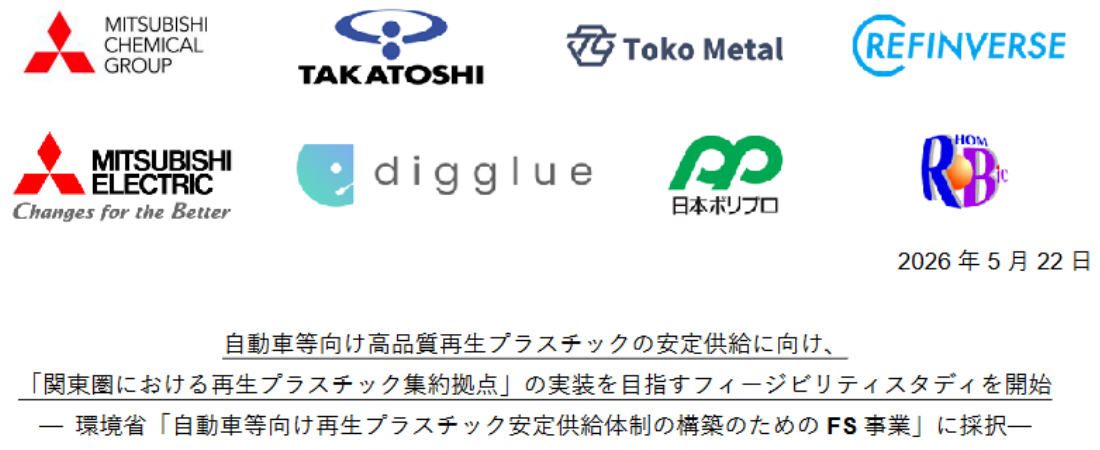
Source: Mitsubishi Chemical. Click “Read the original text” at the end of the article to view the original link.
In recent years, with Europe as the center, regulations on the use of recycled materials in the automotive sector have continued to tighten. Building a stable supply system for high-quality recycled materials has become an urgent need for the global automotive industry chain.
However, in contrast, Japan has yet to establish a comparable system, and recycled plastics are scarcely used in automobile manufacturing. A large volume of waste plastics has failed to be recycled into high-value applications, resulting not only in a waste of resources but also in a major bottleneck in the green transformation of the industry.
To this end, nine companies plan to leverage digital technologies and AI to build a centralized recycled plastic hub that can achieve “advanced sorting” of waste plastic and ensure traceability, with the goal of establishing a new business model that fully recycles sorted plastics without any waste and provides the market with a stable supply of high-quality recycled plastics.
FS Overview: Nearly two years in duration, six major tasks running in parallel
The implementation period of this FS project runs until February 2027, and the core tasks include:
1 Design specific concepts for introducing digital technologies/AI into advanced waste plastic sorting processes.
2 Investigate the feasibility of using physically recycled materials that can meet the quality requirements of the automotive industry.
3 Explore the utilization pathways of waste plastics unsuitable for mechanical recycling through chemical recycling.
4To ensure traceability, clarify the data linkage requirements.
5 Conduct an economic feasibility assessment and estimate the effects of expanding the supply of recycled plastics.
6 Develop a phased implementation roadmap.
The specific division of responsibilities among the nine companies is as follows:
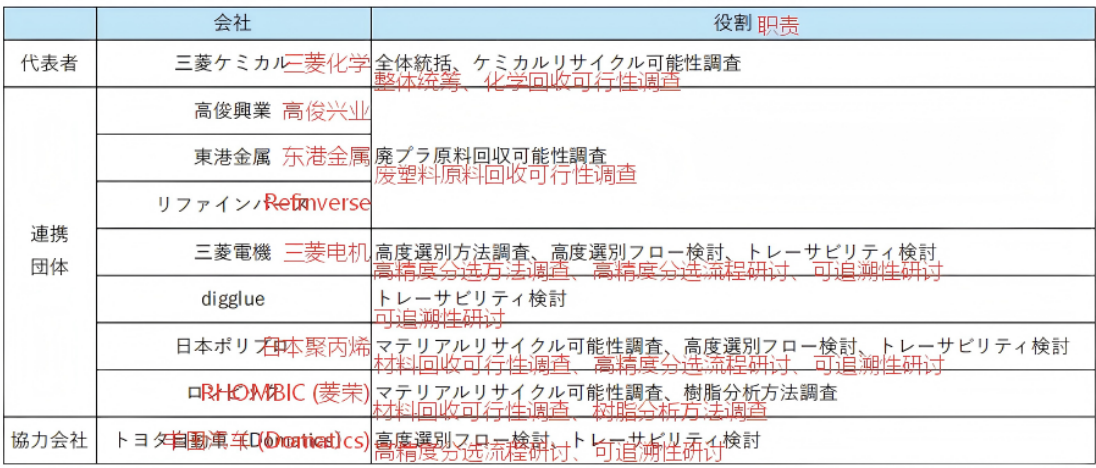
Source: Mitsubishi Chemical, translated by Polymer Recycling.
One of the biggest highlights of this project is the deep collaboration between the "vein industry" companies responsible for the recycling and sorting of waste plastics and the "artery industry" companies responsible for material design, composite processing, and supply to end users. The integrated discussion between both sides on core issues such as the quality, quantity, cost, and source certification of recycled materials breaks the traditional separation between upstream and downstream sectors.
At the same time, the project has three main features that further enhance the recycling capability of regenerated plastics.
Advanced sorting + material design, a dual-drive for high quality.
By combining advanced sorting technologies for waste plastics with material design technologies for recycled plastics, the project is dedicated to developing high-quality recycled materials that can meet the stringent requirements of high-end applications such as the automotive industry.
② Sorted recycling to maximize value
The project will classify and grade waste plastic feedstocks suitable for mechanical recycling and those suitable for chemical recycling.Explore the optimal model for maximizing the overall resource value of waste plastics. Physically recyclable materials should be physically recycled; those unsuitable for that should enter chemical recycling channels, putting an end to the one-size-fits-all approach of low-value utilization.
③ Fully traceable throughout, ensuring safe end use.
Leverage traceability infrastructure to enable end-to-end visualization of information such as raw material sources, sorting and recycling-to-feedstock processes, recycled material content, and environmental value. There is only one goal: to build a recycled plastics supply system that gives automakers and other buyers the confidence to procure and use recycled plastics with peace of mind.
Profiles of 9 Companies:
Mitsubishi Chemical Group
Japan’s largest comprehensive chemical company, with core businesses spanning functional materials, petrochemicals, carbon products, and healthcare.
Takashun Kogyo
A leading construction waste treatment company in Japan, specializing in the treatment of construction and industrial waste, with an annual processing capacity of 835,000 tons and an annual output value of approximately 8.3 billion yen.
Donggang Metal
An enterprise transitioning from metal recycling to integrated resource circular processing.Founded in 1902, the company began with metal scrap recycling and has since expanded into the collection, transportation, and intermediate processing of industrial waste, including waste plastics.
Refinverse Group
A manufacturer of regenerated resins with the core concept of "turning waste into treasure." The main business involves recycling old items and producing synthetic resin products.
Mitsubishi Electric
A comprehensive electronic and electromechanical conglomerate with a century-long history. Its business scope is extremely broad, covering industrial automation, power equipment, elevators, semiconductors, and home appliances, among others.
digglue
A circular economy solutions startup leveraging cutting-edge technologies, providing enterprises with a digital platform and consulting services for resource circularity, and using AI, blockchain, and other technologies to enable carbon reduction visualization and supply chain traceability.
Japan Polypropylene (JPP)
One of Japan’s largest polypropylene (PP) resin manufacturers, specializing in the manufacture, sales, and R&D of polypropylene resins, established as a joint venture between Japan Polychem Corporation and JNC Petrochemical Corporation.
Rhombic
A wholly owned subsidiary of Mitsubishi Chemical, specializing in specialty chemicals for the plastics industry, with core businesses in the development, manufacturing, and sales of compounded products such as engineering plastics and functional masterbatches, as well as the provision of plastic testing services.
Toyota Motor and Dometic
Toyota has entered into an in-depth partnership with mobile living expert Dometic to provide officially certified outdoor camping, off-road, and in-vehicle mobile living equipment for various Toyota models, such as the Sienna, Tacoma, 4Runner, and Hilux.
【Copyright and Disclaimer】The above information is collected and organized by PlastMatch. The copyright belongs to the original author. This article is reprinted for the purpose of providing more information, and it does not imply that PlastMatch endorses the views expressed in the article or guarantees its accuracy. If there are any errors in the source attribution or if your legitimate rights have been infringed, please contact us, and we will promptly correct or remove the content. If other media, websites, or individuals use the aforementioned content, they must clearly indicate the original source and origin of the work and assume legal responsibility on their own.
Most Popular
-
Layoffs, Divestments, Plant Closures While Pouring Billions: BASF Undergoes Major Transformation!
-
Ascend Adipic Acid Hit By Force Majeure, Market Expects Supply Resumption In Mid-September
-

Raw Material Supply Shortage! INEOS Phenol Declares Force Majeure on Phenol and Acetone Businesses
-
South Korea initiates anti-dumping investigation against Chinese PVC suspension resin! The target is Tianjin Bohua and Wanhua Chemical. How to break through?
-

Sixth national procurement set to be implemented: A “Reshuffling” Moment for the $10-Billion Medical Device Market


