



Impact of US Restrictions on China Maritime Logistics on PP Market
Introduction:
On October 3, the U.S. Customs and Border Protection (CBP) issued a formal announcement, stating that it will implement a fee mechanism for Chinese vessels starting on October 14, 2025.
This refined charging system is primarily aimed at three types of vessels:
① A fee of 50 USD per net ton is charged for vessels owned or operated by Chinese entities.
Chinese-built ships are charged at the higher rate of either $18 per net ton or $120 per unloaded container.
For all foreign-manufactured automobile transport vessels, a fee of $14 per net ton will be charged.
It is worth noting that the fees will increase annually. For example, for ships owned by Chinese entities, starting from April 2026, it will rise to $80 per net ton, and from April 2028, it will reach $140 per net ton.
The friction between China and the United States continues to escalate, with the areas of conflict expanding from traditional tariff wars to deeper fields such as technology blockades, decoupling of supply chains, financial sanctions, and logistics restrictions.
1. China's dependence on imports and exports with the U.S. is low, and the U.S. market is non-core.
|
Figure 1: Statistics of China's Polypropylene Imports by Country from 2022 to 2025E (Unit: 10,000 tons) |
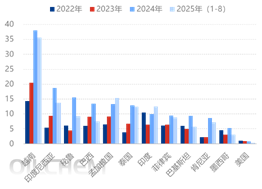
Figure 2: Statistical Analysis of China's Polypropylene Exports by Country from 2022 to 2025 (Unit: 10,000 tons) |
|
|
|
|
Data Source:Longzhong Information |
Data Source: Longzhong Information |
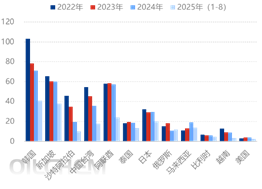
In the import and export pattern of PP in China, the United States is not a core market. Looking at the import market, the trade friction emerged in 2018. At that time, as the United States implemented various trade barriers to restrict China's economic development and increased tax rates on various Chinese products exported to the United States, the friction intensified. China subsequently imposed a 25% punitive tariff on PP/PE originating from the United States, which had a significant impact on China's polypropylene import market. The high costs made it impossible for domestic markets to import plastic granules from the United States. Domestic downstream industries "passively" completed the replacement of imported raw materials from the United States, such as medical transparency and household appliance impact resistance. By 2025, the PP raw materials imported from the United States accounted for less than 1% of the total import volume in China.
Moreover, China is the world's largest producer of polypropylene (PP), and in recent years, its export volume has expanded rapidly. However, current exports are still primarily composed of general-purpose materials, mainly flowing to regions such as Southeast Asia, South Asia, Africa, and South America. The direct export volume to the United States accounts for a very small proportion, insufficient to reach even 1% of China's total export volume, and has shown a trend of gradual decline in recent years. Therefore, overall, the Chinese PP industry has a very low dependence on the U.S. market. From the perspective of direct trade flow, the recent shipping restrictions imposed by the U.S. will have a limited impact on the overall supply and demand landscape of China's PP industry.
China's shipping capacity is limited, and the direct coverage range is controllable.
In the global shipping market, the international container shipping sector is a highly globalized market dominated by a few large alliances. The top ten shipping companies (such as Mediterranean Shipping Company, Maersk, CMA CGM, and COSCO Shipping) control the vast majority of capacity. Although China's COSCO Shipping Group is a significant player globally, its capacity share on trans-Pacific routes is not dominant, and it must share the market with many international giants. Consequently, the capacity share of Chinese-flagged vessels is indeed limited. Furthermore, PP is typically transported in the form of bulk bags or ton bags via container ships. This means it relies on a general container shipping network rather than specific routes monopolized by Chinese companies.
According to statistical data from shipping consultancies such as Alphaliner, the total capacity share (measured in TEU) of all Chinese liner companies (mainly including COSCO Shipping, OOCL, etc.) on the trans-Pacific route (China-US) has long remained around 20%-25%. It is estimated that among China's PP cargo exports to the US, the share actually carried by Chinese ships may be less than 20%. Therefore, the direct coverage scope of the current port fee increase is not large, and most of the cargo can still be transported by fleets from other countries.
3. Port Marginal cost increases drive changes in operational models.
Main affected ports: Major destination/discharge ports for China's PP exports to the United States include Los Angeles Port, Long Beach Port, New York Port, and other major gateway ports on the West Coast and East Coast. These ports will be the enforcement locations for the fee increase.
Impact on the export market: Although the direct coverage is limited, the policy will still increase export costs in two ways.
Direct cost increase: For cargo that still needs to use Chinese ships, the additional cost of $50-140 per net ton will significantly erode profits, greatly reducing the economic viability of exporting polypropylene (PP) to the United States.
Indirect freight rate transmission: Some shippers are turning to non-Chinese vessels, which may increase the demand and rates for these alternative routes, indirectly driving up overall logistics costs to the US.
To cope with cost pressures, Chinese shipping companies and cargo owners are likely to adopt the strategy of leasing ships constructed/registered in South Korea or other countries to operate routes to the United States. This supplementary measure of "substituting ship nationality" will, to some extent, dilute and cushion the direct impact of restrictive policies; however, the tightness of the charter market and rising rental costs will also translate into higher final logistics costs.
4. Shifting from a "Global Supply Chain" to a "Regional Supply Network"
|
Figure 1 Global Polypropylene Supply Flow in 2025 |
||||
|
|
||||
|
Data Source: Longzhong Information |
||||
|
Comparison Dimension |
China Supply Network |
Middle East Supply Network |
North American Supply Network |
|
|
Core Advantages |
The world's largest production capacity (over 44%), coal chemical industry, close to Southeast Asian market. |
Global lowest oil and gas raw material costs, mature long-term customer system, logistics advantages in Africa/South Asia. |
The cost of shale gas ethane cracking is the lowest, the integration of the US, Mexico, and Canada is strong, and the high-end brand technology is leading. |
|
|
Main Market |
Southeast Asia, Africa, parts of South America |
Africa, South Asia, parts of Europe |
America, Europe |
|
|
2024 Annual Export Proportion |
20% of global PP exports |
35% of the global PP export volume |
10% of global PP exports |
|
|
Raw Material Route |
Oil/Coal/PDH |
Ethane/Propane Cracking |
Ethane cracking |
|
|
Policy Support |
"Belt and Road" infrastructure binding |
National Oil Company Support |
IRA Act Subsidy |
|
|
Main Challenges |
Carbon tariffs suppress, Southeast Asia's localized production capacity rises. |
Geopolitical conflicts affect shipping, and China's low-price competition. |
Export infrastructure bottlenecks, China's impact on the Latin American market. |
|
|
Future Strategy |
Localization of factories in Southeast Asia + transition to high-end manufacturing |
Deepening the African Market + Breakthrough in High-End Products |
Expand European market share + consolidate the American market. |
|
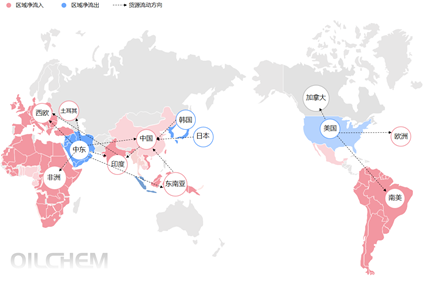
In recent years, geopolitics has had a significant impact on global trade flows, with a high degree of unpredictability. Therefore, amidst the ever-changing overseas environment, the global trade of polypropylene may shift from a "globalized supply chain" to a "regionalized supply network," gradually forming three major regional supply networks centered around China, the Middle East, and North America. Geopolitical factors and cost differences are compelling companies to "produce locally and sell locally," thereby achieving a supply chain rebalance under the dual logic of "cost advantage + geopolitical security." In the future, China, the United States, and the Middle East will form three major regional supply centers, dominating the Asian, American, and Middle Eastern/African markets, respectively, while Europe may reshape its competitiveness through green technology.
Therefore, in summary, the United States' restrictive policies on China's maritime logistics for ChinaPP marketIn terms of its psychological warning significance and long-term structural impact, it outweighs the substantive short-term shock. It will not change the fundamentals of China's PP industry, but will have a partial impact from two dimensions: logistics costs and trade flows. Firstly, it marginally increases the comprehensive logistics costs of exports to the U.S., weakening the price competitiveness of China's PP. Secondly, it catalyzes the operational model adjustments of Chinese shipping and trading companies to seek "flagging" alternatives. In the long run, China's PP industry needs to focus on "cost control + high-end breakthroughs + regional layout" in order to maintain its advantage in global competition.
【Copyright and Disclaimer】The above information is collected and organized by PlastMatch. The copyright belongs to the original author. This article is reprinted for the purpose of providing more information, and it does not imply that PlastMatch endorses the views expressed in the article or guarantees its accuracy. If there are any errors in the source attribution or if your legitimate rights have been infringed, please contact us, and we will promptly correct or remove the content. If other media, websites, or individuals use the aforementioned content, they must clearly indicate the original source and origin of the work and assume legal responsibility on their own.
Most Popular
-
Mexico Imposes Tariff Up to 36% on Cross-Border E-Commerce Products, Effective January 1, 2026; Plastic Shows Partial Fluctuation Today
-
4.5 Million Tons! Wanhua Chemical Dominates Globally in MDI, Heavy Investment in Battery Materials Spurs New Storm
-
Trump Delays Tariff Increase on Furniture, Cabinets, and Vanities
-
Wanhua Chemical Invests $27.3 Billion, 2026 Investment Map Revealed, $1.1 Billion Bet on Battery Materials
-
Back-to-back major joker moves! covestro’s 1.32 million ton mdi dual-line expansion and hdi acquisition reshape global polyurethane landscape


