



High-Performance PEEK Fibers: A Comprehensive Analysis From Core Performance, Major Types, Preparation Processes to Application Frontiers
PEEK fiber, fully known as polyether ether ketone fiber, is a high-performance specialty fiber made from polyether ether ketone (PEEK) resin through a melt spinning process. Its core advantage lies in its outstanding overall performance, especially in terms of stability in extreme environments.
Core performance: high temperature resistance and chemical inertness.
The performance advantages of PEEK fibers have secured them an important position in the field of specialty materials, with the main characteristics as follows:
Excellent heat resistance: this is one of its most prominent features.
Melting point: up to 334°C.
Long-term operating temperature: up to 250°C.
Short-term usage temperature: can still be used in an environment of 260℃.
Exceptional corrosion resistance:
Except for concentrated sulfuric acid, it is virtually insoluble in any conventional chemical reagent and exhibits extremely high resistance to attack by strong acids, strong alkalis, and organic solvents.
High strength and high modulus: PEEK fibers combine excellent strength and rigidity.
Pure resin tensile strength: approximately 94 MPa.
After fiber reinforcement: it can reach 210 MPa. This means extremely strong tensile strength.
Elongation at break: 20%–40%, offering moderate toughness.
Excellent flame retardancy:
According to the UL94 flammability rating standard, PEEK material with a thickness of 1.5 mm can achieve the highest rating of V-0, exhibiting flame-retardant and self-extinguishing properties.
High toughness and wear resistance:
Excellent impact resistance, creep resistance, and wear resistance.
2. Preparation and Production Process of PEEK Fibers
The preparation of PEEK fibers is centered on using PEEK resin as the raw material and producing the fibers through a melt-spinning process. The technical challenges and essence lie in how to address PEEK’s physical characteristics of a high melting point and narrow processing window in order to produce high-performance fibers.
The entire preparation process can be divided into three main stages: polymerization, spinning, and post-treatment, each of which is crucial.
Raw Material End: Synthesis of PEEK Resin
The starting material for PEEK fiber is PEEK resin. Industrial production mainly uses the nucleophilic substitution process.
Chemical reaction: The two core monomers—4,4'-difluorobenzophenone and hydroquinone—undergo a polycondensation reaction in the presence of an alkali metal salt catalyst such as sodium carbonate.
Technical barrier: PEEK polymerization is a typical high-temperature reaction (approximately 280–340°C) and is extremely sensitive to temperature control. Volatilization of the reaction monomers makes it difficult to control molecular weight and batch-to-batch consistency, which is widely recognized in the industry as one of the key technical challenges.
Core Preparation: Melt Spinning Process
Melt spinning is the absolute mainstream method for preparing PEEK fibers, but it presents significant challenges: PEEK has a melting point as high as 334°C, and its thermal decomposition temperature is very close, resulting in a very narrow processing window that imposes stringent requirements on equipment precision and temperature control.
The core process flow is roughly as follows:
1. Melt extrusion: The highly dried PEEK resin is melted at high temperatures and extruded through a screw extruder. The key is that the temperature of the entire screw must be precisely controlled, for example, set from the feed port to the spinneret port at 330°C to higher. Research has confirmed that PEEK exhibits good melt spinnability only at temperatures above 370°C.
2. Spinning and forming: The melt passes through the spinneret to form filaments. Depending on the product, the cooling method varies:
Conventional multifilament is usually cooled by air.
The preparation of monofilament has a higher technical barrier. An innovative liquid cooling patent technology achieves extremely rapid cooling by attaching a cooling liquid to the surface of the nascent filament, resulting in a soft, non-crystalline transparent structure, which lays the foundation for subsequent high-stretching.
3. High-temperature stretching: This is the key factor that determines the final strength of the fiber. The as-spun fiber undergoes thermal stretching at a specific temperature range (usually between 200-250°C). Studies have shown that stretching within this range can significantly increase the strength of the fiber while keeping the elongation at break at a lower level, achieving a balance of rigidity and flexibility.
4. Heat setting: Immediately after stretching, heat setting is performed (at a temperature of approximately 220–260°C) to eliminate internal stress and stabilize the fiber’s microstructure, ensuring its dimensional stability and excellent final mechanical properties.
Performance Leap: Post-Processing Technology
If spinning is the “skeleton,” then post-processing is the crucial step that gives PEEK fibers their soul, enabling a leapfrog improvement in their performance.
Significantly enhanced strength: Through precise optimization of post-processing process parameters, a study successfully increased the average tensile strength of PEEK fibers by 69%. Moreover, certain processing techniques can raise the breaking strength to an excellent level of 6.12 cN/dtex.
Optimized microstructure: The treatment process induces the recrystallization of PEEK fibers, forming a more complete and stable aggregated structure, thereby enhancing their thermal stability and raising their thermal decomposition temperature to as high as 505°C.
Customized surface functionality: Surface treatment can be performed through ultraviolet irradiation, plasma treatment, laser modification, or surface grafting. Particularly in the field of medical implants, constructing porous structures on the PEEK surface or introducing calcium and phosphorus ions can effectively overcome the material’s inherent bioinertness, significantly enhancing its bonding ability with bone and its bioactivity.
Frontier Direction: Compound and Functionalization
In addition to pure PEEK fibers, introducing other materials for compounding or modification can create a new generation of products with even more powerful performance.
Composite reinforcement: By blending carbon fiber or glass fiber with PEEK, composite filaments with even more outstanding performance can be produced. While retaining the advantages of PEEK, these materials further enhance strength and rigidity. After adding high-performance modifiers, their tensile strength can even reach ≥600 MPa, meeting extreme load-bearing requirements.
Process Innovation: In response to the limitations of melt spinning PAEK fibers, some innovative processes have emerged, such as simplifying the approach by using a dissolution method to fully disentangle the molecular chains in solution, thereby significantly enhancing the density and strength of the fibers.
Morphological expansion: In addition to traditional fibers, new forms such as hollow fiber membranes can be prepared using special processes, greatly expanding the application boundaries of PEEK in fields such as healthcare and high-end manufacturing.
These precise manufacturing processes collectively endow PEEK fibers with outstanding performance in cutting-edge fields such as aerospace, automotive, and medical applications.
III. Main Classification Methods of PEEK Fibers
PEEK fibers can be classified from multiple dimensions such as morphology, functionality, and reinforcement methods, with different types focusing on various performance and applications.
Main classification methods of PEEK fibers
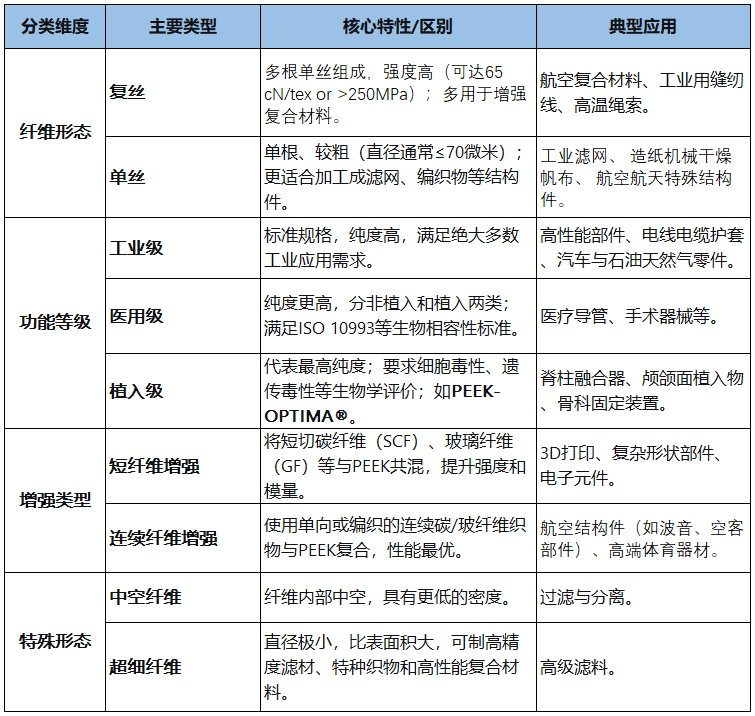
In-depth analysis: Several key classification dimensions
1. By fiber form: monofilament vs. multifilament
This is the most basic form of classification, directly affecting its processing and application.
PEEK multifilament: composed of multiple monofilaments, also known as “PEEK yarn.” It is characterized by high strength and high flexibility. The tensile strength of the filaments in the multifilament can reach 65 cN/tex, making it suitable for weaving and sewing, and an ideal choice for reinforcing composite materials.
PEEK monofilament: Composed of a single fiber, with diameters ranging from several tens to several hundreds of micrometers. Its strength is approximately 25–40 cN/tex, and it offers superior geometric stability, making it a mainstay in the production of various rigid filtration structures (such as paper machine dryer fabrics), specialty ropes, and precision filter meshes for aerospace applications.
2. By functional level: from industrial to medical implants
This dimension is directly determined by the purity of the material.
Medical grade: This grade of material has extremely high purity and has passed rigorous biocompatibility testing, making it suitable for short-term contact with the human body.
Implant grade: represented by the PEEK-OPTIMA® series, this grade pushes quality and standards to the highest level. It not only meets requirements such as non-cytotoxicity and low genotoxicity, but also undergoes long-term clinical validation. For example, Evonik’s VESTAKEEP® iC4612 3DF filament is an implant-grade PEEK material specifically designed for additive manufacturing.
3. By Reinforcement Type: Creating High-Performance Composite Materials
In this dimension, PEEK serves as the matrix material:
By fiber morphology: Depending on application requirements, reinforcing fibers can be classified into chopped fibers and continuous fibers. Chopped fibers are suitable for injection molding and 3D printing, while continuous fibers provide maximum strength and stiffness.
According to material type: Among the various reinforcement materials, carbon fiber and glass fiber are the most widely used. Carbon fiber reinforced (CF/PEEK) is suitable for high-end fields such as aerospace and automotive industries, while glass fiber reinforced (GF/PEEK) is commonly found in industrial machine components. Additionally, aramid fibers, ceramic fillers, and others can also be used to meet specific requirements.
IV. Applications of PEEK Fibers
PEEK fiber has a very wide range of applications, with its core value lying in its two key advantages of lightweighting and high performance, enabling it to replace traditional materials such as metals in demanding and cutting-edge fields.
Aerospace: Composites such as CF/PEEK are used in primary load-bearing structures of aircraft, doors, engine peripheral components, fuselage, and wings, achieving a specific strength up to 8 times that of aluminum alloys and reducing weight by 20%-40%. Monofilaments are also used in the acoustic membranes of domestically produced large aircraft engines for sound insulation and noise reduction.
Automotive industry: In conventional internal combustion vehicles, it is used in bearings, seals, etc.; in the new energy vehicle sector, thanks to its voltage resistance above 2,300 V it has become the core insulation solution for 800 V high-voltage motor flat wire, and is also used in motor film insulation materials, lightweight body and chassis components, and helps honeycomb crash structures increase load capacity by 18.1%.
V. Major Global Manufacturers of PEEK Fibers
International Players: A Stable Pattern of One Superpower and Multiple Strong Powers
Currently, the global PEEK supply market is dominated by several leading companies, with overall resin production capacity characterized by a “one dominant player and several strong competitors” structure.
Victrex plc (UK): Market leader. As the earliest company in the world to commercialize PEEK, its production capacity had reached 7,150 tons per year by 2025, accounting for approximately 60% of the global market share.
Syensqo (formerly Solvay Group, Belgium): A major player in the industry, currently with a PEEK production capacity of 2,500 tons/year. It is an independent company that was spun off from the Solvay Group and holds a significant position in the global PEEK market.
Evonik Industries AG (Germany): The world’s third-largest producer, renowned for low-water-absorption and high-purity medical-grade PEEK, with production capacity reaching 1,800 tons per year in 2025.
Other international manufacturers: In addition, this also includes PEEK profile and modified material companies such as Ensinger, PlastiComp, Quadrant, RTP Company, and Greene Tweed.
Chinese Power: A Rising Thousand-Ton-Class Competitor
Chinese companies are rapidly rising, breaking the long-standing technological and market monopolies overseas.
First tier: kiloton-scale production capacity achieved
ZYPEEK (Zhongyan): It is the fourth company in the world, after Victrex, Solvay, and Evonik, to achieve a PEEK annual production capacity of the kiloton scale, and it is currently the Chinese company with the largest annual output.
WOTE: It has already achieved an annual PEEK resin production capacity of 1,000 tons and has successfully built a complete industrial chain from resin polymerization to profile processing.
Shandong Junhua (JUNHUA) is one of the few enterprises in China that possesses a complete industrial chain from raw material polymerization to finished parts processing, achieving import substitution in key fields such as medical orthopedics and military aerospace.
Panjin Weiyingxing, Kingfa, and Nanjing Julong (JUSEP) are all major players in China’s PEEK materials market, with their combined production capacity accounting for around 30% of the Chinese market.
Zhejiang Pengfulong (PFLUON): Also listed as an important manufacturer in the PEEK market.
Second Tier: R&D/production companies with a hundred-ton-scale production capacity
Changchun Jida Special Plastics: Leveraging the technological background of Jilin University, it is one of the earliest domestic manufacturers to enter the PEEK field.
Zhejiang Kesai, a holding subsidiary of Wote Advanced Materials, has already acquired the capability to produce PEEK profiles at the hundred-ton scale.
Shandong Haoran Special Plastics: has been listed in market reports as one of the domestic PEEK manufacturers.
PEEKChina: A manufacturer located in Taizhou, Zhejiang, providing PEEK resin and carbon/glass fiber reinforced modified materials. The products can be used for melt spinning to produce specialty products such as electromagnetic wires.
Third-tier: New entrants in the R&D/pilot-scale stage
HANSU New Materials: Located in Yancheng, Jiangsu, its products include wide-width high-performance thermoplastic prepreg composites (such as PEEK) and modified engineering plastics.
Guo'en Co., Ltd. (GEGI) is collaborating with universities to develop PEEK polymer products and has planned related production lines and pilot testing platforms.
Hitech has established a pilot production base, and its modified PEEK materials have achieved small batch supply.
Xinhan New Material (NHFL): a key supplier of the core raw material for PEEK, fluoroketone (DFBP), with long-term partnerships with international giants such as Victrex and Evonik.
Note: The above production capacity data mainly refers to PEEK resin. It is worth noting that some companies have undergone changes during their development. For example, Solvay has spun off its specialty chemicals business into Syensqo, and the joint venture between Evonik and Polyplastics in Japan is also active in the market.
From Resin to Fiber: The Complete Industry Landscape
Numerous companies collectively form a complete industrial chain spanning upstream raw materials, PEEK resin modification, and finished fiber products, which can not only meet industrial-grade application needs but also provide customized products for high-end fields such as medical care.
【Copyright and Disclaimer】The above information is collected and organized by PlastMatch. The copyright belongs to the original author. This article is reprinted for the purpose of providing more information, and it does not imply that PlastMatch endorses the views expressed in the article or guarantees its accuracy. If there are any errors in the source attribution or if your legitimate rights have been infringed, please contact us, and we will promptly correct or remove the content. If other media, websites, or individuals use the aforementioned content, they must clearly indicate the original source and origin of the work and assume legal responsibility on their own.
Most Popular
-

Layoffs, Divestments, Plant Closures While Pouring Billions: BASF Undergoes Major Transformation!
-

Ascend Adipic Acid Hit By Force Majeure, Market Expects Supply Resumption In Mid-September
-

Raw Material Supply Shortage! INEOS Phenol Declares Force Majeure on Phenol and Acetone Businesses
-
South Korea initiates anti-dumping investigation against Chinese PVC suspension resin! The target is Tianjin Bohua and Wanhua Chemical. How to break through?
-

Sixth national procurement set to be implemented: A “Reshuffling” Moment for the $10-Billion Medical Device Market


