Hesai Tops 2025 Main Radar Installation Volume
In recent years, the market has experienced strategic swings in its application of LiDAR.
As the core hardware for advanced intelligent assisted driving, lidar was hindered in its early popularization and adoption due to high costs and immature engineering. Some car manufacturers even downplayed or abandoned lidar solutions, instead exploring perception pathways centered on pure vision.
It was not until the last two years that domestic enterprises, represented by Hesai Technology, achieved breakthroughs in self-developed components and mass production capabilities, slashing unit prices from tens of thousands of yuan to the level of several thousand yuan. Meanwhile, continuous improvements in product reliability and consistency, along with significantly enhanced engineering maturity, have laid the foundation for large-scale commercial application.
Pillow and spear ready, only awaiting the east wind. In 2025, LiDAR seizes the "technological equalization" wave in the automotive industry, achieving rapid growth in vehicle installations and continuous improvement in penetration. Leading enterprises entering this bonus period have stepped into a new stage of economies of scale.
Entering the Fast Lane of Popularization
According to data from Gasgoo Research Institute, China's LiDAR installations reached 3.386 million units from January to December 2025, a year-on-year increase of 120.1%, with an overall penetration rate of 11%.
The resulting changes are that the application of lidar has shifted from an optional feature in high-end models to a standard configuration, expanding from new energy vehicles to mainstream gasoline and hybrid vehicles, and descending from high-end models to more affordable ones. Lidar is an indispensable part of promoting "technology democratization." In this process, the popularization of lidar exhibits three major characteristics:
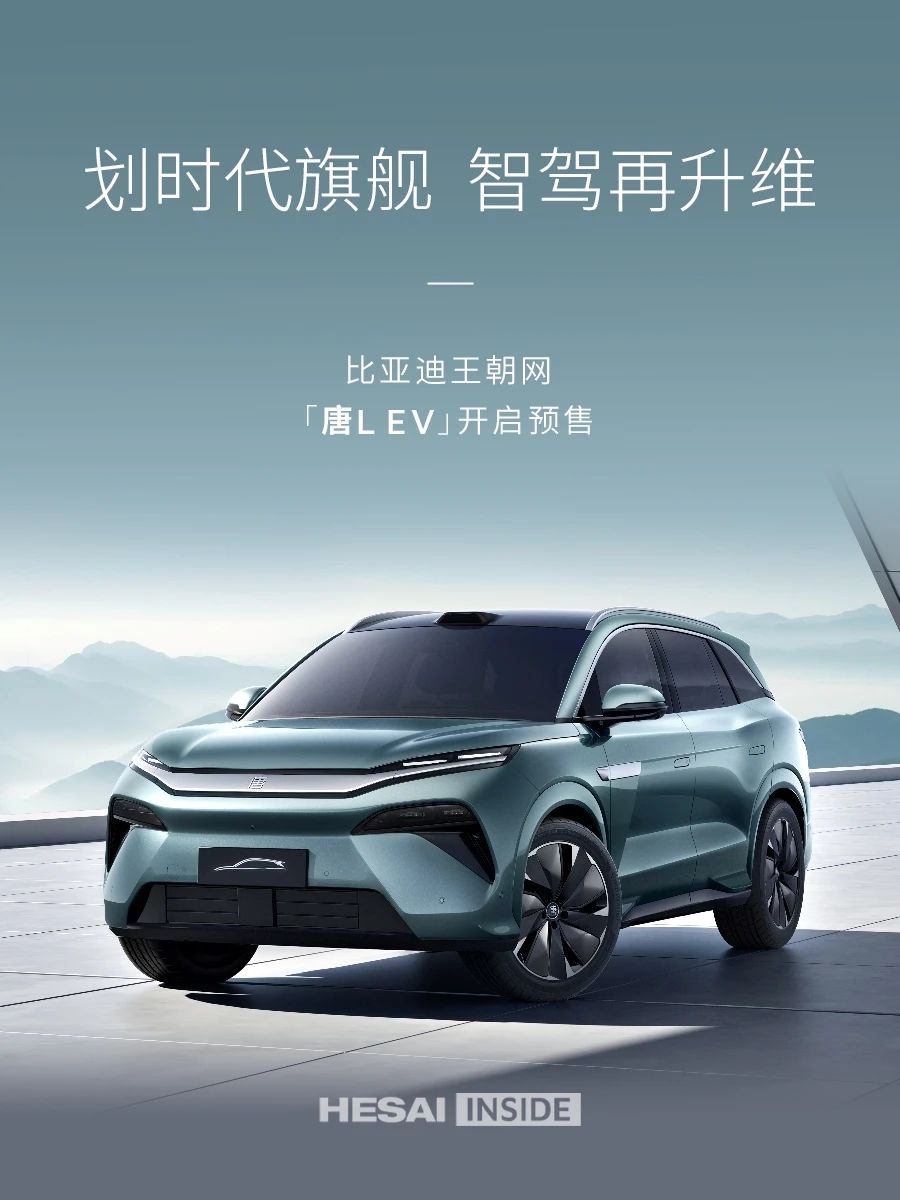
Image source: Hesai Technology
First, high-end models are moving towards making it standard across all configurations. For example, Li Auto made lidar standard on all models when it refreshed its L series, and the subsequent i series and MEGA continued this strategy. At the launch of Xiaomi's SU7, founder Lei Jun repeatedly emphasized the importance of safety and announced that lidar would be standard across all configurations. Brands like Zeekr, Changan Deep Blue, and Leapmotor have also achieved lidar integration in their mainstream priced models.
Secondly, it has become one of the judging standards for "intelligent oil-electric hybrid" vehicles. Traditional internal combustion engine brands have also begun to introduce LiDAR products. For example, Audi's A5L and A6L, among other fuel-powered models, are equipped with dual LiDAR configurations.
Third, car manufacturers are re-evaluating the importance of LiDAR in active safety. The transition of LiDAR from an optional feature to a standard component reflects a reassessment by OEMs regarding the boundaries of safety responsibility in assisted driving. The active safety team at Li Auto once released data showing that models equipped with LiDAR have an accident rate 20%-30% lower than pure vision solutions, with nighttime accident rates reduced by approximately 40%.
Furthermore, as policies evolve, the importance of LiDAR in intelligent driving will be further highlighted. In January 2026, the Ministry of Industry and Information Technology (MIIT) released a mandatory national standard titled "Technical Requirements and Test Methods for Advanced Emergency Braking Systems (AEB) of Light Vehicles."
Industry experts suggest that once the new standards are officially implemented on January 1, 2028, LiDAR may become an indispensable sensing hardware for new vehicles to pass rigorous AEB tests under complex lighting conditions, such as nighttime scenarios.
Because pure vision solutions have physical limitations in their perception ability under extreme conditions such as low light and backlighting. Lidar, however, is not affected by lighting conditions and can provide stable and reliable road information.
Behind the rapid penetration of LiDAR is the continuous breakthrough in technology and cost by Chinese suppliers. Represented by companies such as Hesai and Huawei, Chinese enterprises have driven key technological advancements, utilizing chip-level integration to enhance performance and drive down costs.
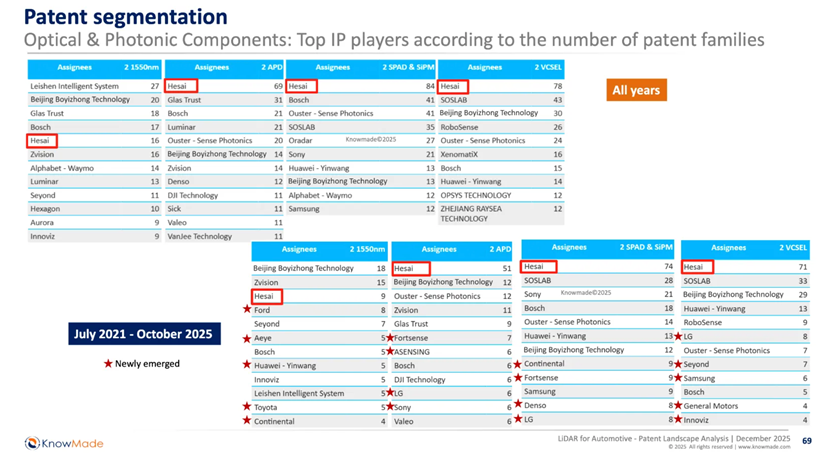
Top IP player patent family count in optical devices, image source: KnowMade
Currently, Chinese LiDAR companies have global competitiveness in terms of core components and underlying technology.
According to the "Automotive LiDAR Patent Landscape Analysis - 2025 Edition" released by intellectual property analysis firm KnowMade, Hesai Technology from China ranks first globally in the number of patents and overall strength in the LiDAR field, placing it in the industry's top tier alongside Bosch and Waymo.
In the field of key components such as SPAD/SiPM, VCSEL emitters, and APD detectors, Hesai Technology also leads comprehensively in patent numbers.
The rise of domestic lidar suppliers such as Hesai Technology has directly driven down product costs. By 2025, related products will enter the price range of 100,000 to 200,000 yuan, which is the main battlefield of the Chinese automotive market. The accelerated penetration of lidar in this price range will push the penetration rate of L2 and above intelligent assisted driving systems in China to exceed the 50% mark in 2025.
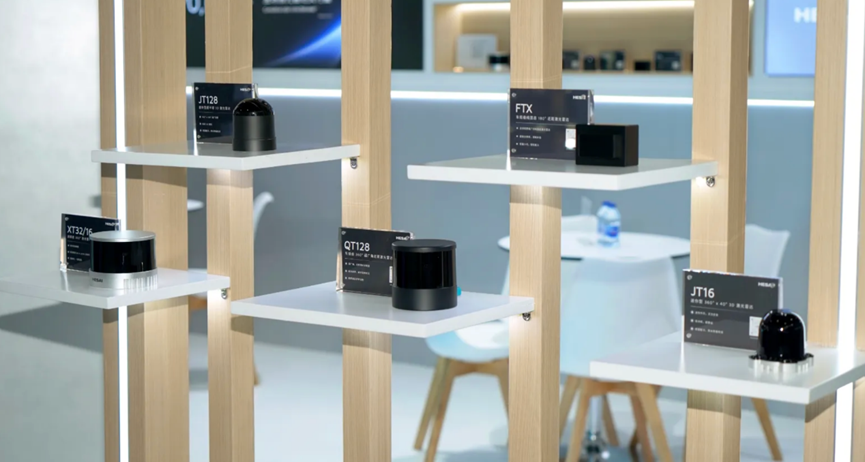
Image source: Hesai Technology
As installation volumes grow rapidly, the overall operating condition of the lidar industry is improving. Taking Hesai Technology as an example, its annual deliveries exceeded 1.6 million units, making it the first and only lidar company globally to achieve full-year profitability. Meanwhile, peers such as RoboSense and Livox are seeing their losses continuously narrow and gross margins improve, with a gradual emergence of an industry-wide profitability inflection point.
Looking ahead to 2026, multiple institutions remain optimistic about the LiDAR market.
Data shows that by the end of 2025, the monthly penetration rate of pre-installed LiDAR for passenger car urban NOA (Navigation on Autopilot) has exceeded 10%. Analysts at Gasgoo Automotive Research Institute believe that as urban NOA accelerates its adoption in the mass market in 2026, the installation volume of LiDAR will also increase. When the penetration rate reaches 10%, it signifies that the trend of LiDAR moving towards the mass market is irreversible.
What's more, the market for lidar extends beyond automotive manufacturing, now reaching into robotics, low-altitude economy, and other intelligent transportation sectors. After 2026, these emerging industries will enter a mass production and scaling phase. This represents another positive development for the lidar industry.
Who will have the largest radar installation base in 2025?
As the core perception hardware of intelligent driving assistance systems, the main lidar is responsible for forward long-range detection and system safety fallback, requiring higher performance, reliability, and vehicle adaptability.
Currently, LiDAR's core position in advanced intelligent assisted driving is becoming increasingly evident, and its installation volume has become an important indicator of OEMs' technological routes. Among them, the installation volume of main LiDAR directly reflects the importance that car companies place on safety and performance.
According to data from Gasgoo Automotive Research Institute, the total installation volume of main LiDARs in China will reach 2.756 million units in 2025. In terms of market landscape, leading manufacturers in installation volume generally possess the following characteristics: first, their products have achieved large-scale implementation across multiple vehicle models and platforms; second, they are capable of long-term stable delivery; and third, the performance and system reliability of their products have been fully verified in forward long-range perception scenarios.
Specifically for enterprises, a pattern of "one dominant player and many strong contenders" is emerging. Hesai Technology ranks first in the main LiDAR market with 1.143 million units installed and a market share of 41.5%, while Huawei and RoboSense rank second and third respectively. It is worth mentioning that Hesai Technology has maintained the top spot in this market's shipment volume for 11 consecutive months.
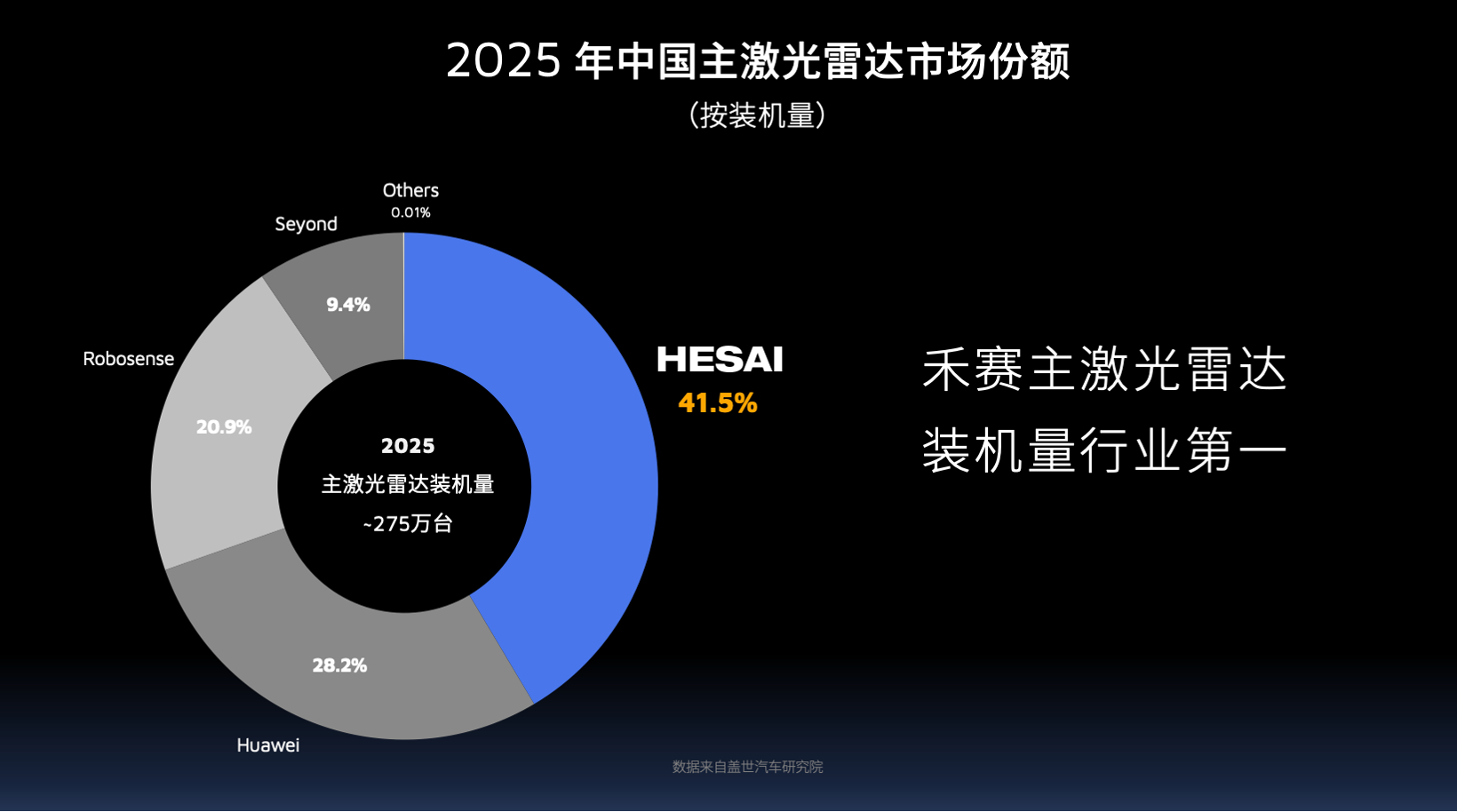
Image source: Hesai Technology
In the 2025 January-December lidar supplier installation volume ranking, Huawei Technologies, Hesai Technology, and RoboSense collectively secured the top three positions, accounting for over 90% of the market share.
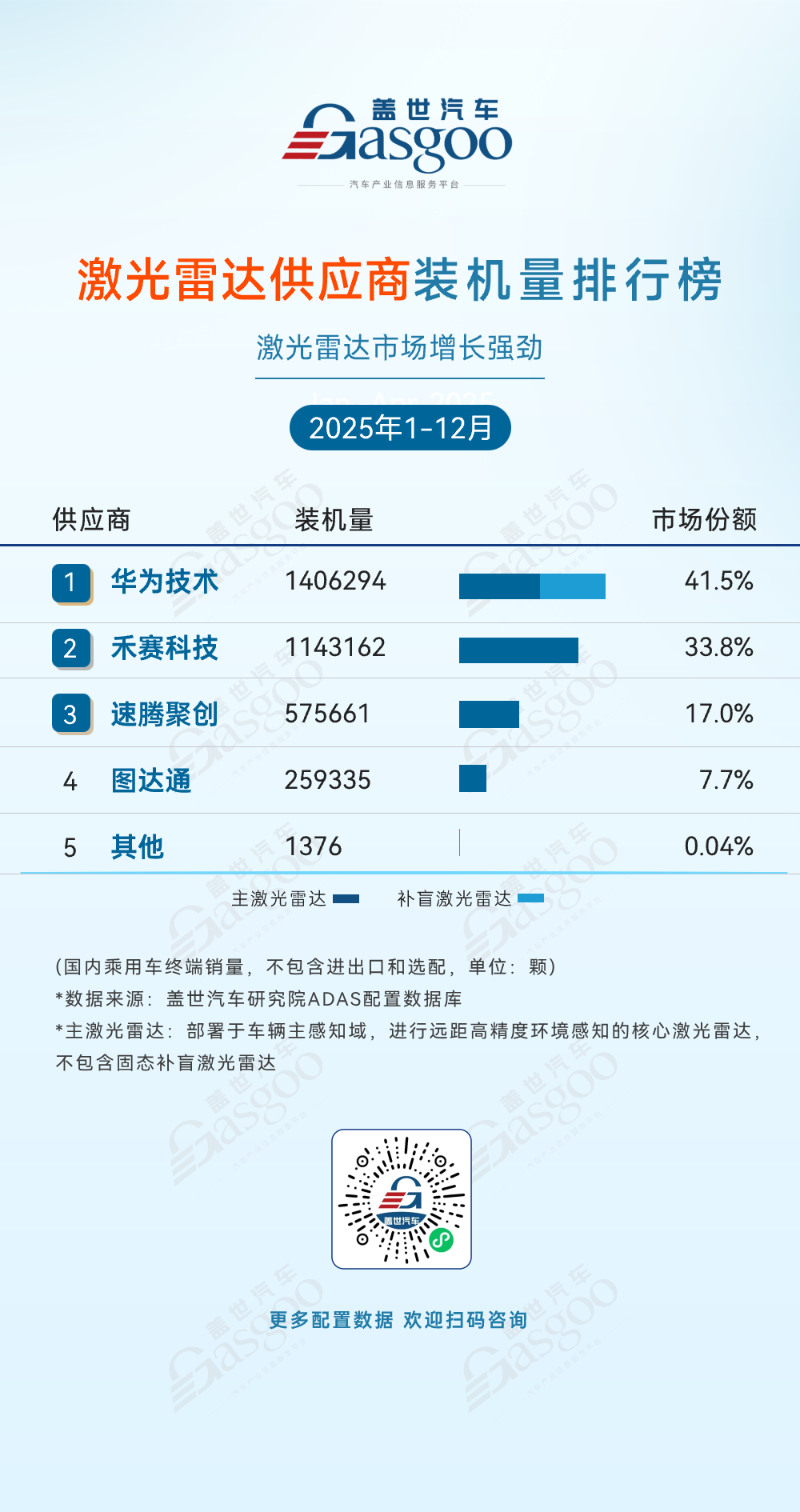
Leading manufacturers' dominance is primarily reflected in three aspects: large-scale deployment, stable delivery, and robust safety verification. Leading suppliers, through self-developed core components and underlying chip technology, have not only significantly improved detection reliability but also achieved a balance between performance and cost. Currently, some leading products have achieved large-scale designated installations, ranging from high-end flagship models priced at 300,000 yuan and above to volume models priced at 100,000-200,000 yuan.
Taking Hesai Technology as an example, its moat lies in its full-stack in-house R&D, from underlying chips to system integration. As the only company in the industry to achieve full-stack in-house R&D in seven key components, including lasers, detectors, and digital signal processors, it pioneered "photon isolation" chip technology to eliminate "ghosting" false positives at the physical level, ensuring strong safety in perception.
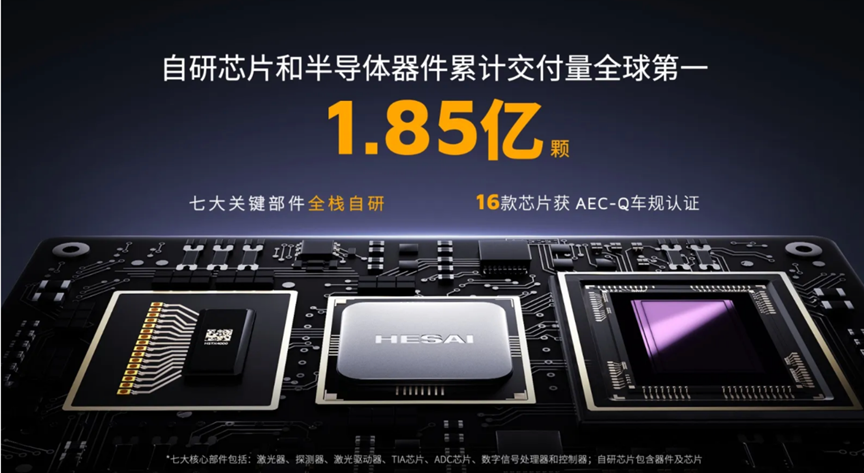
Image source: Hesai Technology
With its compatibility advantages, Hesai Technology has secured production nominations for 38 automotive brands and over 150 car models. Its core products not only cover leading new energy vehicle brands like Li Auto and Xiaomi, but also penetrate high-volume models in the 100,000-200,000 RMB price range, such as Leapmotor.
For OEMs, LiDAR is not a one-time purchase component. Instead, it requires stable supply, flexible adaptability, and reliability across multiple vehicle generations and product lifecycles. This places higher demands on suppliers' engineering capabilities, platform-based development capabilities, and large-scale manufacturing capabilities. These are precisely the advantages of leading LiDAR companies like Huawei and Hesai Technology.
Next, sell the "product" globally.
As the domestic market penetration rate breaks through a key threshold, leading companies are shifting their strategic focus to globalization, seeking a second growth curve. Overseas markets, particularly North America and Europe, are continuously increasing their safety redundancy requirements for advanced driver-assistance systems, providing new incremental opportunities for Chinese lidar companies that have achieved mature mass production.
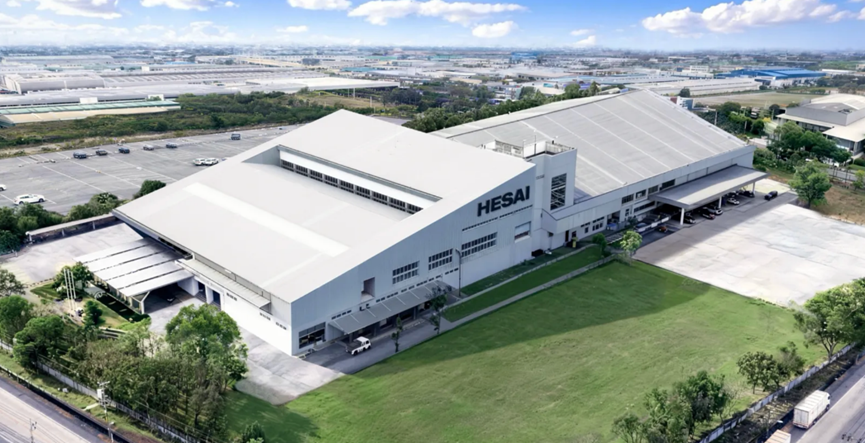
"Galileo," Hesai's overseas factory located in Thailand. Image source: Hesai Technology
Against this backdrop, some believe that in the coming period, the main drivers of growth for domestic lidar companies will come from two aspects: first, the continuous advancement of global expansion, and second, the new demand brought about by the gradual relaxation of L3 autonomous driving.
This shows that global competition is no longer a contest of single products, but a confrontation of comprehensive systems encompassing production capacity, ecosystems, and localized services. This is mainly reflected on three levels:
First, there is a need for forward-looking technology reserves for L3 and higher levels. For L3 and above autonomous driving, lidar needs to have a longer detection range, higher resolution, and stronger anti-interference capabilities. At the same time, the emphasis of overseas OEMs and Tier 1 suppliers on supply chain stability and localized delivery capabilities also places higher demands on lidar companies.
Secondly, is the ability to globally deploy production capacity and supply chains. To meet the demands of domestic and international OEMs for supply chain stability, companies must plan production capacity in advance. Hesai Technology, for example, exemplifies the development strategy of leading manufacturers today through its global market deployments in recent years.
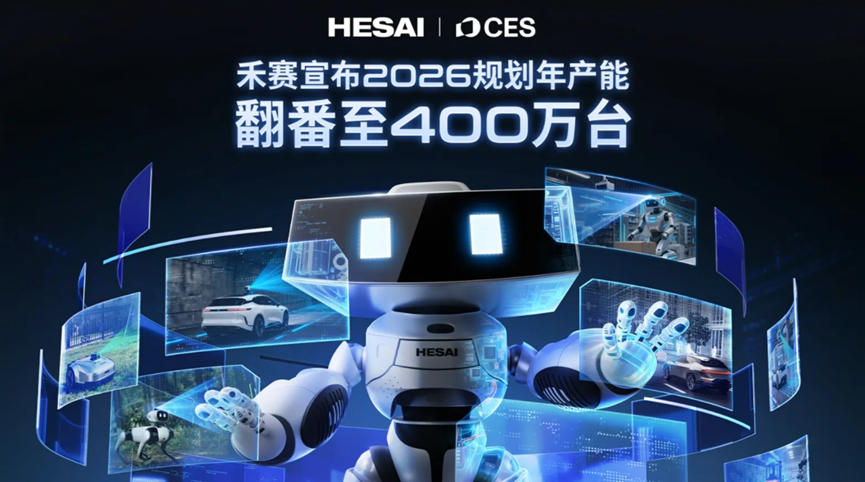
Image source: Hesai Technology
Currently, Hesai Technology has received orders for over 4 million units of its ATX upgraded version alone, and has also secured L3 design wins from several leading overseas automakers and domestic new energy vehicle manufacturers. With these orders as support, Hesai Technology plans to double its annual production capacity to 4 million units by 2026.
Hesai Technology will establish its first overseas factory, "Galileo," in Bangkok, Thailand, with production expected to commence in early 2027, to ensure overseas product delivery and meet the localized production and delivery needs of international orders.
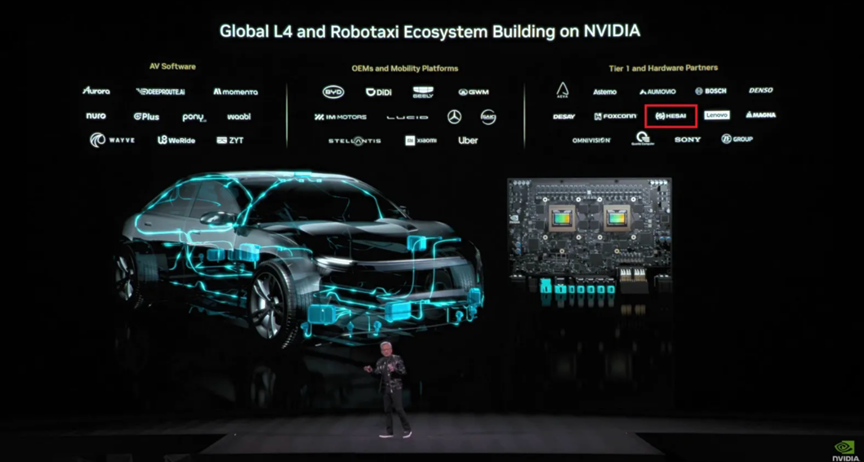
Image source: Hesai Technology
Third, the ability to build a technology ecosystem. By deeply collaborating with mainstream international autonomous driving computing platforms, lidar is no longer introduced into overseas markets as a single hardware product, but as part of a comprehensive software and hardware solution.
A more representative collaboration is between Hesai Technology and Nvidia. Their partnership began in 2019, focusing on the collaborative development of autonomous driving perception and computing platforms.
In 2026, Hesai Technology was selected as a LiDAR partner for NVIDIA's "NVIDIA DRIVE Hyperion 10 platform." This means that OEMs and developers choosing this platform can directly adopt Hesai Technology's hardware and software solutions, including its high-performance LiDAR. An example is Hesai Technology's ultra-long-range radar product, ETX, specifically designed for L3/L4 autonomous driving.
The cooperation between the two parties can also help Hesai Technology's products to enter the European and American OEM systems more smoothly.
Overall, 2026 will still be a favorable year for lidar companies. However, it is important to note that the entry barrier is also tightening. Based on the lidar installation landscape in 2025 and companies' existing orders, resources will further concentrate among leading players with abundant cash flow, strong technological self-sufficiency, and deep ties with automakers or top-tier Tier 1 suppliers.
Leading manufacturers, represented by Hesai Technology, with ample cash reserves and a comprehensive self-developed technology moat, are likely to be the biggest beneficiaries of this round of competitive window, and may even become the navigators defining global autonomous driving perception standards.
【Copyright and Disclaimer】The above information is collected and organized by PlastMatch. The copyright belongs to the original author. This article is reprinted for the purpose of providing more information, and it does not imply that PlastMatch endorses the views expressed in the article or guarantees its accuracy. If there are any errors in the source attribution or if your legitimate rights have been infringed, please contact us, and we will promptly correct or remove the content. If other media, websites, or individuals use the aforementioned content, they must clearly indicate the original source and origin of the work and assume legal responsibility on their own.
Most Popular
-

Middle East Tension Spikes Global Energy Pattern, Crude Oil and Plastic Industries Face Multiple Challenges
-
Middle East Tensions Escalate Sharply: How Polyolefins Respond Amid Soaring Risk Premium
-

Middle East Polymer Export Hub Hit in Sudden Attack, Global Supply Chain Sounds Alarm
-
[Forward-Looking Analysis] Impact of Escalating U.S.-Iran Tensions on Domestic Chemical Market
-

Futures Surge Violently, Polyolefin Spot Prices Rise Sharply in Tandem