



Everything you need to know about silicone masterbatches: Functions, Selection, and Domestic Suppliers
In nylon modified formulas, there is an additive that seems unassuming but can "move a heavy object with a light force" — it isSilicone masterbatchAs a granular functional additive based on ultra-high-molecular-weight polysiloxane, silicone masterbatch plays multiple roles in nylon processing and end-product performance optimization due to its unique molecular structure.
As modified plastics continue to develop towards high performance, high appearance, and ease of processing, the application of silicone masterbatches is moving from "optional" to "essential." This article will systematically“”“” As modified plastics continue to develop towards high performance, high appearance, and ease of processing, the application of silicone masterbatches is moving from "optional" to "essential." This article will systematically review the applications of silicone masterbatches.The core role of silicone masterbatch in nylon modification,and inventory major domestic and international suppliers。
01
Silicone masterbatch
Silicone masterbatch usually refers to a granular product in which ultra-high molecular weight poly (silicone) is uniformly dispersed in a specific polymer carrier (such as PP, PE, PA6, etc.). The silicone content is generally around 50%, and some high-concentration products can reach 70% or more.
Compared to traditional low molecular weight silicones or lubricants, silicone masterbatches have the following advantages:
Better dispersionAdded in the form of masterbatch, to avoid the problems of difficult dispersion and easy migration of liquid silicone oil.
Higher thermal stabilityUltra-high molecular weight silicone has a decomposition temperature > 250°C, enabling it to withstand the high temperatures of nylon processing.
Non-migratory: Form a lasting lubricating layer on the surface of the product, which is not prone to exudation or "blooming"
According to the different carrier resins, silicone masterbatches can be divided into general types (polyolefin carriers) and special types (PA6, PA66 carriers), with the latter having better compatibility with nylon matrix.
02
The Core Role of Silicone Masterbatch in Nylon Modification
Silicone masterbatch exhibits a "dose-dependent" modification effect on nylon—low addition levels primarily improve processability, while higher addition levels enhance surface and mechanical properties. Depending on the dosage, its effects can be categorized into two tiers:

1. Lubrication and Machining Performance Improvement
The molecular chain of silicone is extremely flexible, and adding it can significantly reduce the melt viscosity of nylon, improving its flowability in screws and molds. This is particularly important for thin-walled parts, complex structural parts, and high glass fiber filled systems.
Reduce torque and energy consumptionSilicone can reduce the friction between the melt and the processing equipment, lower the extruder torque, and extend the equipment life.
Improvement of demolding propertyIn injection molding, silicone helps the product to be easily demolded and reduces surface defects.
The coefficient of friction decreases significantly.Adding 3% silicone masterbatch to nylon 66 can reduce the dynamic friction coefficient from 0.38 to 0.12, and the static friction coefficient from 0.35 to 0.20.
2. Surface Performance Optimization
Silicone migration to the surface of the product forms a micro-lubricating layer, which can bring multiple improvements in surface performance.
Glossiness and Tactile FeelReduce surface roughness to achieve high gloss and a silky touch.
Scratch resistance and wear resistanceIn automotive interior parts, silicone can significantly improve the material’s scratch resistance rating.
Anti-adhesionReduce adhesion issues during film and sheet stacking
3. Toughening and Impact Modification
The flexibility of silicone molecular chains enables absorption of impact energy, thereby enhancing the low-temperature toughness of nylon—particularly suitable for components requiring drop resistance or dynamic loading (e.g., automotive parts, electronic housings). When compounded with elastomers such as POE or EPDM, silicone exhibits synergistic improvements in impact resistance while avoiding excessive loss of stiffness.
4. Flame Retardant Synergistic Effect
In a halogen-free flame-retardant nylon system, silicone masterbatch can be used as a flame retardant synergist, bringing multiple benefits:
Reduce the amount of flame retardantIn glass fiber reinforced flame retardant nylon 6/66, adding 2% of silicone synergist can reduce the amount of phosphorus-based flame retardant from 18%-20% to 10%-12%.
Suppress droplet transferImproving the dripping phenomenon of flame-retardant materials during combustion
Reduce corrosivenessReduce total phosphorus content to reduce the risk of corrosion to metal connectors
Comprehensive Cost OptimizationOverall material costs can be reduced by more than 10%.
5. Functional Collaboration and Decentralized Assistance
Silicone masterbatch can also serve as a functional carrier, helping flame retardants, pigments, fillers, etc., to be uniformly dispersed in the nylon matrix, reducing agglomeration and improving the efficiency of modification.
03
Major Domestic and International Silicone Masterbatch Suppliers
According to market research institution data, the global silicone masterbatch market size was approximately USD 1.402 to 1.465 billion in 2025, and is expected to reach USD 2.039 billion by 2031, with a compound annual growth rate of about 5.5% to 5.7%. The Asia-Pacific region is the largest market, with China playing a significant role.
International Giant
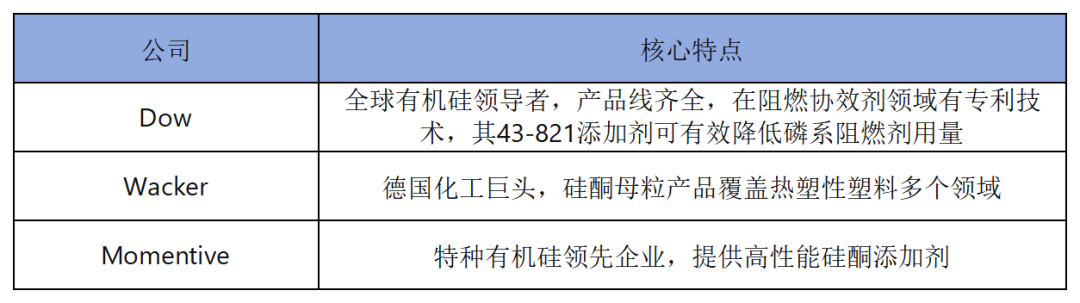
Domestic major suppliers
(Ranked in no particular order)
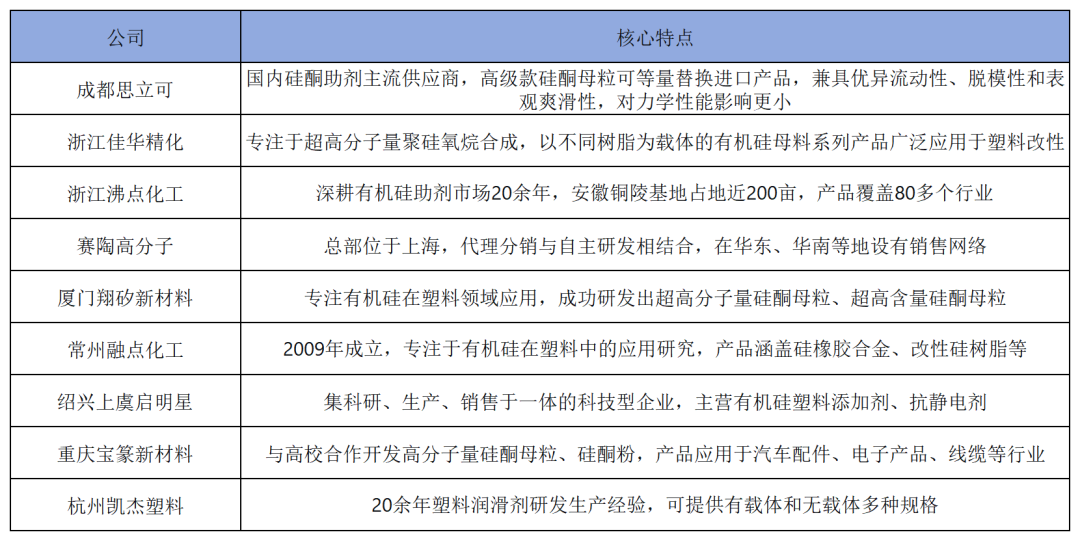
04
Key Points and Precautions for Application
Addition Quantity Control
0.5%-1%Primarily aimed at improving processing flow and demolding
2%-5%Optimize surface performance, reduce friction coefficient, and enhance scratch resistance.
Process Coordination
Silicone masterbatch can be directly physically mixed with resin pellets, and then extruded and pelletized or injection molded through a twin-screw extruder.
Pre-dry at 80-90°C for 3-4 hours before processing.
Compatibility selection
For a PA6 matrix, it is preferable to use a PA6 carrier silicone masterbatch (such as Silike LYSI-307) for better compatibility.
Excessive addition (>5%) may lead to a decrease in material rigidity or surface "bloom," and it is necessary to balance the properties according to the formula.
【Copyright and Disclaimer】The above information is collected and organized by PlastMatch. The copyright belongs to the original author. This article is reprinted for the purpose of providing more information, and it does not imply that PlastMatch endorses the views expressed in the article or guarantees its accuracy. If there are any errors in the source attribution or if your legitimate rights have been infringed, please contact us, and we will promptly correct or remove the content. If other media, websites, or individuals use the aforementioned content, they must clearly indicate the original source and origin of the work and assume legal responsibility on their own.
Most Popular
-

Middle East Tension Spikes Global Energy Pattern, Crude Oil and Plastic Industries Face Multiple Challenges
-
Middle East Tensions Escalate Sharply: How Polyolefins Respond Amid Soaring Risk Premium
-

Middle East Polymer Export Hub Hit in Sudden Attack, Global Supply Chain Sounds Alarm
-
[Forward-Looking Analysis] Impact of Escalating U.S.-Iran Tensions on Domestic Chemical Market
-

Futures Surge Violently, Polyolefin Spot Prices Rise Sharply in Tandem


