Engel to Showcase Thermoplastic Composites Drone Wing Mass Production Process at Jec World
Austrian plastic processing equipment manufacturer ENGEL has announced that it will showcase the fully automated mass production of thermoplastic composite rotor blades for drones at the upcoming JEC World Composites Show in Paris. This scalable production solution integrates high performance, integrated noise reduction, and sustainability within a single continuous process.
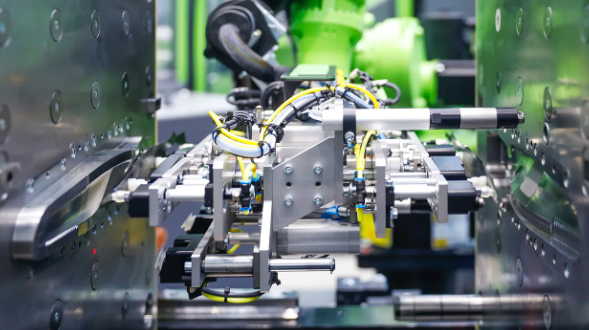
The core of this presentation is an efficient integrated process: key steps—enhanced layer placement, molding, and functional integration, as well as the removal of the finished rotor blade, are continuously cycled within the injection mold.
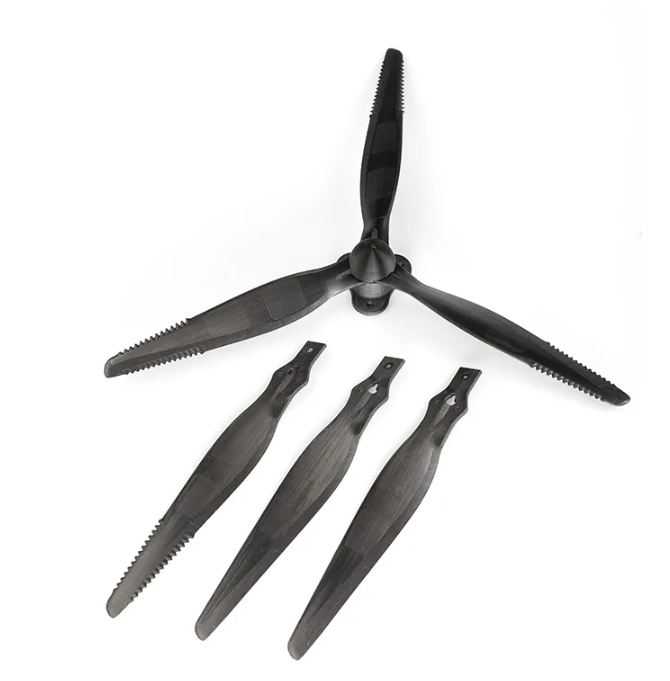
Drones' propellers made of carbon fiber reinforced composite materials, manufactured using tape interlayer injection molding process. Image source: Engel.
Tape-insert injection molding as the core technology
In the press release, Engel described that the core of the process is a structural sandwich design composed of carbon fiber-reinforced thermoplastic tapes and injection-moldable short-fiber composites. The tapes form the load-bearing outer layer of the rotor blades and are precisely positioned and fixed within the mold using vacuum placement, enabling the reinforcement material to be aligned precisely along load paths and used only where structural performance requires it.
A core layer made of short-fiber thermoplastic material is injected between pre-laid tapes and bonded to the outer layers to form a near-net-shape structural component. To further enhance lightweighting, the core layer is produced using a chemical foaming process, which reduces component weight while maintaining structural performance.
The finalized rotor blades are lightweight and highly durable, with molding, structural functionality, and material bonding all completed within an automated cycle; they are ready for direct use after the specified final trimming.
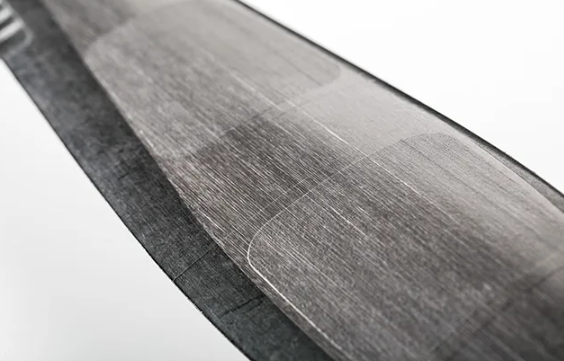
Composite rotor blades manufactured using near-net-shape forming process. Image source: Engel
Function Integration and Design Flexibility
By utilizing interchangeable mold inserts, noise-reducing features such as serrated trailing edges can be directly integrated into the component's geometry without requiring additional machining. This approach meets the acoustic requirements of modern drones, particularly for urban applications, and reduces noise emissions.
Engel will demonstrate the process live on a tie-bar-less Victory 120 injection molding machine equipped with an Easix six-axis robot. The tie-bar-less design provides the necessary space for fully automated material feeding, handling, and part removal, enabling a production cycle time of less than 60 seconds per rotor blade.
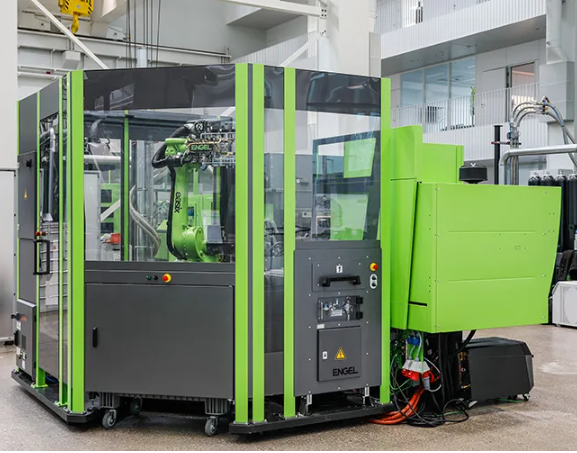
An injection molding cell equipped with a six-axis robot will be showcased at the JEC World Composites Exhibition in Paris. Image courtesy of ENGEL.
The NeoBlade collaboration project covers the entire value chain.
NeoBlade is an interdisciplinary research project spanning the entire value chain, aiming to integrate aerodynamic acoustic design, material and mold development, process automation, and sustainability assessment at an early stage to create an industrially viable holistic solution. Project partners include Alpex Technologies, the Institute of Energy Systems at Johannes Kepler University Linz (JKU), FACC Operations, Plastic Innovation, and the Aircraft Systems Research Group at Vienna University of Technology.
The project evaluated multiple thermoplastic material systems, ranging from high-temperature resistant materials to cost-effective alternatives, and also utilized composites containing recycled carbon fiber. The life cycle assessment shows that compared to the mature thermosetting process, this solution significantly reduces the carbon footprint; another major advantage is the general recyclability of thermoplastic materials.
In addition to sustainability, economic benefits are also a core concern. The primary cost advantage of thermoplastic processes lies in their industrial scalability—for instance, multi-cavity molds enable short-cycle, highly automated production.
From drone rotor blades to high-voltage battery covers
At this year's JEC World, Engel will also showcase a flame-retardant thermoplastic high-voltage battery cover panel based on thermoplastic tape sandwich injection molding technology. Measuring 1.3 m × 1.8 m (4.3 ft × 6 ft), the component has been shortlisted as a finalist for the JEC World Composite Innovation Award 2026. The battery cover combines lightweight design, high stiffness, and full recyclability, with structural features such as spacers and mounting points directly integrated during the manufacturing process.
JEC World, the leading global exhibition for composites and their applications, will take place from March 10 to 12 at Villepinte, north of Paris. ENGEL will exhibit at Booth 5L 106 in Hall 5.
【Copyright and Disclaimer】This article is the property of PlastMatch. For business cooperation, media interviews, article reprints, or suggestions, please call the PlastMatch customer service hotline at +86-18030158354 or via email at service@zhuansushijie.com. The information and data provided by PlastMatch are for reference only and do not constitute direct advice for client decision-making. Any decisions made by clients based on such information and data, and all resulting direct or indirect losses and legal consequences, shall be borne by the clients themselves and are unrelated to PlastMatch. Unauthorized reprinting is strictly prohibited.
Most Popular
-

Middle East Tension Spikes Global Energy Pattern, Crude Oil and Plastic Industries Face Multiple Challenges
-
Middle East Tensions Escalate Sharply: How Polyolefins Respond Amid Soaring Risk Premium
-

Middle East Polymer Export Hub Hit in Sudden Attack, Global Supply Chain Sounds Alarm
-
[Forward-Looking Analysis] Impact of Escalating U.S.-Iran Tensions on Domestic Chemical Market
-

Futures Surge Violently, Polyolefin Spot Prices Rise Sharply in Tandem