



Eight research institutions jointly published: Latest research progress on industrial biotechnology driving the recycling of PET polymers.
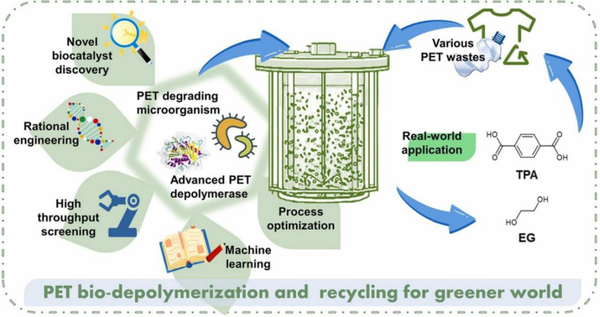
Recently, the project team of the national key R&D program "Green Biotechnology Manufacturing" under the key special project "Key Technologies for Efficient Biodegradation of Plastics" jointly published a review article titled "State-of-the-art advances in biotechnology for polyethylene terephthalate bio-depolymerization" in Green Carbon. The article summarizes the significant breakthroughs achieved during the execution of this project and the international cutting-edge progress in the field of PET biodegradation. It discusses the challenges and potential solutions for promoting enzymatic depolymerization of PET and realizing the recycling of waste PET polymers. Researcher Liu Yajun from the Institute of Urban Environment, Chinese Academy of Sciences, Associate Professor Zhou Jie from Nanjing Tech University, and Professor Li Yanwei from Shandong University are the co-first authors of the paper. Academician Tan Tianwei from Beijing University of Chemical Technology, Professor Jiang Min from Nanjing Tech University, and Professor Cui Zhongli from Nanjing Agricultural University are the co-corresponding authors. A total of 15 experts and scholars from 8 research institutions contributed to the guidance and writing of this paper, reflecting the interdisciplinary collaboration and innovative synergy among various topics, units, and members during the execution of the project.
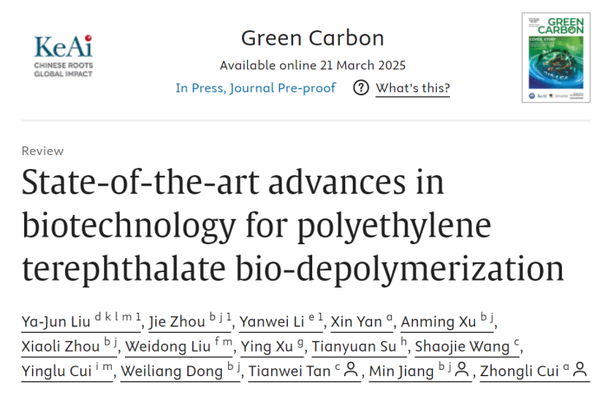
The "Key Technologies for High-Efficiency Biological Depolymerization of Plastics" project is led by Professor Cui Zhongli from Nanjing Agricultural University, in collaboration with 10 institutions including Beijing University of Chemical Technology, Nanjing University of Technology, Shandong University, and Tsinghua University. The project focuses on the national major demand for the recycling of carbon resources from waste plastics, addressing key scientific issues and technical bottlenecks in plastic biological depolymerization. Research is conducted on the interfacial control mechanisms of plastic deconstruction, the catalysis fundamentals of biological depolymerization at the interface, the natural evolutionary laws and molecular mechanisms of plastic biodegradation, and the establishment of a biocatalyst system with high depolymerization activity and stability towards plastics. A new enzymatic depolymerization process and pilot demonstration for treating tons of PET plastic monthly has been developed, achieving green manufacturing from polyester plastics to monomer raw materials and from polyolefin plastics to biodegradable plastics. The key technologies achieved by this project can effectively promote the resource utilization of waste plastics, aligning with major national scientific and technological application needs, and providing significant social, ecological, and economic benefits. It is reported that the project completed its performance evaluation on January 24, 2025, with the expert group unanimously agreeing that the five sub-projects met the established assessment criteria and the pilot validation of enzymatic depolymerization of tons of PET waste plastics, and it has now entered the performance evaluation phase by the Ministry of Science and Technology.
The Nanjing University of Technology - Petrochemical Association Key Laboratory for Biodegradation and Conversion of Waste Plastics, led by Professor Jiang Min, is the undertaking unit for project topic one. Professor Chen Xiaoqiang, as the project leader, is mainly responsible for the efficient screening and intelligent mining of plastic depolymerizing microorganisms/enzymes. Associate Professors Zhou Jie, Zhou Xiaoli, and Xu Anming are the sub-project leaders, respectively undertaking key tasks such as high-throughput screening and identification of plastic-degrading microorganisms, process and pilot study research on plastic biodegradation, and de novo design of biodegradation pathways for polyolefin plastics. This project relies on the earlier research methods and systems established under the National Natural Science Foundation of China’s international (China-Europe) cooperation project “Key Scientific Issues and Technologies for Efficient Biodegradation and Conversion of Waste Plastics” (MIX-UP) in areas such as the biodegradation and high-value conversion of polyethylene terephthalate (PET), polyurethane (PUR), and polylactic acid (PLA). It further develops the construction of a germplasm resource bank for plastic-degrading microorganisms/enzymes and conducts pilot demonstration research on enzymatic depolymerization of plastics. Professors Jiang Min and Dong Weiliang provide important technical guidance and academic support for the smooth implementation of this project.
【Copyright and Disclaimer】The above information is collected and organized by PlastMatch. The copyright belongs to the original author. This article is reprinted for the purpose of providing more information, and it does not imply that PlastMatch endorses the views expressed in the article or guarantees its accuracy. If there are any errors in the source attribution or if your legitimate rights have been infringed, please contact us, and we will promptly correct or remove the content. If other media, websites, or individuals use the aforementioned content, they must clearly indicate the original source and origin of the work and assume legal responsibility on their own.
Most Popular
-

Mexico Imposes Tariff Up to 36% on Cross-Border E-Commerce Products, Effective January 1, 2026; Plastic Shows Partial Fluctuation Today
-
4.5 Million Tons! Wanhua Chemical Dominates Globally in MDI, Heavy Investment in Battery Materials Spurs New Storm
-
Trump Delays Tariff Increase on Furniture, Cabinets, and Vanities
-
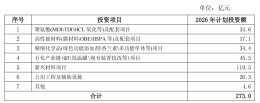
Wanhua Chemical Invests $27.3 Billion, 2026 Investment Map Revealed, $1.1 Billion Bet on Battery Materials
-
Back-to-back major joker moves! covestro’s 1.32 million ton mdi dual-line expansion and hdi acquisition reshape global polyurethane landscape


