



Effective today! Trump announces tariff hike to 20%!
Trump Threatens to Impose Additional 10% Tariff on Chinese Goods
Trump Threatens to Impose Additional 10% Tariff on Chinese Goods
Trump Threatens to Impose Additional 10% Tariff on Chinese GoodsTrump Threatens to Impose Additional 10% Tariff on Chinese GoodsOn February 27, Eastern Time, Trump announced a major new tariff policy on a social media platform: the 25% tariff on imports from Mexico and Canada will take effect on March 4, and an additional 10% tariff will be imposed on Chinese goods imported to the US on the same day.
On February 27, Eastern Time, Trump announced a major new tariff policy on a social media platform: the 25% tariff on imports from Mexico and Canada will take effect on March 4, and an additional 10% tariff will be imposed on Chinese goods imported to the US on the same dayan additional 10% tariff will be imposed on Chinese goods imported to the US on the same day.In addition to the 10% tariff that took effect on February 4, the total tax rate for Chinese goods in the US will rise to 20%, once again stirring up waves in the global trade landscape.
In addition to the 10% tariff that took effect on February 4, the total tax rate for Chinese goods in the US will rise to 20%the total tax rate for Chinese goods in the US will rise to 20%, once again stirring up waves in the global trade landscape.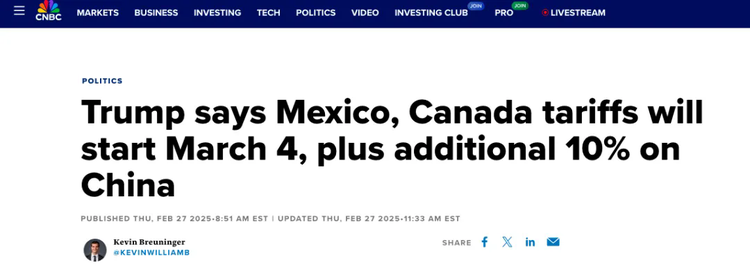
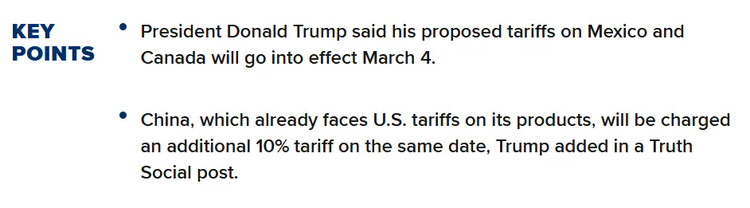
With the previous 25% tariff from the 301 investigation (if not exempted), a cumulative 45% tariff will be imposed on our goods.
With the previous 25% tariff from the 301 investigation (if not exempted), a cumulative 45% tariff will be imposed on our goods. A cumulative 45% tariff will be imposed.The reason for this additional tariff is also quite absurd: Trump claims that this move is due to China's failure to effectively curb the flow of fentanyl-like drugs into the United States, and accuses China of "inadequate drug control". He stated that the amount of drugs flowing into the US from Canada and Mexico is "unacceptably high," with a significant portion being the deadly opioid fentanyl, "supplied by China," leading to over 100,000 deaths last year.
The reason for this additional tariff is also quite absurd: Trump claims that this move is due to China's failure to effectively curb the flow of fentanyl-like drugs into the United States, and accuses China of "inadequate drug control" and accuses China of "inadequate drug control" . He stated that the amount of drugs flowing into the US from Canada and Mexico is "unacceptably high," with a significant portion being the deadly opioid fentanyl, "supplied by China," "supplied by China", more than 100,000 people died from these drugs last year.When one wants to pin a crime on someone, one will never be at a loss for an excuse! See how the Chinese Foreign Ministry responds:
When one wants to pin a crime on someone, one will never be at a loss for an excuse! See how the Chinese Foreign Ministry responds: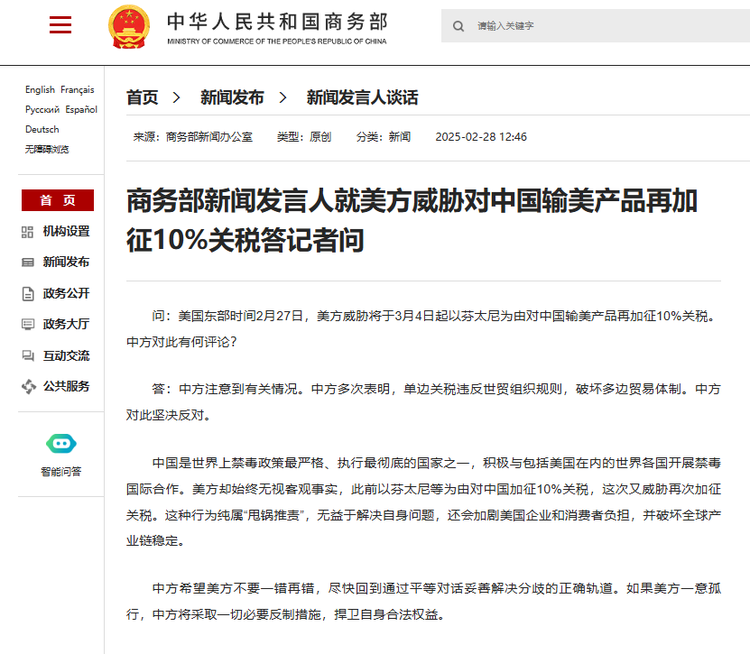
The spokesperson said, China is one of the countries with the strictest drug control policies and the most thorough implementation in the world, actively engaging in international anti-drug cooperation with countries around the world, including the United States. However, the U.S. side has consistently ignored objective facts, previously imposing a 10% tariff on China using fentanyl as an excuse, and now threatening to impose tariffs again. This behavior is purely "shifting blame," which is not helpful in addressing its own issues, but will instead increase the burden on American businesses and consumers and disrupt the stability of the global industrial chain.
The spokesperson said, China is one of the countries with the strictest drug control policies and the most thorough implementation in the world. China is one of the countries with the strictest drug control policies and the most thorough implementation in the world, actively engaging in international anti-drug cooperation with countries around the world, including the United States. However, the U.S. side has consistently ignored objective facts, previously imposing a 10% tariff on China using fentanyl as an excuse, and now threatening to impose tariffs again. This behavior is purely "shifting blame." Previously, using fentanyl as an excuse, a 10% tariff was imposed on China, and now there is a threat to impose tariffs again. This behavior is purely "shifting blame," which is not helpful in addressing its own issues, but will instead increase the burden on American businesses and consumers and disrupt the stability of the global industrial chain.
The Chinese side hopes that the U.S. will not repeat its mistakes and will return to the right track of properly resolving differences through equal dialogue as soon as possible. If the U.S. insists on going its own way, China will take all necessary countermeasures to defend its legitimate rights and interests.
The Chinese side hopes that the U.S. will not repeat its mistakes and will return to the right track of properly resolving differences through equal dialogue as soon as possible. If the U.S. insists on going its own way, China will take all necessary countermeasures to defend its legitimate rights and interests. China will take all necessary countermeasures to defend its legitimate rights and interests.
Tariffs on steel products as high as 70%, toy prices to skyrocket by 56%
Tariffs on steel products as high as 70%, toy prices to skyrocket by 56%Tariffs on steel products as high as 70%, toy prices to skyrocket by 56%It's outrageous! If you do the math, the tariffs on Chinese steel products by the U.S. have reached unimaginable levels:
It's outrageous! If you do the math, the tariffs on Chinese steel products by the U.S. have reached unimaginable levels:Since a 10% tariff was already imposed on February 1st, this year's total additional tariff on our country is 20%.Adding the 25% tariff from the previous 301 investigation, the U.S. has at least imposed a 45% tariff on our products. For steel products, it's even worse, with the majority of steel product tariffs set to reach 70%: i.e., 25% (Section 232) + 25% (Section 301) + 10% (general tariff on February 4th) + 10% (general tariff on March 4th) = 70%.
Since a 10% tariff was already imposed on February 1st, this year's total additional tariff on our country is 20%. Since a 10% tariff was already imposed on February 1st, this year's total additional tariff on our country is 20%.With the 25% tariff from the previous 301 investigation, the U.S. has at least imposed a 45% tariff on our products. With the 25% tariff from the previous 301 investigation, the U.S. has at least imposed a 45% tariff on our products. For steel products, it's even worse, the tariff level for most steel products will soon reach 70% the tariff level for most steel products will soon reach 70% : i.e., 25% (Section 232) + 25% (Section 301) + 10% (general tariff on February 4) + 10% (general tariff on March 4) = 70%.: i.e., 25% (Section 232) + 25% (Section 301) + 10% (general tariff on February 4) + 10% (general tariff on March 4) = 70%.China, Mexico, and Canada are the top three trading partners of the United States, accounting for more than 40% of total U.S. imports in 2024. After Trump announced a series of tariff measures, countries have responded with countermeasures. Some economists warn that the additional tariffs imposed by the U.S. could lead to an increase in the prices of imported goods, driving up inflation.
China, Mexico, and Canada are the top three trading partners of the United States, accounting for more than 40% of total U.S. imports in 2024. After Trump announced a series of tariff measures, countries have responded with countermeasures. After Trump announced a series of tariff measures, countries have responded with countermeasures. Some economists warn that the additional tariffs imposed by the U.S. could lead to an increase in the prices of imported goods, driving up inflation.And what is closely related to our plastics industry is the toy industry! Currently, most toys sold in the U.S. are made in China, accounting for as high as 70%, while the second-largest importer, Mexico, accounts for less than 5%. Once Trump's tariff proposals are implemented, although toy companies may absorb some of the costs, the majority will be passed on to consumers, causing toy prices to rise by 36% to 56% (depending on the final tariff rate). This will significantly weaken the demand for toys among most low- and middle-income families, leading to a general decline in toy consumption. American toy companies are generally worried, and almost everyone is preparing for a decrease in sales. Recently, the topic of 'supply chain diversification' has been widely discussed in the international toy industry. Previously, many Chinese toy companies, under strong demands from European and American customers, also began to move their production lines to Vietnam, Indonesia, and other places, achieving "diversification" of the supply chain.
And what is closely related to our plastics industry is the toy industry! Currently, most toys sold in the U.S. are made in China, accounting for as high as 70% accounting for as high as 70%, while the second-largest importer, Mexico, accounts for less than 5%. Once Trump's tariff proposals are implemented, although toy companies may absorb some of the costs, the majority will be passed on to consumers, causing toy prices to rise by 36% to 56% (depending on the final tariff rate) causing toy prices to rise by 36% to 56% (depending on the final tariff rate).This will significantly weaken the toy consumption demand of most low- and middle-income households, leading to a general downturn in the toy industry. American general toy companies are generally worried, and almost all have prepared for a decline in sales. Recently, the issue of 'supply chain diversification' has been widely discussed in the international toy industry. Previously, under strong demands from European and American customers, many Chinese toy companies also began to relocate their production lines to places like Vietnam and Indonesia, achieving "diversification" of the supply chain. Previously, under strong demands from European and American customers, many Chinese toy companies also began to relocate their production lines to places like Vietnam and Indonesia, achieving "diversification" of the supply chain.The complexity of Sino-US trade means that although Trump's tariff policies may have a certain impact on Chinese companies in the short term, they have not been able to significantly alter China's core position in the global supply chain. The strong competitiveness of Made in China still ensures that Chinese goods hold a significant share in the US market. In recent years, China has vigorously promoted technological innovation, actively strengthened the construction of its own brands, and further enhanced its competitiveness in the global market by improving the technological content of "Made in China." With changes in the international political and economic landscape, China is capable of effectively offsetting the negative impacts of US tariffs through enhanced cooperation with other economies. Additionally, the demand for Chinese products in the global market remains huge, especially as the consumption demand in emerging markets continues to grow, providing new growth opportunities for Chinese enterprises.
The complexity of Sino-US trade means that although Trump's tariff policies may have a certain impact on Chinese companies in the short term, they have not been able to significantly alter China's core position in the global supply chain. The complexity of Sino-US trade means that although Trump's tariff policies may have a certain impact on Chinese companies in the short term, they have not been able to significantly alter China's core position in the global supply chain. The strong competitiveness of Made in China still ensures that Chinese goods hold a significant share in the US market. In recent years, China has vigorously promoted technological innovation, actively strengthened the construction of its own brands, and further enhanced its competitiveness in the global market by improving the technological content of "Made in China." With changes in the international political and economic landscape, China is capable of effectively offsetting the negative impacts of US tariffs through enhanced cooperation with other economies. Additionally, the demand for Chinese products in the global market remains huge, especially as the consumption demand in emerging markets continues to grow, providing new growth opportunities for Chinese enterprises.【Copyright and Disclaimer】The above information is collected and organized by PlastMatch. The copyright belongs to the original author. This article is reprinted for the purpose of providing more information, and it does not imply that PlastMatch endorses the views expressed in the article or guarantees its accuracy. If there are any errors in the source attribution or if your legitimate rights have been infringed, please contact us, and we will promptly correct or remove the content. If other media, websites, or individuals use the aforementioned content, they must clearly indicate the original source and origin of the work and assume legal responsibility on their own.
Most Popular
-
Mexico Imposes Tariff Up to 36% on Cross-Border E-Commerce Products, Effective January 1, 2026; Plastic Shows Partial Fluctuation Today
-
4.5 Million Tons! Wanhua Chemical Dominates Globally in MDI, Heavy Investment in Battery Materials Spurs New Storm
-
Trump Delays Tariff Increase on Furniture, Cabinets, and Vanities
-
Wanhua Chemical Invests $27.3 Billion, 2026 Investment Map Revealed, $1.1 Billion Bet on Battery Materials
-
Back-to-back major joker moves! covestro’s 1.32 million ton mdi dual-line expansion and hdi acquisition reshape global polyurethane landscape


