Development Status and Market Scale Analysis of the Biosynthesis Industry in 2025, along with Competitive Landscape Analysis
The biosynthesis industry, as an emerging sector in the field of life sciences in the 21st century, is leading a new round of biotechnology revolution with its unique technological advantages and broad application prospects. In recent years, with continuous breakthroughs and advancements in technologies such as gene editing and synthetic biology, the biosynthesis industry has experienced rapid development on a global scale.
I. Analysis of the Current Development Status of Bio-synthesis Industry
Biological synthesis has witnessed explosive growth in recent years. Data shows that the global biological synthesis market size grew from $5.3 billion in 2018 to over $17 billion in 2023, with a compound annual growth rate of 26.4%. It is expected that by 2028, the global biological synthesis market size will reach nearly $50 billion, with a compound annual growth rate of 23.4% from 2023 to 2027.
In the Chinese market, biosynthesis has also shown strong development momentum. Data shows that the market size of biosynthesis in China increased from 2.441 billion yuan in 2018 to approximately 10.3 billion yuan in 2022, with a compound annual growth rate far exceeding the global growth rate. It is expected that by 2025, the market size of biosynthesis in China will exceed 7 billion USD, and by 2029, it will reach between 28.5 billion and 40 billion USD.
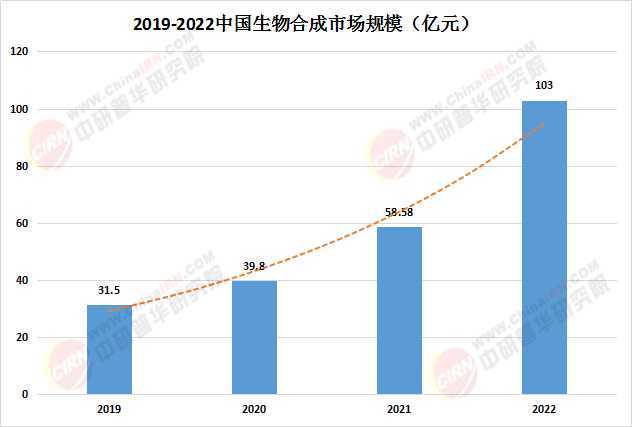
Data source: Zhongyan Puhua
The development of biosynthesis is inseparable from the continuous innovation of technology. In recent years, breakthroughs in key technologies such as gene editing and synthetic biology have provided strong momentum for the development of biosynthesis. For example, gene editing technologies like CRISPR-Cas9 enable researchers to precisely cut, insert, or replace DNA fragments, allowing for precise manipulation of the genetic information of organisms. This capability allows biosynthesis to create organisms or biomolecules with specific functions and properties.
In product applications, biosynthesis technology has been widely used in multiple fields such as medicine, chemicals, agriculture, and food. In the medical field, biosynthesis technology can be used to produce biopharmaceuticals such as insulin and growth hormones, as well as biological products like vaccines and antibodies. In the chemical industry, biosynthesis technology can be used to produce bio-based materials and biofuels, which are green chemicals. In agriculture, biosynthesis technology can be employed to improve crop yields, enhance crop quality, and develop new types of pesticides and fertilizers. In the food sector, biosynthesis technology can be used to produce functional foods and food additives.
II. Analysis of the Competitive Landscape in the Biosynthesis Industry
The global biosynthesis market presents a diversified competitive landscape. Developed countries and regions such as the United States and Europe possess strong technological capabilities and market competitiveness in the field of biosynthesis. Among them, the United States holds a dominant position with a market share of 21.1%, thanks to its increased level of industrialization and growing emphasis on research and development. Germany accounts for 40.2% of the European market, and with the rising number of cancer patients in the region, the demand for the application of biosynthesis technology in cancer treatment is continuously increasing.
In market competition, multinational companies such as Novo Nordisk, Sanofi, and Bayer occupy a dominant position due to their strong R&D capabilities, brand influence, and market expansion abilities. These companies not only possess advanced biosynthesis technologies and products but also continuously expand their business fields and market share through mergers, acquisitions, and collaborations.
According to the "研究报告" released by Bellen House Research Institute,"China's Synthetic Biology Industry Development Potential Suggestions and In-depth Investigation Forecast Report for the Fifteenth Five-Year Plan"Show:
In the Chinese market, biosynthesis also presents a diverse competitive landscape. On one hand, multinational companies are entering the Chinese market, leveraging their advanced technology and product advantages to compete fiercely with domestic companies. On the other hand, domestic companies are continuously increasing their R&D investment, improving product quality and technical standards, and gradually narrowing the gap with multinational enterprises.
Currently, a number of competitive companies have emerged in China's biosynthesis sector, such as Huaxi Bio-Tech, Kaisa Bio-Tech, and Huaheng Bio-Tech. These companies possess strong technical capabilities and market competitiveness in the field of biosynthesis, with their products widely applied in sectors including pharmaceuticals, chemicals, agriculture, food, and more. At the same time, these enterprises are actively expanding their international markets, enhancing the global influence of China's biosynthesis industry.
III. Analysis of the Future Development Prospects of the Biosynthesis Industry
(1) The market demand continues to grow.
With the growth of the global population, improvement in living standards, and increasing awareness of healthcare, the market demand for biosynthetic products will continue to rise. Particularly in the fields of medicine, chemistry, and agriculture, biosynthesis technology will play an increasingly important role. For example, in the medical field, with the aging population and the rising incidence of chronic diseases, the demand for biopharmaceuticals and bioproducts will continually increase. In the chemical industry, as environmental regulations become stricter and consumer awareness of environmental protection grows, the demand for green chemicals and bio-based materials will also continue to grow.
Technological innovation drives industrial upgrading.
Innovation in technology is the driving force behind the continuous development of biosynthesis. In the future, with ongoing breakthroughs and advancements in gene editing and synthetic biology technologies, biosynthesis techniques will become more mature and refined, promoting the growth of the biosynthesis industry to higher levels and broader fields. For example, through gene editing technology, researchers can create microorganisms or cell factories with specific functions and properties for producing high-value-added biological products. Using synthetic biology technology, researchers can design more efficient and stable biosynthetic pathways, enhancing the yield and quality of biological products.
The policy environment continues to optimize.
error
Conclusion
In conclusion, biosynthesis, as a new industry in the field of life sciences in the 21st century, is leading a new wave of biotechnology revolution with its unique technical advantages and broad application prospects. With the global population growth, improvement in living standards, and enhanced health awareness, the market demand for biosynthesis products will continue to increase. Additionally, technological innovation, policy support, and international cooperation will further drive the development of the biosynthesis industry to higher levels and broader fields. In the future, the biosynthesis industry will迎来更加广阔的发展前景和机遇。 (注:最后一句未完整提供,但根据上下文应为“迎来更加广阔的发展前景和机遇。”其英文应为 "usher in even broader prospects and opportunities.") 因此,完整的句子应为: In conclusion, biosynthesis, as a new industry in the field of life sciences in the 21st century, is leading a new wave of biotechnology revolution with its unique technical advantages and broad application prospects. With the global population growth, improvement in living standards, and enhanced health awareness, the market demand for biosynthesis products will continue to increase. Additionally, technological innovation, policy support, and international cooperation will further drive the development of the biosynthesis industry to higher levels and broader fields. In the future, the biosynthesis industry will usher in even broader prospects and opportunities.
【Copyright and Disclaimer】The above information is collected and organized by PlastMatch. The copyright belongs to the original author. This article is reprinted for the purpose of providing more information, and it does not imply that PlastMatch endorses the views expressed in the article or guarantees its accuracy. If there are any errors in the source attribution or if your legitimate rights have been infringed, please contact us, and we will promptly correct or remove the content. If other media, websites, or individuals use the aforementioned content, they must clearly indicate the original source and origin of the work and assume legal responsibility on their own.
Most Popular
-

Mexico Imposes Tariff Up to 36% on Cross-Border E-Commerce Products, Effective January 1, 2026; Plastic Shows Partial Fluctuation Today
-
4.5 Million Tons! Wanhua Chemical Dominates Globally in MDI, Heavy Investment in Battery Materials Spurs New Storm
-

Trump Delays Tariff Increase on Furniture, Cabinets, and Vanities
-
Wanhua Chemical Invests $27.3 Billion, 2026 Investment Map Revealed, $1.1 Billion Bet on Battery Materials
-
Back-to-back major joker moves! covestro’s 1.32 million ton mdi dual-line expansion and hdi acquisition reshape global polyurethane landscape