



China Sells 172 Million More Vehicles but Earns 80 Billion Less, Cars Sell More but Lose Money
The farmers in Jiangnan welcomed a bountiful harvest, with each mu of land yielding three to five more dou. Full of hope, they rowed their boats to the Wansheng Rice Store to sell their rice, only to encounter a sharp drop in rice prices: rough rice was only five yuan per dan, and paddy was three yuan, much lower than the seven and a half yuan per dan last year.
“Brown rice is five cents; grain is three cents.” The rice shop clerk replied listlessly.
"What!" The old felt-hat friend could hardly believe his ears. Their rosy hopes suddenly sank, and for a moment, everyone was stunned.
"Didn't you sell it for thirteen dollars in June?"
"Fifteen yuan has been sold before, let alone thirteen yuan."
Where could someone fall so severely!
"Do you not know what time it is? Rice is pouring in from all directions, and it will drop further in a few days!"
This is Ye Shengtao’s realistic short story “A Slight Increase in the Harvest,” published in the inaugural issue of the magazine Literary Monthly in July 1933.
Today, the scene depicted in this 93-year-old novel is unfolding in China’s automobile market in a different form.
"Total production and sales have increased, but the total output value has declined, which is somewhat unexpected." As a veteran in the Chinese automotive industry for decades, Xu Daquan, President of Bosch China, expressed confusion when facing the 2025 Chinese automotive performance results.
A sigh from the head of a leading supplier is often the most sensitive indicator of industry trends.
It is known that in 2025, the sales of new cars in China grew by 6.7%, reaching 27.302 million vehicles.
According to this calculation, it means that the Chinese automotive market sold 1.725 million more new vehicles in 2025, but collected 79.1 billion yuan less, nearly 80 billion yuan.
Chinese auto industry is experiencing its own "Three or Five Dou More Harvest," and it's the second consecutive year.
Sales volume and sales revenue deviating from each other is uncommon in China's automotive industry. Eguo Auto analyzed data on domestic car sales and sales revenue in China from 2015 to 2025, and found that these two data points were proportional in most periods, rising and falling together.
Only in 2021-2022 and 2025-2026, there were cases where sales volume and sales revenue diverged.
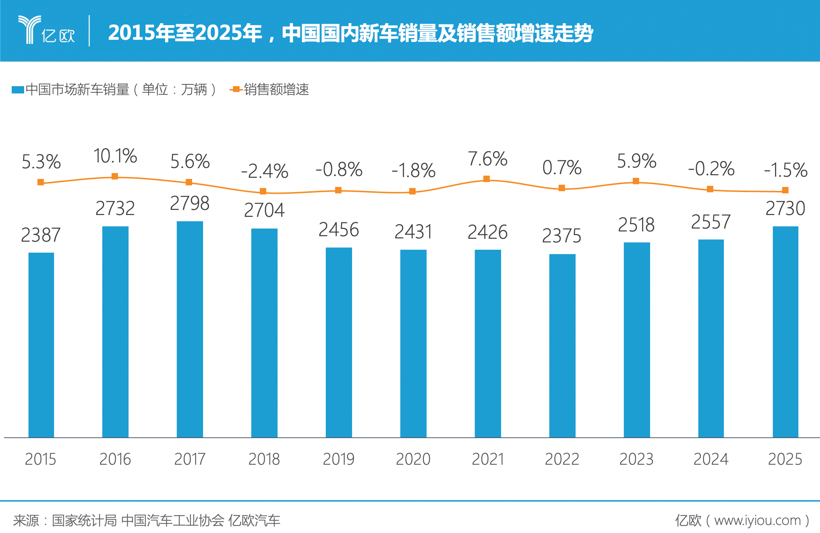
However, these two periods are somewhat different. From 2021 to 2022, there was a decline in sales volume, but an increase in sales revenue. The reason is not hard to understand; at the time, the global automotive supply chain was disrupted by irresistible factors, leading to a shortage of new cars, which in turn caused an increase in sales revenue.
The most typical case is that the world’s three leading luxury car brands—Mercedes-Benz, BMW, and Audi—have all experienced declining sales volumes, yet their sales revenue and net profit have surged dramatically.
However, by 2024 and 2025, the situation reversed — sales volumes grew year-on-year by 1.6% and 6.7%, respectively, while sales revenue declined, with the decline worsening each year, from -0.5% to -1.5%, and the reduction in revenue growing from 32 billion to nearly 80 billion.
This also needs to take into account that by 2025, despite repeated orders from regulators to reduce internal competition within the Chinese auto industry, sales still fell short by nearly 80 billion yuan.
What is the concept of 80 billion?
By comparison, NIO's total revenue for the first three quarters of 2025 was only 81.2 billion yuan, while XPeng's total revenue in 2024 was 40.8 billion yuan.
This is equivalent to the intense competition in China's auto market in 2025 wiping out NIO's profits from the first three quarters, or erasing the combined value of two XPeng Motors from 2024.
Anti-Involution Remains a Daunting Task.
Worked hard for three years, yet the average price is lower than it was three years ago.
Since 2020, amid the once-in-a-century transformation of the automotive industry compounded by various intense, uncontrollable forces, Chinese automotive professionals have demonstrated exceptional resilience—rising to the challenge and enabling the industry’s rapid recovery and growth.
In terms of volume, after years of effort, China’s automobile sales reached 27.302 million units in 2025, approaching the historical peak of 27.988 million units recorded domestically in 2017.
In terms of quality, Chinese automakers have leveraged electrification and intelligent technologies to overtake competitors, now capturing 70% of China's automobile market. As they become the dominant force in China's auto market, they have also achieved brand elevation, driving up the average price of new vehicles nationwide.
According to data from the China Passenger Car Association (CPCA), the average price of new vehicles in China has risen for five consecutive years from 2019 to 2024, increasing from RMB 151,000 per vehicle to RMB 184,000 per vehicle.
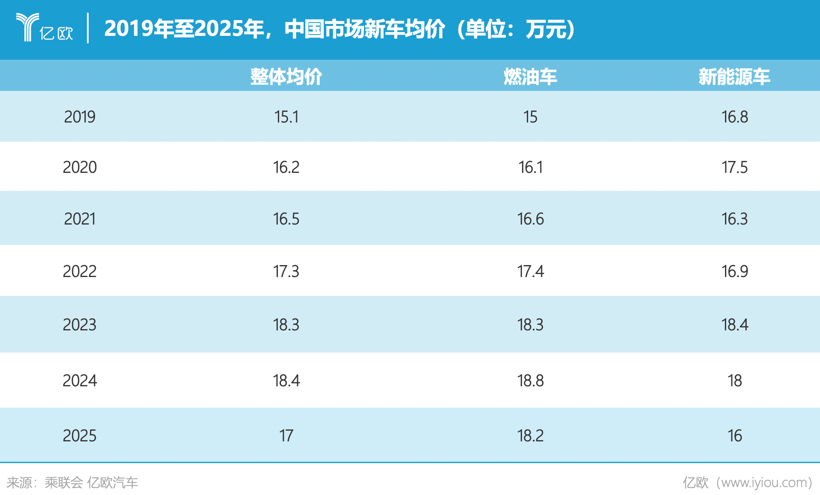
However, by 2025, the situation changed dramatically, with the average transaction price of new cars in China dropping in one go to 170,000 yuan, a decline of 7.5% from 2024. This is already lower than the 173,000 yuan in 2022, but slightly higher than the 165,000 yuan average price of new cars in 2021.
Why, despite a thriving industry and continuous sales growth, has the average price of new cars dropped back to three years ago, causing the retail total to decrease by nearly 80 billion yuan?
Cui Dongshu, secretary general of the China Passenger Car Association, believes that changes in the structure of new car consumption have affected the average price. On one hand, by 2025, high-end gasoline vehicles will shrink rapidly, and at the same time, the average price of new energy vehicles will gradually decrease, leading to a decline in the average price of new cars.
In addition, Cui Dongshu believes that in the second half of 2024, the sales of low and medium-end vehicles have increased significantly due to the promotion of scrappage and trade-in subsidy policies, leading to a decline in the average price of new vehicles in 2025.
But at the end of the day, it all boils down to one word—involution.
From the two reasons summarized by Cui Dongshu, it can be clearly seen that the shrinkage of the high-end gasoline car market and the decline in the average price of new energy vehicles are definitely influenced by price wars, which is the impact of internal competition.
Moreover, apart from the average price of new vehicles, another key indicator of China's automotive industry—the profit margin—fell to 4.1% in 2025, hitting a five-year low and remaining below the average profit margin of 5.9% for downstream industrial enterprises.
So, involution, please carry the blame.
But the problem comes along, in 2025, the regulatory authorities have repeatedly emphasized the need to fight against excessive competition, why is excessive competition still not curbed?
A supplier told iResearch Auto that although regulators have repeatedly emphasized anti-internal competition, some leading car manufacturers have become even worse.
Nevertheless, overall, the anti-involution efforts in 2025 have achieved remarkable results; for instance, the highly publicized issue of payment terms for automotive suppliers has already shown significant improvement.
After conducting a survey and analysis of 17 automakers, the China Association of Automobile Manufacturers stated in February that the majority of key automakers have compressed their payment terms to within 60 days, with an average term of about 54 days, which is approximately 10 days shorter than the same period last year. In terms of payment methods, 15 companies use cash or bank acceptance bills exclusively, while a few companies use commercial acceptance bills.
However, the China Association of Automobile Manufacturers (CAAM) also pointed out that some automakers still have issues regarding payment to suppliers. For instance, the starting point for calculating payment terms varies—such as upon goods delivery and acceptance, centralized account reconciliation, receipt of invoices, or vehicle loading verification—though the nominal payment term is uniformly stated as 60 days. As a result, the actual time elapsed between suppliers’ delivery of goods and receipt of payment differs significantly, effectively extending the payment terms.
If that's the case, will the average price of cars in China rebound in 2026?
Game 2026
There are already clear signs of recovery.
According to the latest data released by the China Passenger Car Association, the average price of passenger cars in January 2026 has reached 186,000 yuan, significantly higher than the 170,000 yuan average in 2025, and even surpassing the historical high of 184,000 yuan in 2024.
Looking at the, the high-end fuel vehicle purchasing group is gradually stabilizing, leading to an increase in the average price of fuel vehicles, with an average price of 181,000 yuan in January; the average price of new energy vehicles is rising even faster, reaching as high as 195,000 yuan in January. Corrected translation: Looking at the breakdown, the high-end fuel vehicle purchasing group is gradually stabilizing, leading to an increase in the average price of fuel vehicles, with an average price of 181,000 yuan in January; the average price of new energy vehicles is rising even faster, reaching as high as 195,000 yuan in January.
The average price trend in January got off to a strong start for the year, and the full-year sales forecast may also provide support for this year’s average price trend.
In 2026, the China Association of Automobile Manufacturers and the CPCA both expect new car sales to continue to grow. Based on the experience of the past ten years, it is highly likely that sales and revenue are proportional, and there has never been a case of consecutive three years where sales and revenue declined. Therefore, the growth in sales will undoubtedly support the average price of new cars.
On the other hand, new car prices may still receive some "support" from the supply chain level in 2026.
Since 2025, with the explosive growth of the artificial intelligence industry, overseas AI giants have begun massively procuring memory chips, causing prices of related products to surge rapidly and severely squeezing demand from automotive manufacturers.
UBS data shows that the overall price of automotive-grade DRAM memory chips has increased by 180% over the past three months. According to TrendForce’s research and consulting firm, Memory Market Monitor, since the second half of 2025, prices of DDR4 memory chips for automotive applications have risen by over 150%, while DDR5 memory prices have surged by 300%.
Meanwhile, because account for less than 5% of the global memory chip procurement, this puts them at a disadvantage in the competition with AI giants for memory chips. Li Bin, founder, chairman, and CEO of NIO, recently stated that NIO feels pressure in the memory price hike competition, "We are competing for resources with AI and computing centers. They have invested hundreds of billions of dollars, and we can't compete." Therefore, as the new year 2026 began, Li Bin advised consumers to buy cars earlier, while the impact of memory price hikes on the automobile industry has not yet fully emerged, and consumers who want to buy a car are advised to do so as soon as possible.
Xiaomi’s President Lu Weibing was more direct: to cope with price pressure, Xiaomi has already signed a memory supply agreement covering the period through 2026.
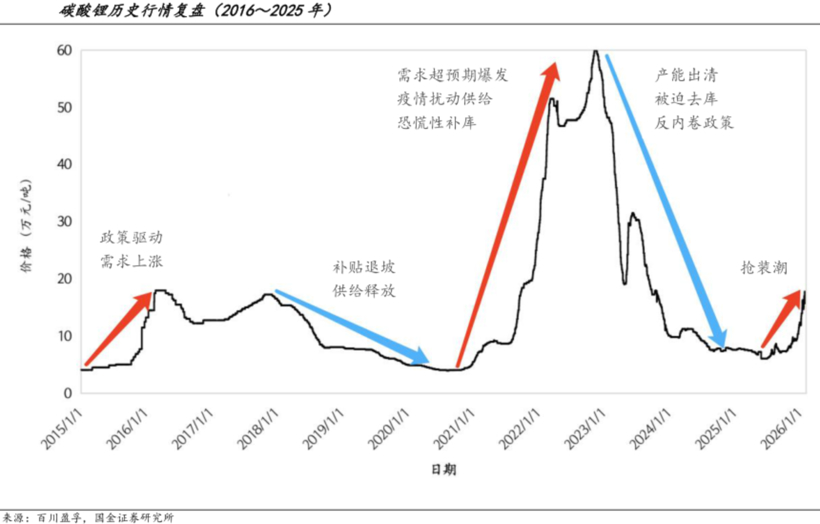
As another major cost component of new energy vehicles, power batteries are also facing significant upward pricing pressure. From July 2025 to this January, lithium carbonate prices surged from 70,000 yuan per ton to 180,000 yuan. Although prices declined somewhat after the Spring Festival, as of the close of trading on February 27, the main contract price for lithium carbonate futures remained as high as 168,000 yuan per ton.
But on the other hand, major automakers are still facing cost pressures and are indirectly competing on prices.
On February 26, Tesla announced that its three main models would be eligible for a 5-year 0% interest financing offer before March 31. Meanwhile, several automakers, including BYD, have also rolled out their own interest-free or low-interest loan programs.
Resisting the “involution” trend remains a daunting task. The overall sales revenue and profit margin data for 2025 have issued a stern warning: if we relentlessly pursue the illusion of scale while neglecting fundamental business logic and value principles, the closer such growth approaches its peak, the further it may drift from genuine, healthy development.
After experiencing this "gathering of a few more bushels," China's automotive industry may need to seriously consider how to recover the lost value in future competition and bring growth back to its fundamental value.
【Copyright and Disclaimer】The above information is collected and organized by PlastMatch. The copyright belongs to the original author. This article is reprinted for the purpose of providing more information, and it does not imply that PlastMatch endorses the views expressed in the article or guarantees its accuracy. If there are any errors in the source attribution or if your legitimate rights have been infringed, please contact us, and we will promptly correct or remove the content. If other media, websites, or individuals use the aforementioned content, they must clearly indicate the original source and origin of the work and assume legal responsibility on their own.
Most Popular
-

Middle East Tension Spikes Global Energy Pattern, Crude Oil and Plastic Industries Face Multiple Challenges
-
Middle East Tensions Escalate Sharply: How Polyolefins Respond Amid Soaring Risk Premium
-

Middle East Polymer Export Hub Hit in Sudden Attack, Global Supply Chain Sounds Alarm
-
[Forward-Looking Analysis] Impact of Escalating U.S.-Iran Tensions on Domestic Chemical Market
-
Futures Surge Violently, Polyolefin Spot Prices Rise Sharply in Tandem


