Carbon Fiber Strikes Again! Haier’s Lightest AI Sports Exoskeleton Robot Unveiled
On May 26, Haier officially launched the Haier W3, the world’s lightest AI-powered sports exoskeleton robot. Thanks to an integrated molding process using full carbon fiber combined with titanium alloy, the total weight of the device has been reduced to just 1.75 kg, setting a new industry record for lightness and achieving a dual breakthrough in both lightweight design and structural strength. This product not only addresses the longstanding pain points of traditional exoskeleton devices—such as bulkiness and the burden of wearing them—but also brings the practical value of carbon fiber, the “king of new materials,” back into the public spotlight.

Image source: Haier Group
Haier W3 demonstrates remarkable ingenuity in its choice of materials. Carbon fiber has a density only one-quarter that of steel, yet its tensile performance far surpasses that of ordinary steel. Combined with the lightweight, high-strength, and corrosion-resistant properties of titanium alloy, it creates an almost imperceptible wearing experience. The parts of the device that come into contact with the body are made with non-Newtonian fluid materials, which remain soft and skin-friendly in daily use but rapidly harden under stress during movement to cushion impact, providing comprehensive protection for human joints. The rollout of Haier W3 is a typical achievement of the integration of carbon fiber composites with AI technology and materials science, and it also marks the official entry of the smart wearables and assistive equipment industry into a new era of “imperceptible assistance.”
As a core material in the high-end manufacturing sector, carbon fiber, with its unique advantages of being lightweight and high-strength, is widely used in aerospace, wind power, the low-altitude economy, commercial spaceflight, and other fields, and is currently at a critical stage of industrial transformation. Looking at the global market, companies such as Japan’s Toray and the United States’ Hexcel have long controlled high-end core technologies. However, China’s carbon fiber industry is rapidly catching up, with its overall competitiveness continuing to rise. Domestic materials are accelerating the shift from “following” to “leading,” and are gradually achieving large-scale substitution in fields such as wind power and civil aviation.
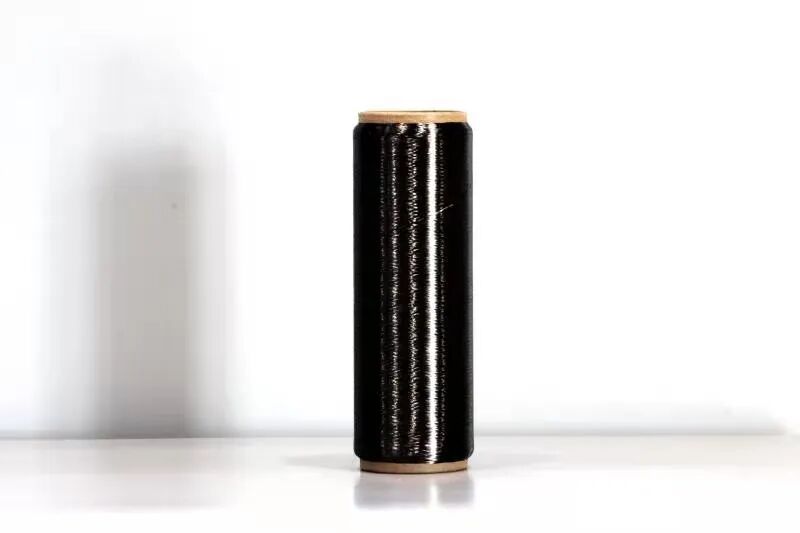
Carbon fiber (Image source: Jilin Chemical Fiber)
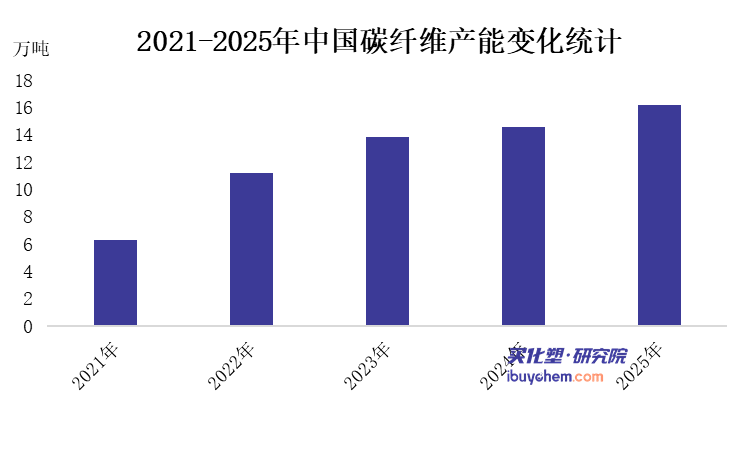
After a period of rapid capacity expansion from 2019 to 2023, the development pace of China’s carbon fiber industry has gradually become more rational. In 2024–2025, the industry moved away from extensive capacity competition, with its development logic shifting from “supply-driven” to “demand-driven.” Data show that by the end of 2025, China’s annual carbon fiber production capacity reached 162,000 tons, with 16,400 tons of new capacity added during the year and the growth rate falling to 11.3%. Compared with the several-fold expansion seen over the previous five years, the industry’s growth has slowed significantly. However, the newly added capacity is focused on high-end and diversified segments, effectively improving the previous structural imbalance of insufficient supply of high-end products and overcapacity in mid- to low-end products.
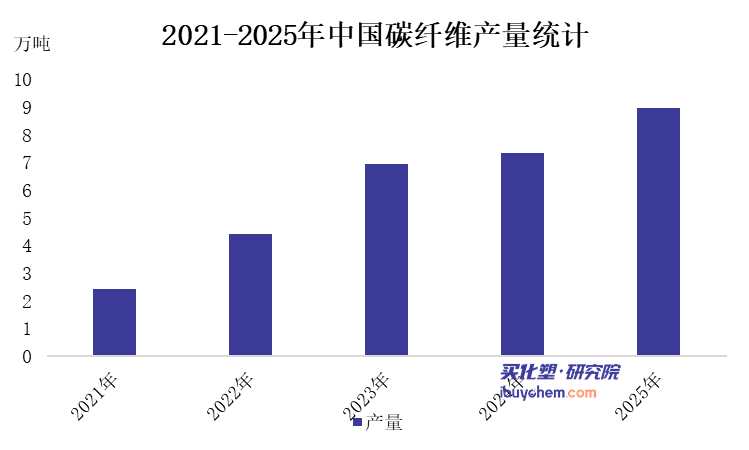
While production capacity continued to optimize steadily, industry production vitality was further unleashed. In 2025, domestic carbon fiber output reached 89,600 tons, up 22.2% year on year. The growth rate of output was higher than that of capacity, indicating a continuous improvement in industry capacity utilization and a sustained strengthening of the downstream end-market’s ability to absorb demand.
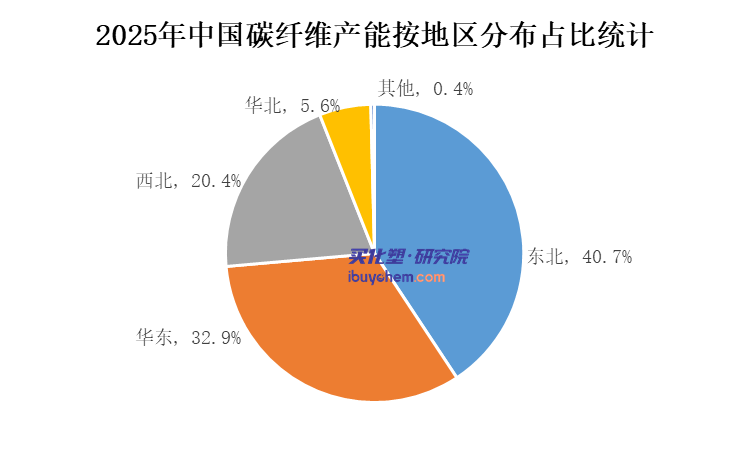
From the perspective of industrial distribution, domestic carbon fiber production in China exhibits a tripartite pattern centered in Northeast China, East China, and Northwest China, with these three regions accounting for as much as 94.0% of total production capacity. Among them, Northeast China, supported by the clustering of leading enterprises such as Jilin Chemical Fiber, accounts for 40.7% of capacity and is the country’s largest carbon fiber supply base. East China, leveraging its strong R&D foundation, accounts for 32.9% of capacity, with a wide variety of products and downstream derivatives. Northwest China, relying on its energy advantages, has undertaken industrial deployment and accounts for 20.4% of capacity. North China, as a major hub of downstream demand, accounts for 5.6% of capacity, with the industry developing steadily and in an orderly manner.
In 2025, rising global raw material prices, coupled with the upgrading of domestic demand structures, have further reshaped the development landscape of the carbon fiber industry. On the cost side, increases in energy prices and raw materials such as PAN precursor have driven companies at home and abroad to raise product prices collectively, with international giants and leading domestic firms successively adjusting prices as cost pressures are gradually transmitted downstream. On the demand side, demand has become the core engine of industry growth, with four major sectors showing strong momentum: wind power, aerospace, the low-altitude economy, and commercial space. Demand from the wind turbine blade sector accounts for more than 50%, serving as the “ballast stone” for the industry’s stable development; demand from the aerospace sector has seen explosive growth, with its share rising to 7.29%; low-altitude equipment such as drones and electric vertical takeoff and landing aircraft, as well as commercial space applications including satellites and space-based data centers, continue to expand the market space for high-end carbon fiber. At present, domestic industry inventories are being cleared at an accelerated pace, and the operation of the industrial chain is returning to a healthy state.
For a long time, core carbon fiber production technologies were monopolized by overseas companies. However, a host of domestic enterprises in China have devoted themselves to research, pursued continuous breakthroughs, and steadily dismantled technological barriers, significantly accelerating the import substitution process. Leading companies have each leveraged their respective strengths to build a complete industrial matrix with differentiated competitiveness: Guangwei Composites, as an industry pioneer, overcame the engineering challenges of T300-grade carbon fiber as early as 2005 and has now established a fully integrated industrial chain, with products covering multiple mainstream grades; Sinofibers Technology has mastered the kiloton-scale mass production technologies for T700- and T800-grade carbon fiber, taking the lead in breaking through the core dry-jet wet-spinning process, with total capacity ranking among the top three globally; Jilin Chemical Fiber has built a full industrial chain layout, with its three major production bases focusing respectively on large-tow and small-tow carbon fiber to achieve differentiated development; Shanghai Petrochemical has successfully mastered the production technology for 48K large-tow carbon fiber, becoming the world’s fourth company to do so; Zhongjian Technology focuses on the high-end aerospace sector, with product performance reaching internationally leading standards.
The technological breakthroughs and large-scale production achieved by domestic enterprises have not only significantly improved the quality of products, but also effectively reduced production costs, laying a solid foundation for the broad popularization and application of the material. Looking ahead, with the commissioning of new high-end capacity by leading companies and the continued expansion of application scenarios, coupled with ongoing improvements in R&D capabilities and cost control, will continue to gain global market share. Industry competition will also shift from a simple race in production capacity to a comprehensive contest centered on quality upgrading, scenario expansion, and deepening along the industrial chain, thereby breaking away from the low- and mid-end market rat race and driving the industry toward high-quality development.
With the dual momentum of the implementation of the carbon peaking and carbon neutrality strategy and the upgrading of China’s high-end manufacturing industry, the long-term value of carbon fiber, this strategic new material, is being continuously unleashed. From sports exoskeleton robots to major national equipment, from civilian gear to aerospace, domestically produced carbon fiber is steadily empowering a wide range of industries through technological innovation, writing a new chapter for China in the global landscape of the advanced materials industry.
【Copyright and Disclaimer】The above information is collected and organized by PlastMatch. The copyright belongs to the original author. This article is reprinted for the purpose of providing more information, and it does not imply that PlastMatch endorses the views expressed in the article or guarantees its accuracy. If there are any errors in the source attribution or if your legitimate rights have been infringed, please contact us, and we will promptly correct or remove the content. If other media, websites, or individuals use the aforementioned content, they must clearly indicate the original source and origin of the work and assume legal responsibility on their own.
Most Popular
-

Layoffs, Divestments, Plant Closures While Pouring Billions: BASF Undergoes Major Transformation!
-
Ascend Adipic Acid Hit By Force Majeure, Market Expects Supply Resumption In Mid-September
-

Raw Material Supply Shortage! INEOS Phenol Declares Force Majeure on Phenol and Acetone Businesses
-
South Korea initiates anti-dumping investigation against Chinese PVC suspension resin! The target is Tianjin Bohua and Wanhua Chemical. How to break through?
-

Sixth national procurement set to be implemented: A “Reshuffling” Moment for the $10-Billion Medical Device Market