Car Companies Shorten Payment Terms, But Suppliers Still Complain
The automotive industry is a pillar of the national economy, with a long and interconnected supply chain. The health of small and medium-sized suppliers directly determines the resilience of the industrial ecosystem. For a long time, excessively long payment terms and inflexible payment methods for supplier invoices have been a persistent pain point in the automotive supply chain. This not only exacerbates the cash flow difficulties of small and medium-sized enterprises but also harbors risks of supply chain disruption.
Image source: 699pic.com
In June 2025, 17 key automakers responded to the State Council's revised "Regulations on Ensuring Payment of Funds to Small and Medium-sized Enterprises" by collectively pledging "payment terms not exceeding 60 days." Eight months later, a special research report from the China Association of Automobile Manufacturers has been released, using concrete data to highlight the achievements of the reform and frankly pointing out the remaining shortcomings in the industry. Where has this reform, aimed at optimizing the industrial chain ecosystem, reached?
Is the shortening of the payment term effective?
On February 12th, the China Association of Automobile Manufacturers (CAAM) released a research report on the implementation of payment term commitments by key automotive suppliers, comprehensively reviewing the payment term implementation of 17 key automakers. According to the data, the achievements in compressing payment terms are indeed remarkable.
The most intuitive change is the significant reduction in average payment terms. According to the research report, the vast majority of the 17 key automotive enterprises have completed the compression of their payment cycles, with the average payment term dropping to 54 days—10 days shorter than the same period last year. Notably, four enterprises performed exceptionally well with average payment terms under 50 days, demonstrating significant progress in fulfilling their payment term commitments.
Optimizing payment methods is another significant highlight of this reform. For a long time, non-cash payment methods such as commercial acceptance drafts and electronic accounts payable vouchers have been common means for automakers to extend payment terms in disguise. If suppliers urgently need cash, they have to bear additional discounting costs, further exacerbating their financial pressure.
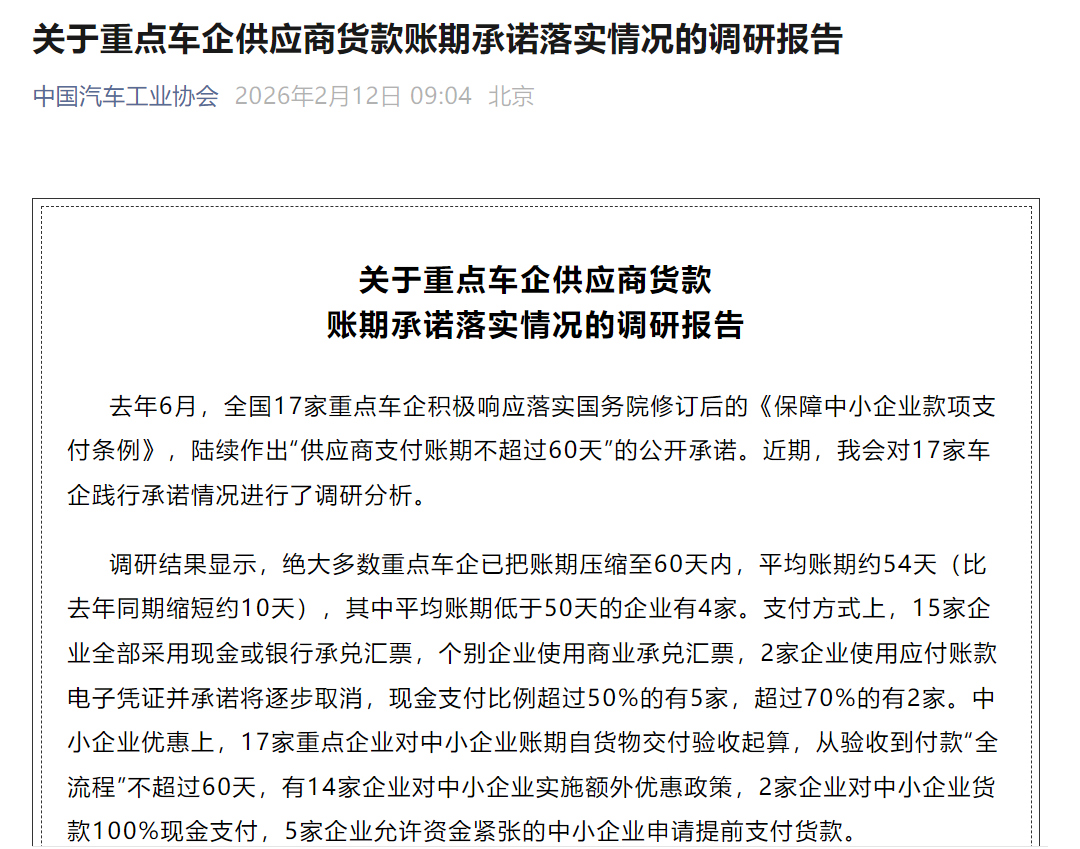
Image source: screenshot of CAAM report
The survey revealed that all 15 companies are now using cash or bank acceptance drafts for payments, with only a few still using commercial acceptance drafts. Furthermore, two companies that previously used electronic accounts payable vouchers have explicitly committed to phasing out this method to reduce the financial burden on suppliers.
Support for small and medium-sized enterprises (SMEs) is particularly prominent. All 17 auto companies allow SMEs to calculate payment terms from the date of goods delivery and acceptance, with a maximum of 60 days for the entire process. Among these, 14 have introduced additional preferential policies, 2 offer 100% cash payment to SMEs, and 5 allow SMEs facing cash flow challenges to apply for early payment.
The report indicates that all major automotive manufacturers have established special mechanisms to ensure the implementation of payment term commitments. Many companies have set up special working groups and issued policy documents to adjust payment terms for existing contracts. Some companies have optimized financial processes and improved information systems to achieve regular automatic payments. Other companies have changed the start date for payment terms to the delivery and acceptance date, and switched the settlement frequency from monthly to every ten days, significantly improving settlement efficiency. Several companies are also preparing over ten billion yuan in special funds to improve invoice payment terms.
The CAAM (China Association of Automobile Manufacturers) specifically noted that the payment period in the survey is calculated from the starting point, such as acceptance or reconciliation, to the actual payment date. Due to differences in statistical calibers, results from some financial reports may be higher than the actual situation. Furthermore, as an industry practice, bank acceptance bills are widely accepted by suppliers for their high credit ratings and strong liquidity.
Remaining issues,Not to be ignored.
This survey report did not "only report the good news and hide the bad," explicitly pointing out the current shortcomings in accounts receivable management. More noteworthy is the discrepancy between the feedback from many industry insiders and the survey data; the "data looks good, but the feeling is not good" has become a common sentiment among some suppliers. Behind this lies the pain points and loopholes that remain unresolved in the implementation of reforms.
The most prominent issue is the inconsistent starting point for payment terms, with some automakers effectively extending payment periods. A CAAM research report points out that some automakers use various methods to determine the starting point of payment terms, such as goods delivery and acceptance, centralized reconciliation, invoice receipt, and installation verification. Although nominally all have 60-day payment terms, there are significant differences in the time from delivery to receipt of payment for suppliers. The process management is not standardized enough, resulting in a disguised extension of payment terms.
According to the revised *Regulations on Ensuring Payments to Small and Medium-sized Enterprises*, the payment period shall be calculated from the date of delivery of goods or the date of passing inspection and acceptance, and automobile enterprises are prohibited from delaying such processes. However, in practice, some automakers exploit tactics such as "vague acceptance standards" and "cumbersome procedures" to artificially prolong the inspection and acceptance cycle.
More covertly, some automakers use the invoice date as the starting point for payment terms, but then artificially delay the invoicing process. Several industry insiders have reported to Gasgoo that the phenomenon of automakers withholding invoices still exists. One supplier bluntly stated, "Invoicing upon vehicle off-line is a very peculiar practice. There's infinite room for manipulation in between. Previously, it was about 45 days from shipment to invoicing, now it's compressed to 35 days, but the invoices aren't fully issued. 35% are left un-invoiced, to be issued next month."。Furthermore, some suppliers revealed that invoices for certain payments had not been issued for as long as a year. In addition, some suppliers reported issues such as "received banker's acceptances with maturities of up to six months" and "payment cycles of at least three to four months."

Image source: 699pic.com
While some companies have previously indicated that payment terms from automakers have indeed shortened compared to the past, the aforementioned feedback cannot be ignored. Although this feedback does not specify particular companies, it sufficiently reflects that the payment term management of some enterprises is still not standardized, and the phenomenon of disguisedly extending payment terms has not been completely eradicated.
At the same time, a few companies have made unreasonable demands on suppliers under the guise of "shortening payment terms." Amid continuous pressure on profit margins in the automotive industry, some automakers, while fulfilling their payment term commitments, have shifted costs to suppliers through other means. The most common among these is "payment terms in exchange for price reductions." A few automakers have even demanded that suppliers accept other unfair terms, such as bearing costs that should have been covered by the original equipment manufacturer (OEM), including research and development, testing, and mold development, or significantly increasing the cost-sharing ratio.
The "hidden pitfalls" of payment methods have also meant that the financial pressure on some suppliers has not been fundamentally alleviated. Although most car manufacturers promise not to use commercial acceptance bills, some companies still do, and even though some companies use bank acceptance bills, they issue bills that mature in 180 days. For suppliers, if they urgently need cash, they have to pay additional discount costs.
Objectively speaking, the existence of these problems stems from both automakers' own mismanagement and short-term profit orientation, as well as objective difficulties in the industry's development. Over the past three years, amidst fierce price wars, the automotive industry's profit margins have continued to decline. Some automakers, in order to squeeze out profits, have had to pass on the pressure to upstream suppliers, which has created many obstacles to the implementation of account period reforms.
More efforts are needed in reforming payment terms/credit periods.
Payment term reform is never a "passing breeze" of a political show, but a "war of attrition" that determines the resilience of the automotive supply chain. While the report cards of 17 major automakers are indeed impressive—with average payment terms compressed to 54 days, fulfilling the "under 60 days" pledge—the complaints that "the data looks good but the reality feels harsh" precisely indicate that the reform has yet to hit the true pain points of small and medium-sized suppliers. To clear the bottlenecks in the industrial chain, multi-party synergy and precision targeting are essential; we must not stop at superficial efforts.

Image source: Pexels
The top priority is for regulation to be "sharp and powerful," safeguarding the bottom line of reform. The core is to effectively implement the "Regulations on Ensuring Payments to Small and Medium-sized Enterprises," preventing the system from becoming a "paper tiger." We need to unify the starting point for payment terms, clearly stipulating that only the "date of delivery and acceptance of goods" counts, and strictly prohibit car companies from using "vague acceptance standards" or "intentionally delaying invoices" to implicitly extend payment periods.
The online complaint window of the Ministry of Industry and Information Technology needs to be accelerated. A closed loop of "complaint-investigation-rectification-feedback" should be established for issues reported by suppliers, such as delayed payments and unreasonable clauses. Violating enterprises should be publicly notified. At the same time, a unified procurement contract template should be launched in conjunction with the China Association of Automobile Manufacturers, clearly specifying payment methods and acceptance deadlines to reduce room for covert operations.
As the core of the industrial chain, car companies must shed their "boss mentality" and shoulder their primary responsibilities. They should not just focus on their short-term interests, but rather confront management loopholes, simplify acceptance procedures, clarify deadlines, and eradicate hidden violations such as "invoice suppression and delay." Payment methods must strictly adhere to commitments, reduce the use of commercial acceptance bills, and prioritize cash payments for small and medium-sized enterprises. Even when issuing bank acceptance bills, they should avoid the "trick" of 180-day long-term limits.
More crucially, stop playing the game of "extending payment terms for discounts." Instead of shifting costs to upstream small and medium-sized enterprises, focus on optimizing your own supply chain and improving production efficiency to save costs. Like FAW and GAC, establishing special mechanisms and optimizing processes to achieve a win-win situation with suppliers is the long-term solution.
In addition to that, the industry and policies should also lend a hand to solve the practical difficulties of reform. CAAM should act as a "bridge," continuously track the implementation of automakers, promote advanced experience, and hold accountable companies that fail to rectify, and not be a "nice guy." At the same time, it should work with financial institutions to launch accounts receivable financing products for small and medium-sized suppliers, relying on the credit of automakers to help suppliers alleviate financial pressure.
Given the reality of mounting pressure on profit margins within the automotive industry, relevant authorities should also introduce supporting policies. Preferential treatment in terms of subsidies and project applications should be granted to automakers that strictly fulfill their commitments and proactively support small and medium-sized enterprises. Such measures would help alleviate the cost burden on car manufacturers and ensure the long-term sustainability of payment cycle reforms.
The resilience of the automotive industry chain has never been a "solo performance" by any single automaker, but rather a "chorus" involving every entity upstream and downstream. The core of payment term reform is simple: ensure that the "blood and sweat money" of small and medium-sized suppliers is received in a timely manner, fostering a virtuous cycle within the industry chain. Currently, the reform has only taken the first step. To truly solve the problem of "disconnect between data and actual experience," it requires sustained regulatory oversight, responsible automakers, and collective industry effort.
【Copyright and Disclaimer】The above information is collected and organized by PlastMatch. The copyright belongs to the original author. This article is reprinted for the purpose of providing more information, and it does not imply that PlastMatch endorses the views expressed in the article or guarantees its accuracy. If there are any errors in the source attribution or if your legitimate rights have been infringed, please contact us, and we will promptly correct or remove the content. If other media, websites, or individuals use the aforementioned content, they must clearly indicate the original source and origin of the work and assume legal responsibility on their own.
Most Popular
-

A Look at the Material Suppliers Behind SpaceX
-
Daily Review: Cost and Supply Support Push Polyester Bottle Film Market Higher
-
【Overseas News】Trump visits china, us auto industry issues collective appeal; china-us economic and trade talks held in south korea; celanese announces price increase
-
Major industry layoffs: BASF, Evonik, Dow, Wacker, and Others Cut 12,550 Jobs
-

【Overseas News】BASF Launches TPU Product Portfolio! Middle East Conflict Sparks Sulfur Price Surge! First Batch of Chinese Electric Vehicles Lands in Canada