



Breaking the metal myth! how high-performance plastics are reshaping the “core backbone” of modern industry?
In the pursuit of lightweight, high energy efficiency, and extreme durability today, traditional metal materials are facing unprecedented institutional challenges. Issues such as corrosion when exposed to water, heaviness and high consumption, and noise under high-frequency vibrations have become the "hidden pains" of modern industrial upgrading.
Against this backdrop, the dazzling jewel at the pinnacle of the plastics industry—High-performance plastics (HPPs)With its unique material properties, it is accelerating progress in high-end fields such as automotive, aerospace, semiconductors, and industrial automation.Replace steel with plasticThe material revolution.
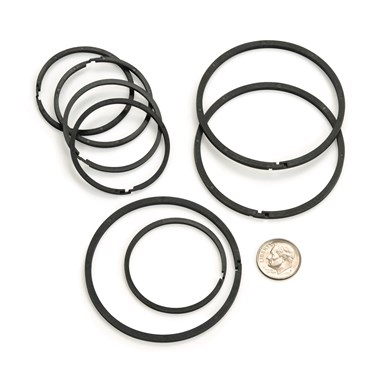
HPP seal ring with a one-jiao coin for scale reference. All images courtesy of Trelleborg.
The application and advancement of HPP often stem from its extreme physical properties that surpass those of conventional polymers. In the industry, such materials are typically defined from two dimensions:
Naturally strong and tough specialty polymers.This class of matrix resins possesses inherently superior molecular structures and can maintain excellent dimensional stability and intrinsic physical properties even under extreme mechanical, thermal, or chemical conditions.
Modified empowering composites:By incorporating specific modifiers, their performance can be elevated to levels unattainable by conventional materials. For example, adding carbon fiber to polyphthalamide (PPA) can deliver exceptional structural rigidity, while introducing molybdenum disulfide (Moly) into polyamide (PA) can significantly enhance its surface wear resistance and durability.
To achieve an ultra-low coefficient of friction and enhanced wear resistance in practical tribological applications, modification engineers often customize materials using oriented fibers or impregnated fillers.
For example, PTFE is compounded into polyether ether ketone (PEEK) to reduce friction, or molybdenum disulfide is added to nylon to obtain a more robust wear-resistant surface.
Craftsmanship Soul:Precisely balancing the amount of base resin and specific fillers to achieve dual optimization of performance and processability is the very essence of modified plastics processing.
For a long time, the industry has always been wary of plastics replacing metals.Insufficient strength, not heat-resistantHowever, modern HPP is breaking this metal myth with hard-core system-level benefits.
1. The "Energy Efficiency Ledger" Brought by Extreme Lightweighting
The most intuitive advantage of HPP lies in making industrial application components lighter and more durable. Take a seemingly simple industrial washer as an example: replacing it with a lightweight polymer material not only allows it to perfectly fulfill its original structural support role, but also significantly reduces wear on mating hardware.
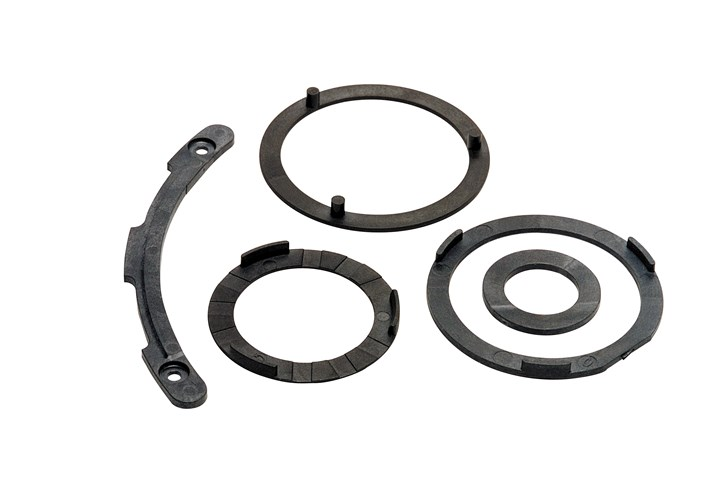
Industrial washer
From the perspective of systems engineering, the reduction in component weight means that the mechanical energy required to drive the application is significantly reduced, leading to a surge in overall system efficiency. At the same time, it completely eliminates electrochemical corrosion of metal parts, and its inherent insulation and noise reduction properties are innate advantages that traditional metals cannot match.
2. Crossing the hellish battlefield of high temperature and high PV
In terms of thermal performance, for example,PEEK (polyether ether ketone), PPS (polyphenylene sulfide), and PAI (polyamide-imide)Special materials such as these are fully capable of performing with ease in harsh high-temperature environments traditionally dominated by metals, making them an ideal substitute for metal.
In high pressure-velocity (PV) limit tribological applications, HPP demonstrates excellent durability through a comprehensive balance of operating temperature, chemical media exposure, cooling, and thermal management.
By introducing special fillers, the friction characteristics can be specifically optimized under different lubrication or dry friction conditions.
3. Embracing the wave of PFAS bans in line with green and environmental protection trends
More importantly, against the backdrop of increasingly stringent global regulations on PFAS (per- and polyfluoroalkyl substances),HPP is becoming a leader in eco-friendly, PFAS-free alternatives.Currently, cutting-edge modification companies are actively responding to market pressures for green transformation, working hard to develop and test customized formulations, including "PFAS-free wear-resistant additives."
High-performance plastics rely on precision manufacturing processes such as injection molding, compression molding, or extrusion for their development and implementation. These processes provide HPP with extremely precise control over dimensions and shapes.
Precision-molded plastic parts not only eliminate the complexity and cost of subsequent grinding processes, but also, thanks to their superior flexibility and adaptability compared with metal parts, can absorb and cushion certain tolerance deviations in mating hardware, thereby reducing the overall system tolerance stack-up and making the overall application more stable and reliable.
Currently, these modified plastic components have demonstrated irreplaceable value in multiple heavy-duty fields.
Plastic guide ring:In hydraulic cylinders, plastic guide rings in the piston and piston rod are designed to absorb lateral loads and completely eliminate direct metal-to-metal contact.
It offers a low coefficient of friction, long service life, and high load-bearing capacity, and can be customized with angle cuts, straight cuts, or step cuts according to the type of motion.
Plastic bearings and bushings:Widely used in non-hydraulic systems, it also helps to eliminate metal contact wear, reduce friction, and significantly extend the overall system life.
Back-up RingsInstalled in the seal groove, it provides solid rigid support for the elastomeric seal and prevents it from being extruded into the sealing gap under high pressure. It is also a standard component in heavy-duty hydraulic cylinders such as those used in excavators and agricultural machinery.
To wear the crown, one must bear its weight. The more impressive HPP’s performance is, the more demanding the processing and formulation development becomes. To master it, you must overcome three major challenges:
“Hidden Wear” of Tooling Components:Due to the high proportion of rigid modified fillers in HPP formulations, the wear on components such as the screw and barrel is extremely severe. Processing companies often need to custom-design specialized screw and barrel systems to extend equipment life and ensure process stability. Additionally, constrained by the unique molecular chemical structure of HPP, the flowability of the material in multi-cavity molds presents significant challenges.
Thermal management control across 425°C:The processing melt temperature of conventional standard polymers is generally between 200–275°C (392–527°F), while the processing temperature of HPP is often as high as 425°C (797°F).
In order to precisely control the temperature of all components of the mold and prevent high-precision flat parts from warping and volumetric shrinkage due to uneven cooling, it is essential to employ an advanced programmable thermal management system (such as high-pressure softened water operating at 227°C/440°F) to stabilize the crystallinity of the material and optimize the cycle time.
Extremely stringent formulation compatibility: The HPP matrix is extremely selective, and the range of additives and fillers that are both highly heat-stable and highly compatible is very limited. This puts the technical expertise of modification engineers to a severe test—they must work as closely with upstream suppliers as a married couple in order to develop the perfect customized formulation.
High-performance plastics transition from a modified resin in the laboratory to robust structural components in industrial settings, representing a systematic closed loop that spans formula development, mold design, CAE processing simulation, and design for manufacturability (DFM) optimization.
For an outstanding polymer engineering solutions partner, it is essential not only to possess the hard capabilities to master the full spectrum of specialty and engineering plastics such as PAEK, PEEK, PEKK, PEKEKK, PBI, PA, PEI, PPS, PPA, PPSU, POM, and PBT, but also to have in-depth customized formulation capabilities.
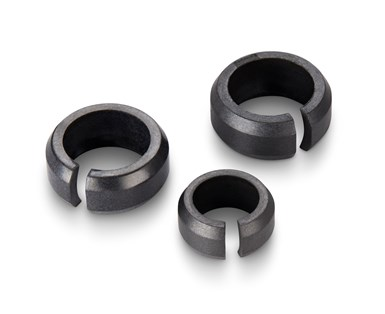
Injection molded PEKEKK material turbine components
In this“Use plastic in place of gold”In this era of opportunities, whoever can be the first to fully master HPP modification and processing technologies will, amid the wave of modern industrial upgrading, firmly seize an absolute technological high ground!【Copyright and Disclaimer】The above information is collected and organized by PlastMatch. The copyright belongs to the original author. This article is reprinted for the purpose of providing more information, and it does not imply that PlastMatch endorses the views expressed in the article or guarantees its accuracy. If there are any errors in the source attribution or if your legitimate rights have been infringed, please contact us, and we will promptly correct or remove the content. If other media, websites, or individuals use the aforementioned content, they must clearly indicate the original source and origin of the work and assume legal responsibility on their own.
Most Popular
-

Layoffs, Divestments, Plant Closures While Pouring Billions: BASF Undergoes Major Transformation!
-
Ascend Adipic Acid Hit By Force Majeure, Market Expects Supply Resumption In Mid-September
-

Raw Material Supply Shortage! INEOS Phenol Declares Force Majeure on Phenol and Acetone Businesses
-
South Korea initiates anti-dumping investigation against Chinese PVC suspension resin! The target is Tianjin Bohua and Wanhua Chemical. How to break through?
-

Sixth national procurement set to be implemented: A “Reshuffling” Moment for the $10-Billion Medical Device Market


