



2025 Annual Domestic Tire Complaint Analysis Report
As a leading platform for collecting information on defective automotive products and receiving consumer complaints about automotive product quality and service in China, Chezhi.com received a total of 227,803 valid consumer complaints regarding automotive product quality and service issues in 2025 (including 326 complaints from third-party platforms and after-market tires). Among these, there were 3,365 real-name complaints about tire issues, an increase of 111.5% year-on-year. In terms of complaint ratio, tire issues accounted for 1.5% of the total annual complaints, an increase of 0.6 percentage points compared to 2024. A total of 25 tire brands were involved in tire complaints in 2025, a decrease of 2 compared to 2024. Among them, 23 tire companies responded to and handled consumer complaints, with a total of 3,279 complaints responded to, resulting in an overall complaint response rate of 97.4%, an increase of 0.5 percentage points compared to 2024.
For automobile products, quality assessment requires a multi-dimensional evaluation approach, among which tires are undoubtedly an indispensable component. As a parts supplier, the quality of tires—whether superior or inferior—not only affects the overall reliability of the automobile but also serves as an independent evaluation criterion.
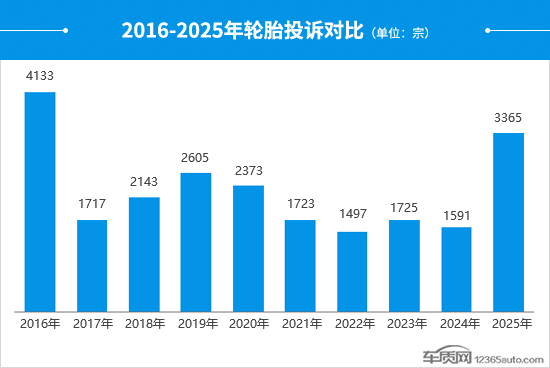
According to the Vehicle Quality Network data, the number of tire complaints in 2016 reached a peak in the past decade due to a group complaint incident. Subsequently, from 2017 to 2025, the number of tire complaints experienced two fluctuations, generally showing an oscillating trend of repeated rises and falls.
I. Complaints increased year-on-year in most months; complaints surged in December.
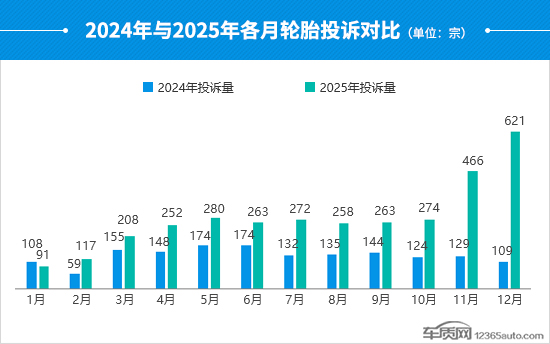
Regarding the specific monthly complaint situation, it can be seen from the comparison chart that, influenced by the significant increase in overall tire complaints in 2025, the number of tire complaints in most months has risen compared to 2024. Among these, the most notable increase is in December, with the number of complaints surging more than 4.6 times compared to the same period in 2024. It is worth noting that the complaint volume in the fourth quarter of 2025 accounted for over 40% of the total annual complaint volume, with an increase of approximately 2.7 times compared to the same period in 2024, becoming the core growth interval driving the annual increase in tire complaints.
Second, the complaint ratio of South Korean tire brands exceeds 50%, while Japanese brands see a decline in complaints.
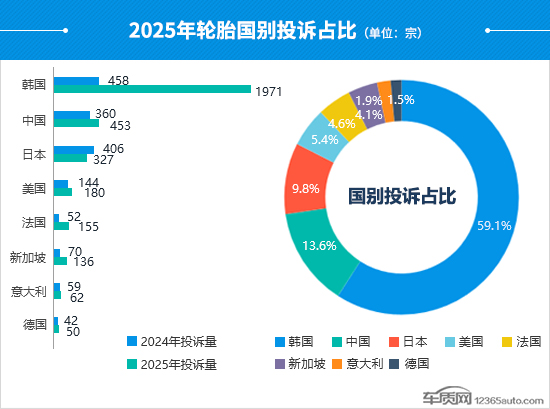
In terms of complaints by tire brand origin, complaints against brands from South Korea, China, and Japan continue to far exceed those against brands from other countries, with their combined share exceeding 80% of total complaints. Notably, only Japanese tire brands saw a year-over-year decline in complaints, while all other origins reported varying degrees of increases compared to 2024. South Korean tire brands stood out particularly, with complaints surging by 330.3% year-over-year, becoming the key driver behind the overall rise in complaint volume.
Compact car tires are the focus of complaints, while large SUVs see the highest increase in complaints.
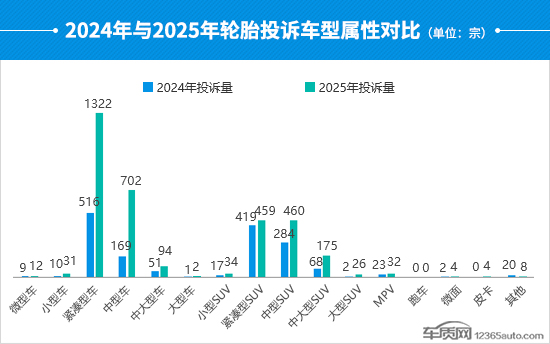
From the perspective of the passenger car tire market, the number of complaints for compact cars, mid-size cars, compact SUVs, and mid-size SUVs all exceeded 400, significantly higher than for other models. Among them, the number of complaints for compact cars exceeded 1,000, with the main issue being "tire cracking." Additionally, the number of complaints for large SUVs saw the highest year-on-year increase, surging 12 times compared to 2024, with the complaints coming from some domestically-branded new energy vehicle models.
IV. The proportion of tire issues occurring between 20,000 to 50,000 kilometers in advance is prominent.
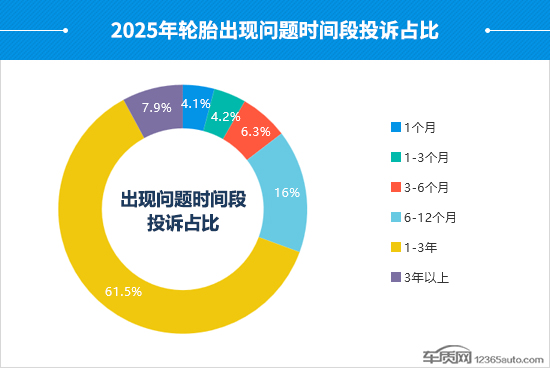
According to the car quality network complaint data, in the tire problem complaints accepted in 2025, the proportion of complaints about tire issues occurring 1-3 years after the purchase exceeded 60% of the total, an increase of 18.2 percentage points compared to 2024. In comparison, the proportion of all other time periods for tire complaints decreased compared to 2024, with the largest decrease being in the proportion of complaints about issues occurring more than 3 years after the purchase, which decreased by 7.7 percentage points year-on-year.
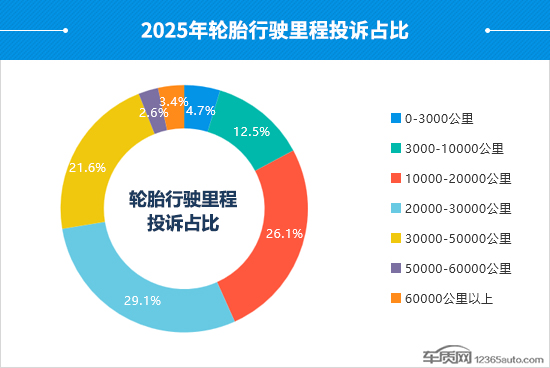
Considering the mileage of vehicles, in 2025, more than 50% of tire issues occurred between 20,000 and 50,000 kilometers, an increase of 10.7 percentage points compared to 2024. Among these, the proportion of complaints for the 20,000 to 30,000 kilometer range saw a significant increase, rising by 8.9 percentage points compared to 2024. In contrast, the proportion of complaints for the 3,000 to 10,000 kilometer range decreased notably, falling by 4.6 percentage points year-over-year.
V. Shandong Province Leads in Complaints; “Tire Cracking” Emerges as the Core Pain Point
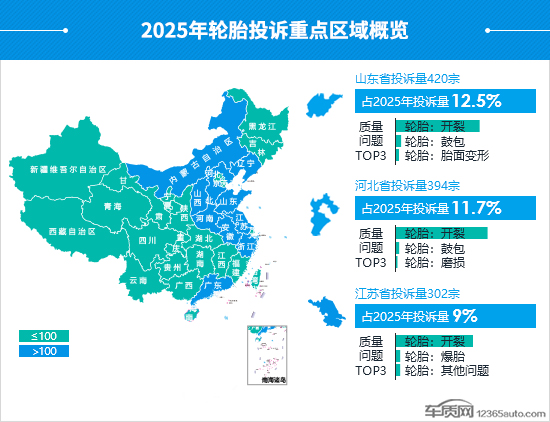
From a regional perspective, in 2025, all 31 provinces (autonomous regions, municipalities) across the country experienced tire problem complaints, with the number of provinces having over 100 complaints reaching 10, an increase of 5 compared to 2024. Shandong Province, Hebei Province, and Jiangsu Province are leading in terms of the number of tire problem complaints. Among them, Shandong Province ranks first with 420 cases, and its complaint ratio has increased by 0.9 percentage points compared to 2024; Hebei Province ranks second for the second consecutive year, with the number of complaints increasing by more than 1.7 times compared to 2024; Jiangsu Province has replaced Guangdong Province to take the third place, and its complaint ratio has increased by 2.1 percentage points compared to 2024. In terms of the quality issues reflected in these provinces, the majority of the fault problems are concentrated in "tire cracking" and "tire bulging." Among them, the former remains the most concentrated core pain point of complaints.
6. Complaints about "tire cracking" continue to rise; "tire wear" enters the top 5 for the first time.
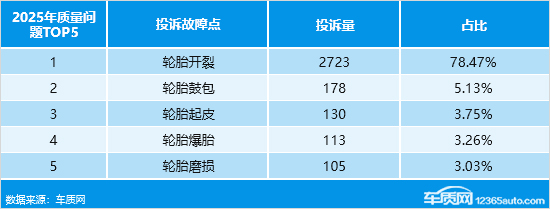
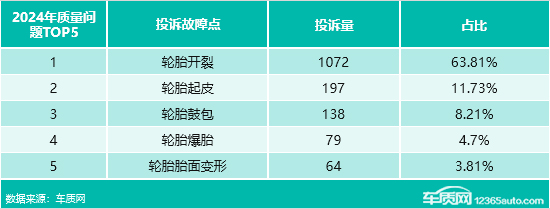
According to data from the Vehicle Quality Network, in the 2025 complaints about tire quality, "tire cracking" remained the most concentrated fault issue, with both the number of complaints and the complaint ratio significantly increasing compared to 2024. At the same time, the number of complaints about "tire bulging," "tire blowout," and "tire wear" also increased to varying degrees compared to the previous year, with "tire wear" showing the highest increase of 81%. In contrast, the number of complaints about "tire peeling" decreased, with a decline of 34%.
In fact, issues such as tire cracking, bulging, and tread separation have become focal points of consumer complaints in recent years. Although these problems are related to factors like rubber aging, tire structural integrity, and usage conditions, automakers’ requirements for tire suppliers have become increasingly stringent in recent years due to heightened national focus on vehicle emissions—primarily demanding lower rolling resistance and reduced weight—which inevitably impacts tire durability to some extent. Additionally, constrained by production costs, the compatibility among different rubber compounds, as well as the appropriateness of formulations and processing techniques, have become critical factors affecting the stability of tire products.
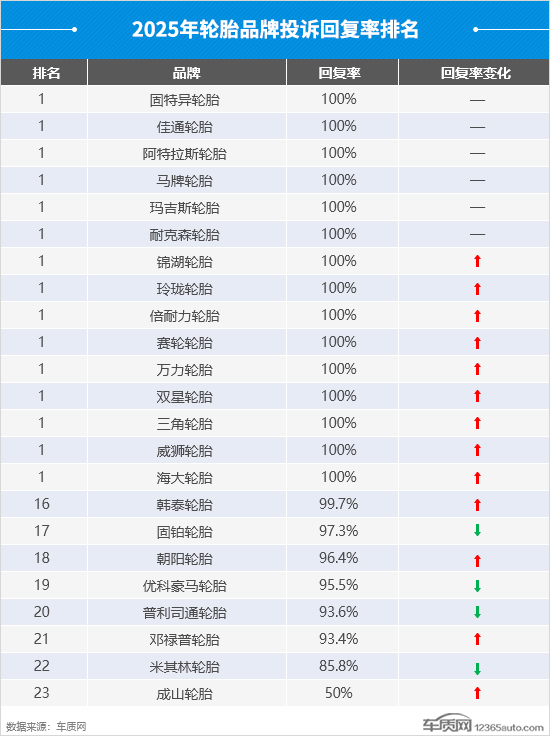
According to data from Che Zhi Wang (Chezhiwang), a high volume of complaints does not necessarily indicate that manufacturers are indifferent to product quality. In 2025, 15 tire brands achieved a 100% complaint response rate, nine of which were newly added brands. Notably, Sailun, Wanli, Doublestar, Triangle, Westlake, and Haida made particularly significant progress, achieving a dramatic leap from a 0% to a 100% complaint response rate. In contrast, the complaint response rates of Cooper, Yokohama, Bridgestone, and Michelin all declined compared to 2024.
Summary:
In recent years, the tire industry has significantly increased its emphasis on product quality. Tire companies have promoted product reliability through multi-dimensional measures such as technological innovation, process optimization, and upgrading quality management systems. From the time of complaints and the mileage at which complaints occur, although some original equipment (OE) tire products still have reliability issues, the time and mileage when problems occur have clearly shifted later. Additionally, regarding the handling of complaints by manufacturers, the complaint response rate of most tire companies has improved compared to 2024, and their attitude toward addressing issues has become more proactive. In the future, with the advancement of tire material technology and the continuous improvement of regulatory systems, the quality level of tire products is expected to reach a new level. Chezhi.com will continue to closely monitor tire product quality and service, comprehensively safeguarding consumers' driving safety through multi-dimensional analysis.
【Copyright and Disclaimer】The above information is collected and organized by PlastMatch. The copyright belongs to the original author. This article is reprinted for the purpose of providing more information, and it does not imply that PlastMatch endorses the views expressed in the article or guarantees its accuracy. If there are any errors in the source attribution or if your legitimate rights have been infringed, please contact us, and we will promptly correct or remove the content. If other media, websites, or individuals use the aforementioned content, they must clearly indicate the original source and origin of the work and assume legal responsibility on their own.
Most Popular
-

Middle East Tension Spikes Global Energy Pattern, Crude Oil and Plastic Industries Face Multiple Challenges
-
Middle East Tensions Escalate Sharply: How Polyolefins Respond Amid Soaring Risk Premium
-

Middle East Polymer Export Hub Hit in Sudden Attack, Global Supply Chain Sounds Alarm
-
[Forward-Looking Analysis] Impact of Escalating U.S.-Iran Tensions on Domestic Chemical Market
-

Futures Surge Violently, Polyolefin Spot Prices Rise Sharply in Tandem


