U.s. and israel bomb tehran, world enters “hormuz moment,” investors hit hard
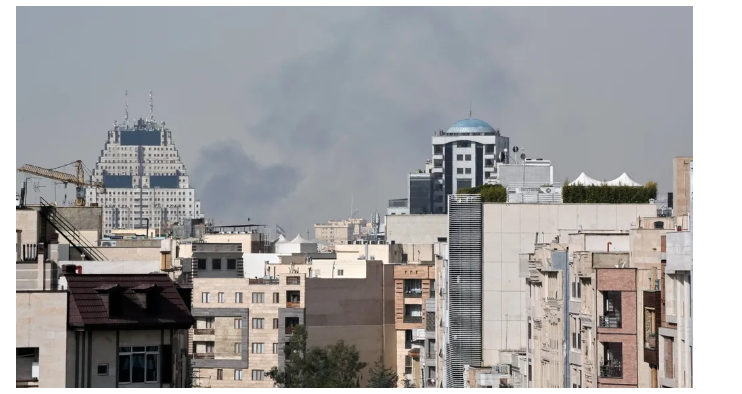
Image source: Visual China
The US and Iran are facing off, and a war that was once considered unlikely has already begun. US stocks fell sharply overnight, while international gold and oil prices rose sharply.
On February 28 local time, an explosion occurred in the center of Tehran, the capital of Iran. Israel announced the attack on Iran and declared a state of emergency nationwide.
At the beginning of this week, the US military massed in the Middle East, and it was reported that a military strike against Iran might have taken place as early as this weekend. When asked whether he would use military force against Iran, Trump said, "I don't want to do it, but sometimes you have to."
The most critical issue is undoubtedly the escalating tensions in Iran, which threaten global energy security and could disrupt shipping through the Strait of Hormuz—the world's most vital energy trade corridor. Approximately one-fifth of the world’s oil and liquefied natural gas, valued at over $1.3 billion per day, passes through this strait, including Iran’s exports.
How big could the potential spillover effects of the US-Iran conflict be? What impact would it have on major asset classes?
I. Focus on the Probability and Impact of a Strait Blockade
Despite heightened tensions between the U.S. and Iran, major institutions currently believe, according to Tencent News “Panwang,” that the likelihood of a full blockade of the Strait of Hormuz remains relatively low, as such a move would be “damaging to both sides, but especially self-destructive for Iran.”
The reason is that Iran's vast majority of oil exports still rely on the Strait of Hormuz. Although Iran has promoted the construction of the Goreh-Jask pipeline in an attempt to bypass this route, the pipeline's actual capacity is about 300,000 barrels per day, and its operation is unstable. In other words,If the Strait is indeed blockaded, Iran would first cut off its own economic lifeline.Against the backdrop of already heavy fiscal pressure, this practice is tantamount to self-harm.
Secondly, the direct impact of blocking the strait on the United States has significantly weakened, with over 80% to 85% of the crude oil and condensate transported through the strait ultimately flowing to the Asian market. In 2024 to 2025, the United States imports only about 500,000 to 700,000 barrels per day of crude oil from Persian Gulf countries via the Strait of Hormuz, which accounts for about 7% of U.S. crude oil imports and only about 2% of overall oil consumption. In other words,If Iran takes extreme actions, its potential partners or trading counterparts could be more significantly affected.
Yet, precisely for this reason, policymakers in Washington are increasingly inclined to view the Strait of Hormuz as no longer a decisive strategic lever. Under this assessment, Washington can leverage the Iran issue to achieve multiple objectives: on one hand, imposing higher tariffs or punitive measures on relevant countries under the pretext of the Iran issue; on the other, maintaining a risk premium in energy markets without directly escalating conflict, thereby supporting the U.S. energy industry; and simultaneously, continuously sending deterrence signals to adversaries through diplomatic and rhetorical pressure alone.
II. Extreme risks cannot be ruled out.
But the market has not become complacent, as the continued decline in the US stock market on February 27 is evidence.
Tencent News' "Deep Dive" also learned from the renowned research institution Oxford Economics that the difference in the current situation is that the risk of external escalation is intertwined with domestic unrest in Iran. This increases the likelihood that the Iranian regime may feel its survival is threatened, and thus Iran may be more willing to take costly actions, including severely disrupting traffic in the Strait of Hormuz, even if this would harm its own exports and relations with neighboring countries and major trading partners.
For now, a severe trade disruption is considered unlikely to persist, as it would require Iran to maintain an unprecedented maritime blockade, which could trigger swift military, economic, and diplomatic countermeasures from major powers—something Iran may not wish to risk. Therefore, the market impact is expected to be short-lived, with trade and prices quickly rebounding.
Bridget Payne, Head of Energy Forecasting at Oxford Economics, stated that targeted attacks and disruptions—rather than a complete shutdown—are more likely in the Strait, leading to reduced, rather than halted, energy flows. Reduced alternative supplies, pipelines, and storage facilities are sufficient to buffer some of the disruptions.
Now, some minor disruptions have begun—aside from last week’s brief partial disruption, vessels linked to Israel and the United States are avoiding the Strait of Hormuz, and the market can still easily absorb these impacts.
III. Three Scenario Assumptions of Oil Price Shocks
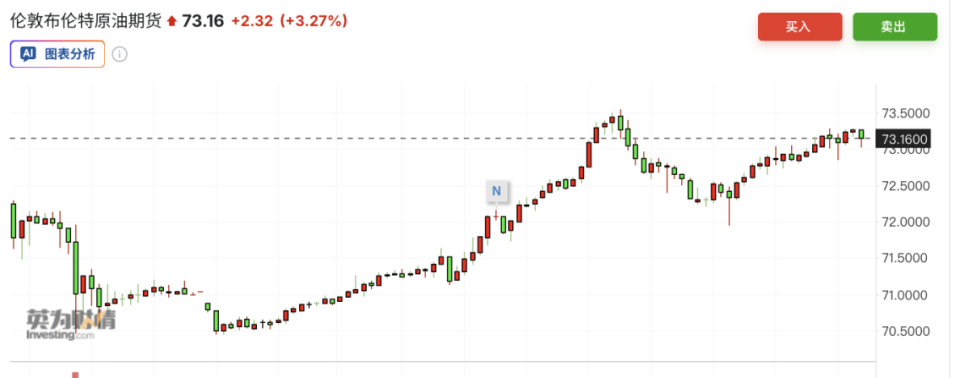
International oil prices have hit a one-year high, with Brent crude oil prices surging past the $70 per barrel mark, an unexpected development given the severe oversupply. Tencent News' "Qianwang" summarized the current scenarios predicted by various institutions, and the impact of these different assumptions on oil prices varies.
Scenario One: Basic Assumption
In this scenario, the strait remains open, and energy flows are not substantially disrupted. Markets will still be affected by news reports, military movements, and political statements, but there will be no sustained interruption to oil or liquefied natural gas shipments.
In this scenario, oil and gas prices would still carry a certain geopolitical premium, but there would be no supply shock.
Scenario Two: The strait continues to experience low-level interference.
In this scenario, the strait would still allow partial vessel passage, but repeated disruptions could cause shipping interruptions lasting several weeks, leading to reduced traffic volume and increased costs. This situation would likely involve U.S. strikes against Iran.
Iran's available measures include disrupting shipping, interfering with or deceiving navigation systems, harassing, and selectively creating incidents, all of which increase transit risks and uncertainties, raising costs and reducing traffic even if vessels continue to pass through.
This is easier and more feasible than Iran imposing a full maritime blockade, and also aligns with Iran’s motivations, enabling it to use the Strait as leverage to influence markets without immediately cutting off all trade flows.
In this scenario, the institution assumes that the strait's ship traffic will decrease by 50% within two months. Transport remains possible, but it will be slower, more expensive, with higher insurance and freight rates, and more delays. The net supply impact is about 4 million barrels per day, as some exports are redirected through pipelines, price-sensitive demand decreases, and the US increases its exports to full capacity.
At this time, crude oil prices are expected to rise to approximately $84 per barrel, primarily because Asia will compensate for import losses by sourcing from other suppliers, thereby driving up global oil and gas prices.
Tail Risk Uplift - Severe Disruption
In this case, assuming the severity of the interruption but a short duration, Iran would actually block the strait for a week, causing a sharp surge in global prices.
However, completely blocking the strait is extremely difficult, and maintaining a blockade is even more challenging, as the international community would quickly take action to reopen the waterway, increasing the difficulty for Iran to implement a maritime blockade.
Although unlikely, if the Iranian regime perceives its survival as being under threat, a complete closure of the Strait would become a rational scenario, as it would damage Iran's own oil infrastructure and thereby reduce its incentive to keep the Strait open for its own trade.
According to the Oxford Economics Institute, the net impact of an actual strait closure on natural gas supply is about 11 million barrels per day, taking into account alternative pipelines, decreased demand, and full-capacity supply from the US. Without alternative routes, all of Qatar's LNG exports would be delayed, and Asia would temporarily lose its largest source of natural gas.
This could cause global oil and gas prices to surge immediately, with institutions forecasting oil prices will rapidly climb to $140 per barrel and liquefied natural gas (LNG) prices will exceed $40 per million British thermal units (MMBtu)—a fourfold increase—as buyers rush to secure alternative supplies, mirroring the shock witnessed immediately after the outbreak of the Russia-Ukraine war.
IV. Precious Metals May Emerge as Big Winners Again
The asset most likely to benefit is undoubtedly precious metals. Recently, gold has rebounded somewhat after a significant earlier pullback, yet it remains largely range-bound; an escalation in geopolitical risks could act as a catalyst.
This Friday, the international spot gold price has approached $5,300 per ounce, having previously neared $5,600 at the end of January before falling to the $4,400 range due to profit-taking, with the recent rally accelerating.
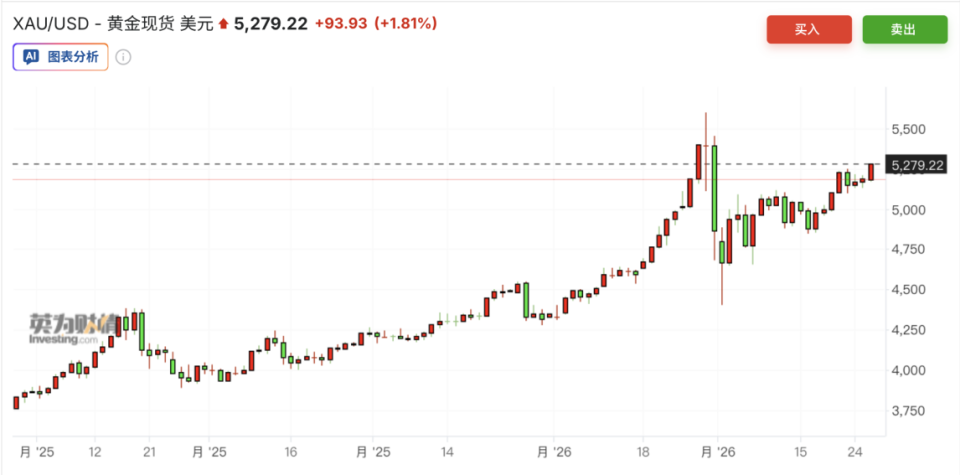
Tencent News' "Deep Dive" has also learned from foreign bank traders that there has been a noticeable increase in the trading volume of gold call options recently.
"I still tend to be bullish above 5,000, with the bulls having the opportunity to test 5,300 again. The key issue is whether the support zone between 5,114 and 5,144 can be held. If 5,300 is broken, attention will shift to the 5,400 psychological level and the previous swing high just below 5,500," said Matt Simpson, senior analyst at StoneX.
Earlier, he believed that unless U.S. military conflict escalates, gold's upward momentum would likely remain constrained in the short term—making it unlikely for gold prices to sustainably rise to $5,500. However, the market is now clearly trading in that direction.
Once the situation escalates, global stock markets may see further corrections. The U.S. stock market, caught between the AI narrative and financial risks, has been hit hard recently. However, Japanese and Korean stock markets continue to attract significant inflows of funds amid the booming memory chip sector. A trader from an American investment bank reported that traders seem to be not fully prepared yet. If the market is pricing in severe tail risks for Iran, it is difficult to reconcile this with the scenario where investors are chasing Japanese and Korean stock markets (both countries have very little domestic energy supply) and pushing them to new highs.
【Copyright and Disclaimer】The above information is collected and organized by PlastMatch. The copyright belongs to the original author. This article is reprinted for the purpose of providing more information, and it does not imply that PlastMatch endorses the views expressed in the article or guarantees its accuracy. If there are any errors in the source attribution or if your legitimate rights have been infringed, please contact us, and we will promptly correct or remove the content. If other media, websites, or individuals use the aforementioned content, they must clearly indicate the original source and origin of the work and assume legal responsibility on their own.
Most Popular
-

[Forward-Looking Analysis] Impact of Escalating U.S.-Iran Tensions on Domestic Chemical Market
-

Mercedes-Benz China Announces Key Leadership Change: Duan Jianjun Departs, Li Des Appointed President and CEO
-
BASF Raises Prices! Nova Chemicals Expands Recycled PE Lineup! South Korea, UAE Sign $35B Defense MOU
-
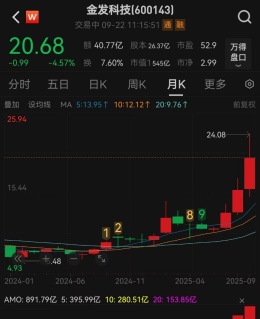
Behind a 41% Surge in 6 Days for Kingfa Sci & Tech: How the New Materials Leader Is Positioning in the Humanoid Robot Track
-
Vynova's UK Chlor-Alkali Business Enters Bankruptcy Administration!