Styrene: Weekly Gain Exceeds 20% Will It Rise Further
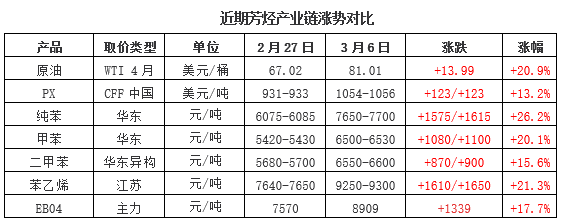
The ongoing escalation of conflicts between the US and Iran has led to disruptions in crude oil supplies and maritime transportation in multiple countries in the Middle East, causing international crude oil prices to rise continuously. As the largest naphtha supplier to Asia, all supplies from the Middle East have now been halted, with loading conditions still uncertain, leading to delayed deliveries and higher naphtha spot prices. The support from the cost side continues to strengthen, impacting the entire aromatics chain, with notable price increases; over the past week, the prices of multiple products have risen by more than 20%. Moving forward, will styrene prices continue to rise?
Cost-side favorable factors strengthen
Before the outbreak of the conflict, the focus of the pure benzene market was mainly on the high inventory at the port. However, the market driving factors have recently shifted to a strong macroeconomic positive momentum. Sinopec's price was raised five times consecutively from March 2 to March 6, a total increase of 1350 yuan/ton to 7500 yuan/ton, causing market sentiment to become extremely bullish and prices continuing to rise. Moreover, the futures price of pure benzene has also seen consecutive limit-up prices. If the geopolitical situation shows no signs of easing, pure benzene is expected to continue breaking through and rising strongly, providing strong support for styrene.
Potential supply reduction risk
Middle East geopolitical conflicts have led to shipping blockades, providing a buffer for potential short-term raw material shortages. Several production enterprises in South Korea, Singapore, and the Middle East have announced reduced operations or force majeure declarations. Moreover, several major domestic refineries have started early maintenance, issued force majeure notifications, and implemented measures such as potential production cuts at any time. For styrene, there is also potential risk of supply reduction in the future.
Continuous export demand combined with
In recent years, China's styrene has been in a state of complete oversupply, making its dependence on foreign imports virtually negligible. The Middle East conflicts have had almost no impact on the supply side of styrene imports into China, but they have provided an opportunity for China's potential export demand.
Styrene supply replenishment in Europe primarily comes from the Middle East and the United States. The U.S. has now officially entered its spring maintenance season, tightening spot supply and limiting its ability to supplement European demand in the near term. Meanwhile, the Middle East, as the world's largest styrene exporter, primarily ships to Europe, Northeast Asia, and India. Due to ongoing conflicts, some regional producers have already declared force majeure, canceling deliveries under March contracts. Additionally, planned maintenance turnarounds are scheduled for late March in the region. If Middle Eastern exports remain disrupted, European and Indian buyers may actively seek alternative supply from China to fill the gap.
In the near term, geopolitical conflicts remain the core driver of the styrene market. After recent consecutive rallies, market participants are bullish but hesitant to chase higher prices. However, arrivals of styrene at East China ports have slowed recently, and some major production units have either reduced operating rates or face potential rate cuts. Coupled with sporadic export deals, these factors point to an improving supply-demand balance, leading ports into a destocking cycle, which provides underlying support for market price levels. Overall, the styrene market’s trading range has shifted upward, and in the medium to short term, it remains prone to gains rather than declines, with a bias toward strong, elevated-range consolidation. Continued attention should be paid to developments in Middle East conflicts for potential resonant market drivers.
【Copyright and Disclaimer】The above information is collected and organized by PlastMatch. The copyright belongs to the original author. This article is reprinted for the purpose of providing more information, and it does not imply that PlastMatch endorses the views expressed in the article or guarantees its accuracy. If there are any errors in the source attribution or if your legitimate rights have been infringed, please contact us, and we will promptly correct or remove the content. If other media, websites, or individuals use the aforementioned content, they must clearly indicate the original source and origin of the work and assume legal responsibility on their own.
Most Popular
-
Middle East Tensions Escalate Sharply: How Polyolefins Respond Amid Soaring Risk Premium
-

Middle East Tension Spikes Global Energy Pattern, Crude Oil and Plastic Industries Face Multiple Challenges
-
Middle East Polymer Export Hub Hit in Sudden Attack, Global Supply Chain Sounds Alarm
-
Huntsman Introduces “War Surcharge” Amid Shipping Disruption and Soaring Energy Costs, Global MDI Prices Continue to Rise
-

Futures Surge Violently, Polyolefin Spot Prices Rise Sharply in Tandem