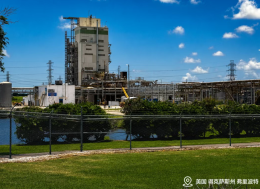
Source: Hanwha Corporation
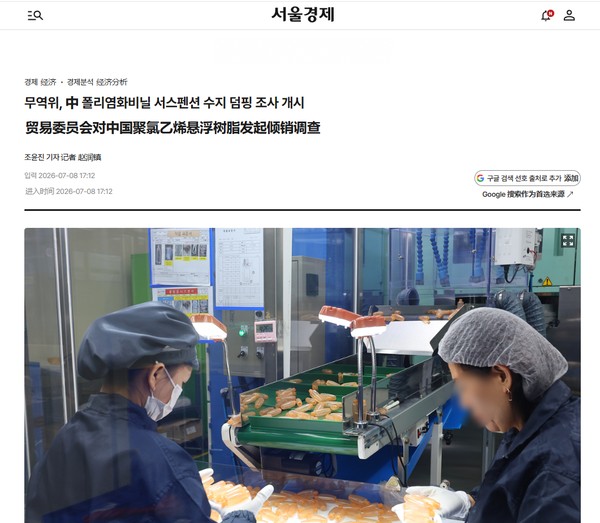
According to a report by a South Korean media on July 8, 2026, the Korea Trade Commission issued Announcement No. 2026-13, deciding to launch an investigation into the dumping facts and domestic industry damage caused by Chinese-produced polyvinyl chloride suspension resin. The applicant, Hanwha Corporation, submitted the application on April 28, 2026. The investigation target is the porous white granular polyvinyl chloride suspension resin produced by suspension polymerization of vinyl chloride monomer, with an average particle size of 100-180 μm (chemical formula (C₂H₃Cl)ₙ, customs tariff code HSK 3904.10.0000, and paste or micro-suspension polymerized resins are not within the scope of the investigation), and the investigation targets two Chinese chemical giants, Tianjin Bohe Chemical and Wanhua Chemical.
Standard Professional English Translation
This is not an isolated trade friction. Prior to South Korea’s move, India imposed anti-dumping duties ranging from USD 122 to USD 232 per metric ton on suspension PVC resins from Chinese mainland in August 2025, while Pakistan levied anti-dumping duties of 3.44% to 20.47% on Chinese PVC products. From South Asia to Northeast Asia, an anti-dumping net targeting China’s PVC exports is tightening.
A 115% Surge in Imports: Who Has Been Disrupted?
The core dispute underlying this investigation lies in a stark mismatch between two sets of figures.
Statistics from the Korea International Trade Association (KITA) show that South Korea’s imports of suspension PVC resins from China jumped from 14,345 metric tons in 2024 to 30,806 metric tons in 2025, representing a staggering 115% year-on-year increase. Over the same period, however, the import value only rose from USD 11.6 million to USD 26.8 million, far lagging the volume growth. Based on this discrepancy, the Korea Trade Commission concluded that Chinese goods may involve unfair low-price dumping.
Hanwha Solutions’ litigation logic is straightforward: China suffers from severe overcapacity in PVC production, and massive volumes of low-priced Chinese products are flooding the South Korean market and causing material injury to its domestic industry. As the founder of South Korea’s PVC sector—the firm that delivered South Korea’s first domestically manufactured PVC in 1966—Hanwha Solutions’ sensitivity and anxiety reflect deeper industry-wide concerns. When large-scale production capacity fleets operated by China’s chemical giants sail into regional neighboring markets, the competitive moats of regional industrial leaders are rapidly eroding.
Wanhua Chemical and Tianjin Bohua: Two Chinese Enterprises Caught in the Crosshairs
The two firms singled out for investigation by the Korea Trade Commission epitomize the two major forces driving the expansion of China’s PVC industry today.
Wanhua Chemical, China’s flagship chemical enterprise whose annual revenue exceeded CNY 200 billion for the first time in 2025, is undergoing a strategic transformation from a polyurethane leader to an integrated comprehensive chemical group. Its petrochemical division, covering bulk commodities including ethylene, propylene and PVC, surpassed the polyurethane segment to become its top revenue generator in the first three quarters of 2025. The 500,000-ton-per-annum PVC plant of Wanhua Fujian and the 960,000-ton PVC project of Wanrong New Materials have propelled Wanhua Chemical into a key player in the PVC market. At present, some of its production lines are undergoing annual maintenance, compounded by the impact of South Korea’s anti-dumping probe, drastically narrowing its overseas export channels.
Tianjin Bohua, the core subsidiary of Bohai Chemical Industry Group, is also ramping up its production capacity. Its new 400,000-ton-per-annum PVC facility came on stream in 2025, placing the firm at a critical stage of expanding its overseas footprint. Although South Korea’s market scale is modest—its annual import volume of over 30,000 tons accounts for a small share of China’s total annual PVC exports exceeding 2 million tons—the symbolic weight of this market far outweighs its actual volume. Should South Korea issue an affirmative ruling and impose anti-dumping duties, it will likely set a precedent, prompting other trade partners to follow suit.
Three Layers of Tariff Barriers: The Predicament Trapping China’s PVC Exports
Taking a broader view, South Korea’s current investigation is by no means an isolated incident.
In August 2025, India’s Ministry of Commerce and Industry issued a final affirmative anti-dumping ruling against suspension PVC resins originating from Chinese mainland, imposing anti-dumping duties of USD 122 to USD 232 per metric ton for a five-year term. India ranks among China’s largest PVC export destinations, and this ruling delivered an earthquake-level shock to China’s PVC export landscape. Industry analysts forecast that China’s PVC shipments to India will drop sharply, with suppliers from Japan, South Korea, the United States and other nations poised to fill the supply gap.
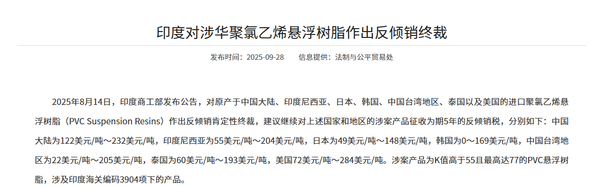
Screenshot Source: Official Website of the People’s Government of Beijing Municipality
Pakistan followed suit by imposing anti-dumping duties ranging from 3.44% to 20.47% on PVC products originating from the Chinese mainland. Coupled with South Korea’s launch of the current investigation, three major anti-dumping fronts — India, Pakistan and South Korea — have formed a connected blockade. China’s PVC exports are now facing an unprecedented containment situation.
The macro backdrop warrants even greater vigilance. 2025 marked a year of massive capacity expansion for China’s PVC sector, with roughly 2.2 million metric tons of new production capacity put into operation over the full year. The total newly added capacity stood between 2 million and 2.5 million metric tons, representing a year-on-year capacity growth rate of 7.35% — the largest volume of new capacity commissioned in the past five years.
A string of new ethylene-process and calcium carbide-process production lines came online in concentrated batches, including Tianjin Bohua’s 400,000-ton unit, Wanhua Fujian’s 500,000-ton unit, Xinpu Chemical’s 500,000-ton unit and Shaanxi Jintai’s 300,000-ton unit. Together with the ongoing capacity ramp-up of newly completed facilities commissioned in the same period, the industry’s full-year average …
For full details, please refer to the Zhuan Su Shi Jie mobile application.
【Copyright and Disclaimer】The above information is collected and organized by PlastMatch. The copyright belongs to the original author. This article is reprinted for the purpose of providing more information, and it does not imply that PlastMatch endorses the views expressed in the article or guarantees its accuracy. If there are any errors in the source attribution or if your legitimate rights have been infringed, please contact us, and we will promptly correct or remove the content. If other media, websites, or individuals use the aforementioned content, they must clearly indicate the original source and origin of the work and assume legal responsibility on their own.