



Shenzhou Twenty-Three Launches Into Orbit, "Tianhe" Welcomes First Hong Kong Astronaut
According to the China Manned Space Engineering Office, at 23:08 on May 24, 2026, the Long March-2F Yao-23 carrier rocket carrying the Shenzhou-23 crewed spacecraft was ignited and launched at the Jiuquan Satellite Launch Center. After about 10 minutes of flight, the spacecraft entered its planned orbit, and the launch was a complete success.
At 2:45 a.m. on the 25th, the Shenzhou-23 spacecraft successfully docked with the radial port of the Tianhe core module of the space station, with the entire docking process taking about 3.5 hours. After the successful rendezvous and docking, the Shenzhou-23 astronaut crew smoothly entered the orbital module from the return capsule of the spacecraft. At 5:13 a.m., the Shenzhou-21 astronaut crew, who were carrying out missions in orbit, opened the “door to their home” and welcomed the long-traveling Shenzhou-23 astronaut crew to the Chinese space station.
The Shenzhou-23 mission is the 7th manned flight mission in the application and development phase of the Chinese space station and the 40th flight mission of China's human spaceflight project. Additionally, it is the first time that an astronaut from Hong Kong, China has been stationed in the "Tiangong."
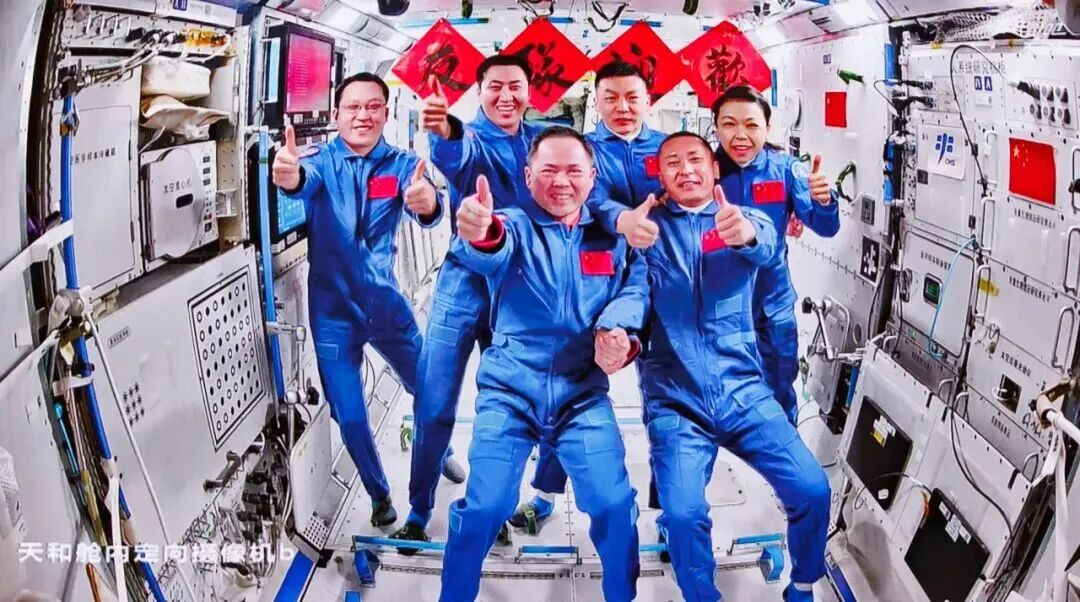
(Source: China Manned Space Engineering Office)
The Shenzhou 23 crew consists of Commander Zhu Yangzhu, spacecraft pilot Zhang Zhiyuan, and payload specialist Li Jiaying. Among the three astronauts, Zhu Yangzhu is the most experienced. A native of Peixian, Jiangsu Province, he was born in September 1986 and holds a doctoral degree. In September 2020, he was selected as part of the third group of astronauts as a spaceflight engineer. He previously carried out the Shenzhou 16 crewed mission in May 2023. This mission marks his second journey into space, and he is also the first Chinese astronaut to serve as commander in the capacity of a spaceflight engineer. Zhang Zhiyuan, a native of Baiyin, Gansu Province, was born in June 1986 and holds a bachelor’s degree. He was selected in September 2020 as part of the third group of astronauts, and this will be his first spaceflight mission.
One of the most talked-about highlights of this mission is the selection of Lai Ka-ying, the first astronaut from Hong Kong, China, to join the crew. In recognition of this, the mission insignia specifically incorporates the bauhinia flower, a symbol closely associated with Hong Kong. Born in November 1982 in Hong Kong, China, with ancestral roots in Shunde, Guangdong, Lai holds a Ph.D. in Computer Science from the University of Hong Kong. In June 2024, she was selected as a payload specialist in China’s fourth group of astronauts. Lai Ka-ying is also the fourth Chinese woman astronaut to travel to space, following Liu Yang, Wang Yaping, and Wang Haoze.
The Shenzhou-23 mission will undertake multiple scientific experiments and technology verification tasks with historic breakthrough significance. According to the plan, the Shenzhou-23 astronaut crew will carry out over 100 new scientific and application projects during their time in orbit, focusing mainly on in-depth research and verification of cutting-edge scientific and technological issues in the fields of space life sciences, space materials science, microgravity fluid physics, aerospace medicine, and new aerospace technologies.
In the field of space life sciences, zebrafish, mice, and stem cell–derived artificial embryos will be used to explore and establish a space embryo research system spanning from lower vertebrates to higher mammals. In the field of space materials science, new materials such as high-performance rare-earth permanent magnet alloys and lightweight high-entropy alloys will be prepared. In the field of aerospace medicine, the one-year flight opportunity will be fully leveraged to implement China’s first space human research program, obtain health data from astronauts during longer-duration flights, verify health support capabilities during long-term missions, and improve in-orbit medical care and protection systems.
According to the China Academy of Launch Vehicle Technology, the Long March-2F Yao-23 carrier rocket assigned to the Shenzhou-23 launch mission has, since the space station entered its application and development phase, completed six crewed launch missions and one emergency launch mission. This mission marks another crewed launch for the Long March-2F rocket following its execution of the first emergency launch mission in China’s manned space program in November 2025.
In early November 2025, the planned return of the Shenzhou-20 spacecraft was postponed due to suspected cracks in the return module’s window, believed to have been caused by impacts from small space debris. To ensure the safety and health of the astronauts, the return mission was delayed. Subsequently, on November 14, the three astronauts of Shenzhou-20—Chen Dong, Chen Zhongrui, and Wang Jie—“transferred” to the Shenzhou-21 spacecraft and successfully returned safely to Earth. For this launch, the Shenzhou-23 crewed spacecraft underwent adaptive improvements in its window’s space debris protection, enhancing the Shenzhou crewed spacecraft’s ability to withstand space debris.
At the press conference for the Shenzhou-23 manned flight mission held on May 23, Zhang Jingbo, spokesperson for China’s Manned Space Program and Director of the Comprehensive Planning Bureau of the Engineering Office, introduced that China has integrated its manned lunar landing and unmanned lunar exploration into the “Lunar Exploration Project.” In April this year, the Chang’e-7 probe was delivered to China’s Wenchang Space Launch Site and is currently undergoing pre-launch testing and preparation for the Chang’e-7 mission. Subsequently, China will proceed as planned to complete important missions such as the technical verification flight of the Long March 10 launch vehicle, the maiden flight of the Mengzhou manned spacecraft, and the first flight of the Lanyue lunar lander, with the goal of achieving the first Chinese astronaut landing on the Moon before 2030.
【Copyright and Disclaimer】The above information is collected and organized by PlastMatch. The copyright belongs to the original author. This article is reprinted for the purpose of providing more information, and it does not imply that PlastMatch endorses the views expressed in the article or guarantees its accuracy. If there are any errors in the source attribution or if your legitimate rights have been infringed, please contact us, and we will promptly correct or remove the content. If other media, websites, or individuals use the aforementioned content, they must clearly indicate the original source and origin of the work and assume legal responsibility on their own.
Most Popular
-
A Look at the Material Suppliers Behind SpaceX
-

Two Major Chemical Giants to Shut Down, Sell Again
-

BASF, Selling Again!
-

BASF Cuts Core Business As It Exits All Non-Core Operations, Triggering A New Round Of Industry Restructuring
-

Two Major Chemical Giants Fell Successively In May, And The Industry As A Whole Turned Cold


