



One-Time In-Depth Analysis! 25 Flame Retardants Fully Explained: Formulation, Performance, Applications
Flame retardants are the second largest plastic additive after plasticizers. They can be classified into two main categories based on chemical structure: organic flame retardants and inorganic flame retardants. According to the type of elements, they can be divided into halogen-based, phosphorus-based, nitrogen-based, silicon-based, and aluminum-magnesium-based flame retardants. Based on the method of use, they can be categorized as additive and reactive flame retardants. Nearly half of the plastic products worldwide contain flame retardants to ensure electrical safety and fire protection in people's daily lives.
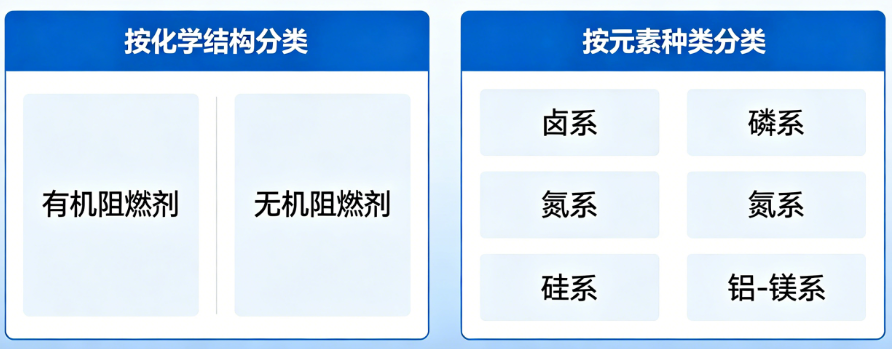
Selected Text25 Mainstream Flame Retardants Inorganic metal-based, bromine-based (halogen-containing), phosphorus-based, nitrogen-based, intumescent composite systems, silicon-based, and othersSix major categories analyzed one by one, covering performance parameters, formulation logic, and application scenarios to help you make the right selection.
I. Inorganic Metal-based Flame Retardants
1. Aluminum Hydroxide (ATH)
Aluminum hydroxide is one of the earliest used inorganic flame retardants, with abundant sources and low cost. It combines three functions in one: flame retardancy, smoke suppression, and filling.It is derived from bauxite, purified by the Bayer process, and then micronized.
Performance Parameters:
Decomposition temperature: dehydration begins at approximately 180–200℃.
Heat absorption: approximately 2 kJ/g, dehydration absorbs a large amount of combustion heat.
Appearance: white micropowder, non-toxic, odorless, non-volatile
Flame retardant rating: meets UL94 V-0 (at high filler content)
Formula and ApplicationThe addition level of aluminum hydroxide must exceed 50% to achieve a significant flame-retardant effect. After ultrafine treatment, the flame-retardant performance is markedly improved, and when the particle size is reduced to 1 μm, the oxygen index increases substantially.Suitable for polymers processed at relatively low temperatures (such as PP, PE, EVA, PVC, and unsaturated polyester), mainly used in wire and cable sheaths, building materials, sealing materials, etc.
2. Magnesium Hydroxide (MDH)
Magnesium hydroxide is the most representative environmentally friendly inorganic flame retardant. It has better high-temperature stability than aluminum hydroxide, does not produce harmful gases during combustion, and also offers smoke suppression performance.
Performance parameters:
Decomposition temperature: 340–490°C
Resolution: 1.37 kJ/g, higher than aluminum hydroxide’s 1.17 kJ/g
Features: can accelerate surface charring of plastics, but its heat absorption is slightly lower than that of ATH.
Appearance: white fine powder
Formulation and ApplicationSuitable for polymers with higher processing temperatures (PP, ABS, PPO, etc.); not suitable for thermoplastic polyesters (as it catalyzes degradation).The surface needs to be modified with a coupling agent to improve dispersibility. A typical formulation includes magnesium hydroxide and red phosphorus coating, which can produce a synergistic effect. It is widely used in high-temperature processing scenarios such as automotive interiors, cable sheathing, high-end home appliances, and rail transportation.
3. Composite Aluminum-Magnesium Flame Retardant
The combined use of aluminum hydroxide and magnesium hydroxide can leverage their strengths and avoid their weaknesses—ATH absorbs heat during dehydration at lower temperatures, while MDH functions effectively at higher temperatures, broadening the flame retardant temperature range.
Performance parameters:
Composite method: prepared by physical blending/compounding or chemical co-precipitation (e.g., Al(OH)₃·6Mg(OH)₂·4.5H₂O)
Surface treatment: Surface activation modification using silane or titanate coupling agents.
Features: Overcomes the shortcomings of single inorganic flame retardants, such as poor compatibility and high loading levels.
Formula and ApplicationsThe oxygen index can reach 29% when red phosphorus is coated and compounded with 80 parts of magnesium hydroxide.Ultrafine (nano-level) processing can reduce the amount of additives and improve mechanical properties. It is suitable for appliance housings, environmentally friendly cables, automotive parts, packaging materials, and more.
4. Antimony Trioxide (ATO)
Antimony trioxide itself has limited flame retardant effects, but as a key synergist for brominated flame retardants, it can create a synergistic effect with halogens, significantly enhancing flame retardant efficiency and reducing the amount of brominated additives needed. Micronization and nanoization can further reduce the required dosage.
Performance parameters:
Appearance: white powder, purity generally ≥99.5%
Mechanism of synergistic effect: Reacts with halogen-based flame retardants to form SbX₃ and SbOX, capturing free radicals and promoting char formation.
Addition amount: usually 1/4 to 1/3 of the brominated flame retardant amount.
Formulation and ApplicationsCommonly used in combination with brominated flame retardants in electronic and electrical products, engineering plastics, and cable flame-retardant systems. Antimony pentoxide has a smaller particle size and better dispersibility. Raw material prices fluctuate significantly, and costs have continued to rise in recent years.
2. Brominated Flame Retardants
5. Decabromodiphenyl ethane (DBDPE)
Decabromodiphenylethane is one of the most widely used brominated flame retardants and is considered a highly effective alternative to decabromodiphenyl ether. It does not produce toxic by-products such as dioxins/furans and has a safety assessment in global regulatory frameworks that is superior to that of previous generation products.
Performance Parameters:
Bromine content: 82%
Initial melting point: 345°C, with better thermal stability than DBDPO (305°C)
Weather resistance: better light resistance than DBDPO; flame-retardant plastics can be recycled and reused.
Appearance: White powder
Formulation and ApplicationSuitable for replacement in almost all applications where DBDPO is used.Adding 15–20% to HIPS can achieve a V-0 rating. It is mainly used in HIPS, ABS, PBT, PET, PA, polyolefin elastomers, wire and cable insulation materials, coatings, adhesives, etc. Representative grades: Saytex® 8010 (Albemarle), Fire Dog® DBDPE MP8.
6. Tetrabromobisphenol A (TBBPA)
Tetrabromobisphenol A is the most classic reactive brominated flame retardant. It can be used as an additive flame retardant, or it can be covalently incorporated into the backbone of polymers such as epoxy resins and polycarbonates through chemical reactions. In recent years, it has attracted regulatory attention under the EU REACH regulation.
Performance Parameters:
Bromine content: approximately 58–60%
Appearance: White or pale yellow powder
Characteristics: reactive substrate-compatible, low migration.
Environmental Update: Brominated Bisphenol A Derivatives are Undergoing PBT Assessment.
Formula and ApplicationMainly used in epoxy resin copper-clad laminates (PCB), ABS, PC/ABS alloys, polycarbonate, etc. Representative grade: Saytex® CP2000 (Albemarle)
7. Brominated Epoxy Resin
Brominated epoxy resin combines high molecular weight with bromine content; it has a relatively high molecular mass, good compatibility with polymers, and its usage has been increasing year by year. It is a reactive brominated flame retardant.
Performance Parameters:
Bromine content: up to 50%
Molecular weight: 1,000–45,000, available in EP and EC types.
The EP type has better light resistance and lower bromine content; the EC type flame-retardant ABS/HIPS has better impact strength.
Appearance: pale yellow translucent flakes or white powder
Formulation and ApplicationSuitable for ABS, HIPS, PBT, PET, PC/ABS, etc. When added at 15–25% in combination with an antimony synergist, it can achieve UL94 V-0. It is especially suitable for flame-retardant ABS and HIPS requiring high impact strength.
8. Brominated Polystyrene (BPS)
Brominated polystyrene is a polymeric additive flame retardant with excellent compatibility with flame-retarded styrenic polymers, exerting minimal impact on the physical and mechanical properties of the substrate.
Performance Parameters:
Bromine content: approximately 60–68%
Appearance: White to light yellow powder
Features: Polymeric type, migration-resistant, good thermal stability
Low-molecular-weight products offer better fluidity and compatibility.
Formulation and ApplicationsIn PA6/PA66, brominated polystyrene used in combination with antimony trioxide typically requires an addition level of about 18–25% to achieve a V-0 rating. It is mainly used in nylon, HIPS, PBT, PET, ABS, and other materials, and is particularly suitable for flame-retardant modification of glass fiber reinforced nylon.
9. Polybrominated Styrene (PBS)
Polymer of brominated styrene, which can improve compatibility with certain resins, enhance heat resistance and flowability, and prevent material foaming.
Performance Parameters:
Bromine content: 65–70%
Heat resistance: Excellent
Processability: Improves the melt flowability of the material.
Appearance: Powdered
Formula and ApplicationSuitable for flame-retardant plastics with high heat-resistance requirements, commonly used in high-flow flame-retardant engineering plastics (high-performance PA, PBT, etc.).
10. Tetrabromobisphenol A carbonate oligomer
Additive aromatic brominated flame retardants can maintain the original substrate's color, impact strength, fluidity, and thermal stability when used with thermoplastic polyesters such as PBT.
Performance parameters:
Bromine content: 52–58%
Appearance: oligomer powder
Characteristics: Minimal impact on the overall performance of thermoplastic polyester.
Formula and ApplicationMainly used for PBT, PET, PC/ABS, polysulfone, etc., and especially suitable for flame-retardant modification of reinforced and unreinforced PBT.
III. Phosphorus-Based Flame Retardants
11. Organophosphate esters (TPP, RDP, BDP, etc.)
Organophosphate esters combine flame retardancy and plasticization in a single additive and are widely used in the halogen-free flame-retardant modification of engineering plastics. Different types vary in phosphorus content and performance, and achieving a balance between flame-retardant effectiveness and mechanical properties is the key to selection.
Performance Parameter Comparison
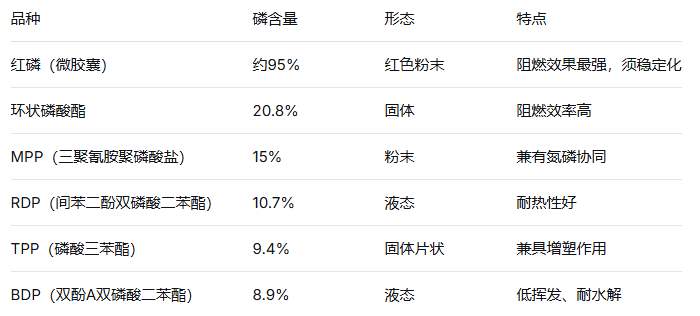
Formulation and ApplicationOrganophosphate esters are highly effective for oxygen-containing polymers (PC, PET, PBT, PPE, and polyurethane); for polypropylene, they must be used in combination with ATH, MDH, or similar additives to achieve flame retardancy.Mainly used in PC/ABS alloys, PPE/HIPS blends, PVC, PU foam, etc.
12. Red phosphorus flame retardant (microencapsulated red phosphorus)
Red phosphorus is the inorganic phosphorus-based flame retardant with the highest phosphorus content and extremely high flame retardant efficiency, widely used in engineering plastics such as nylon. Industrial products must undergo coating treatment to prevent reaction with moisture in the air, which can produce toxic phosphine.
Performance Parameters:
Phosphorus content: theoretical 95% or above
Appearance: Red powder (color can be controlled after microencapsulation)
Flame-retardant performance: better than phosphate ester flame retardants
Formula and ApplicationThe common formulation consists of 10 parts encapsulated red phosphorus and 80 parts magnesium hydroxide, achieving an oxygen index of up to 29%. Adding 7-10% microencapsulated red phosphorus along with synergists to glass fiber reinforced nylon can reach V-0 rating. It is mainly used for engineering plastics such as PA6, PA66, PC, PET, and PBT.
13. Ammonium Polyphosphate (APP)
Ammonium polyphosphate is an important component of inorganic phosphorus-based flame retardants. With high phosphorus content and low water solubility, it serves as the core acid source component in intumescent flame-retardant systems.
Performance parameters:
Phosphorus content: approximately 28–32%
Degree of polymerization: High degree of polymerization (n > 1000) varieties exhibit better performance.
Water solubility: low, good water resistance.
Appearance: white powder
Formula and ApplicationAPP, pentaerythritol (PER), and melamine (MA) constitute a classic IFR system (APP:PER:MA ≈ 3:1:1).Mainly used in polyolefins, polyurethane foam, fireproof coatings, flame-retardant paper, etc. Representative brand: JLS-APP (Hangzhou Jiels).
14. Dimethyl methylphosphonate (DMMP)
Colorless transparent liquid, a highly efficient phosphorus-based flame retardant with advantages such as low toxicity and low cost. With a phosphorus content of up to 25%, it is one of the most effective flame retardants.
Performance Parameters:
Phosphorus content: 25%
Appearance: Colorless transparent liquid
Volatility: relatively high, limiting its applications.
Formulation and ApplicationReact with hydroxyl-containing resins in thermosetting resins (polyurethane rigid foam, unsaturated polyester) to prevent a decrease in flame retardancy due to volatilization.
15. DOPO and its derivatives
DOPO (9,10-Dihydro-9-oxaphosphaphenanthrene-10-oxide) is a novel phosphorus-based flame retardant intermediate, and its derivatives have characteristics such as halogen-free, smoke-free, non-toxic, non-migratory, and durable flame retardancy.
Performance Parameters:
Phosphorus content: approximately 14–15%
Appearance: White crystalline powder
Thermal stability: Excellent, with good char formation at high temperatures.
Features: Can synergistically enhance the flame retardant effect with silicon elements.
Formulation and ApplicationDOPO derivatives are used as acid sources to replace APP, overcoming the disadvantage of traditional IFRs being prone to water absorption. Integrating DOPO with organic silicon elements into a macromolecule yields excellent flame retardant effects for alloys such as PC/ABS.Adding only 4% can enable epoxy resin to achieve a V-0 rating while improving mechanical properties. It is mainly used in epoxy resins, polyester, and PC/ABS.
16. HCA (DOPO-type reactive flame retardant)
HCA is a reactive phosphorus-based flame retardant from the DOPO series, containing phosphorus-carbon bonds, with better thermal stability and water resistance than ordinary phosphates. It can be used as either a reactive or additive type, primarily for polyester fibers and thermosetting resins.
Performance Parameters:
Phosphorus content: approximately 14%
Appearance: White crystalline powder
Thermal stability: high
Features: The phosphorus-carbon bond structure provides higher thermal stability and chemical stability.
Formula and ApplicationCopolymerized into the main chain of PET polyester fibers to achieve durable flame retardancy; additive type is used for polyurethane foams, epoxy resin adhesives, etc.
4. Nitrogen-based Flame Retardants
17. MCA (Melamine Cyanurate)
MCA, one of the most representative nitrogen-based environmentally friendly flame retardants, is formed by the hydrogen-bonded self-assembly of melamine and cyanuric acid. With the advantages of being halogen-free, low-toxicity, and low-smoke, it is a mainstream choice for the flame-retardant modification of nylon.
Performance Parameters:
Molecular formula: C₆H₉N₉O₃
Nitrogen content: approximately 49%
Appearance: White crystalline fine powder with a slippery feel, insoluble in water.
Thermal stability: thermal loss remains very low at 300°C.
Flame retardant rating: Enables nylon to achieve UL94 V-0.
Formulation and ApplicationsIn PA6/PA66, using MCA alone with the addition of 15-20% processing aid can achieve V-0 rating.The composite with boron nitride can simultaneously achieve flame retardant and thermal conductivity functions (thermal conductivity increased to 3.2 W/(m·K)). It is suitable for electronic connectors, 5G optical module shells, automotive charging pile enclosures, high-speed train seat frameworks, bellows, cable joints, and more.
V. Expansion-type Composite Flame Retardant System
18. Classical IFR Framework (APP + PER + MA)
Intumescent flame retardants (IFRs) are halogen-free flame retardant systems composed of three synergistic components: an acid source, a carbon source, and a gas source, with the typical formulation being APP + PER + MA. Upon heating, the acid source catalyzes the dehydration and carbonization of the carbon source, while the gas source decomposes to generate gases that cause the char layer to expand, forming an insulating and oxygen-blocking porous carbonaceous foam layer.
Formulation Plan:
Classic formulation (PP): APP 20–30% + PER 6–10% + MA 4–8% (total additive amount about 30–40%).
APP:PER:MA ≈ 3:1:1 (mass ratio) was found to provide the best overall performance.
The APP:PER ratio of 3:1 shows a significant effect in EPDM.
Performance Parameters:
Thermal stability: In conventional systems, PER has poor thermal stability and water resistance due to its low molecular weight.
Coke performance: Generates a uniform layer of carbon foam on the surface, providing thermal insulation, oxygen barrier, smoke suppression, and preventing dripping.
Formula and ApplicationApplicable to PP, PE, EPDM, ABS, fire retardant coatings, etc. Traditional IFR is limited by water resistance and thermal stability. In recent years, the comprehensive performance has been improved through modification with macromolecular char agents (such as TT4).
19. Phosphorus-Nitrogen Intumescent Flame Retardant System
Phosphorus-nitrogen intumescent flame retardants integrate P and N elements into the same molecule or system, serving as both an acid source and a gas source, with high char expansion efficiency and better flame-retardant performance than traditional IFRs.
Formulations and ApplicationsIn ABS, the incorporation of nanoclay in synergy with the compatibilizer SEBS-g-MAH can significantly improve mechanical properties. The phosphorus–nitrogen system acts in both the gas phase (free-radical trapping) and the condensed phase (char formation and barrier effect), resulting in higher flame-retardant efficiency.
20. DOPO-based intumescent flame retardants
A novel intumescent flame retardant synthesized using DOPO as the acid source overcomes the drawback of traditional IFRs being prone to moisture absorption, and exhibits good thermal stability and a high char yield. Synergistic enhancement can be achieved by incorporating organosilicon elements.
Performance Parameters:
A relatively high char yield can be obtained under high-temperature conditions at 800°C.
Excellent thermal stability
Hygroscopicity: significantly reduced
Formulation and ApplicationDOPO derivatives significantly enhance the flame-retardant properties of PC/ABS and other alloys, making them suitable for outdoor flame-retardant materials with high water-resistance requirements.
21. Macromolecular Char-Forming Agent System
To address the issues of low molecular weight, poor compatibility, inadequate thermal stability, and water resistance of traditional IFRs with pentaerythritol (PER), a macromolecular carbonizer based on THEIC has been developed, with a typical grade of TT4.
Performance Parameters:
Significantly improves water resistance and thermal stability when compounded with APP.
Reduce the decomposition and volatilization of carbon sources during high-temperature processing.
Formulation and ApplicationThe APP and TT4 combination can significantly broaden the applicability of flame-retardant materials in high-humidity environments, making it especially suitable for flame-retardant materials used in high-temperature processed plastics and under humid conditions.
VI. Silicon-Based and Other Flame Retardants
22. Polysiloxane Flame Retardant
Organosilicon flame retardants are halogen-free, environmentally friendly flame retardants centered on silicon. They act through a condensed-phase flame-retardant mechanism and migrate to the material surface during combustion to form a heat-resistant silicon-carbon layer.
Performance Parameters:
Typical grades: Dow Corning RM4-7081, RM4-7105, are 100% active silicone powders.
Appearance: White powder (silicone resin type)
Features: reduced heat release rate, decreased smoke and toxic gas emissions, improved impact strength, and enhanced processability
Formula and ApplicationSilicon-based flame retardants can enhance char density and flame retardancy in polycarbonate with only a small addition, without affecting transparency.POSS-based silicon flame retardant is specially designed for PC, featuring low dosage and high flame-retardant efficiency. Suitable for HIPS, PP, EVA, PC, PC/ABS, etc.
23. Silicon Powder-Modified Resin/Silicone Rubber Flame Retardant
Flame retardant based on a silicone rubber copolymer carrier, represented by GENIOPLAST® Pellet 345 (containing >90% siloxane), in the form of a soft elastomer with excellent compatibility with polymer materials.
Performance Parameters:
Siloxane content: >90%
Form: soft elastic granules
Compatibility: Excellent, with good compatibility with a variety of plastic and rubber substrates
Flame retardant rating: up to V-0 or V-1 level.
Formulation and ApplicationAdding 3–8 parts can significantly improve the flame-retardant rating, making it especially suitable for applications with stringent low-smoke and low-toxicity requirements, such as low-smoke halogen-free cables, automotive interiors, and rail transit vehicles. WACKER’s ELASTOSIL® series products are certified in accordance with the DIN EN 45545-2 railway safety standard.
24. Antimony-based flame retardants (antimony trioxide synergistic system)
Antimony-based flame retardants have limited flame-retardant effects on their own, but when used as synergists in combination with brominated flame retardants, they can capture free radicals in the gas phase and promote char formation, reducing the amount of bromine additives by more than 30%.
Performance Parameters:
Antimony trioxide (Sb₂O₃) is a white powder.
Main Bromine-Based Synergists
The addition amount can be reduced after nanonization and microencapsulation.
Alternative direction: Halogen-free and antimony-free flame retardants are gradually entering the market (such as the new solutions developed by enterprises in Heze).
Formula and ApplicationTypically compounded at a ratio of brominated flame retardant to antimony trioxide of (3–4):1, it is used in electronic and electrical housings, flame-retardant cables, engineering plastics, etc.
25. Novel Halogen-Free and Antimony-Free Flame Retardant
In 2025, domestically developed new halogen-free and antimony-free flame-retardant solutions by Chinese enterprises provide entirely new solutions for PVC cables, modified plastics, and other applications, achieving halogen-free, antimony-free, and cost-optimized performance.
Performance parameters:
Halogen-free, antimony-free, highly efficient flame retardant
The cost has an advantage over traditional systems.
Fully compliant with RoHS and REACH environmental requirements
Formulation and ApplicationIt has been applied in the R&D of PVC cables and modified plastics, and is particularly suitable for export products with strict restrictions on heavy metals and halogens.
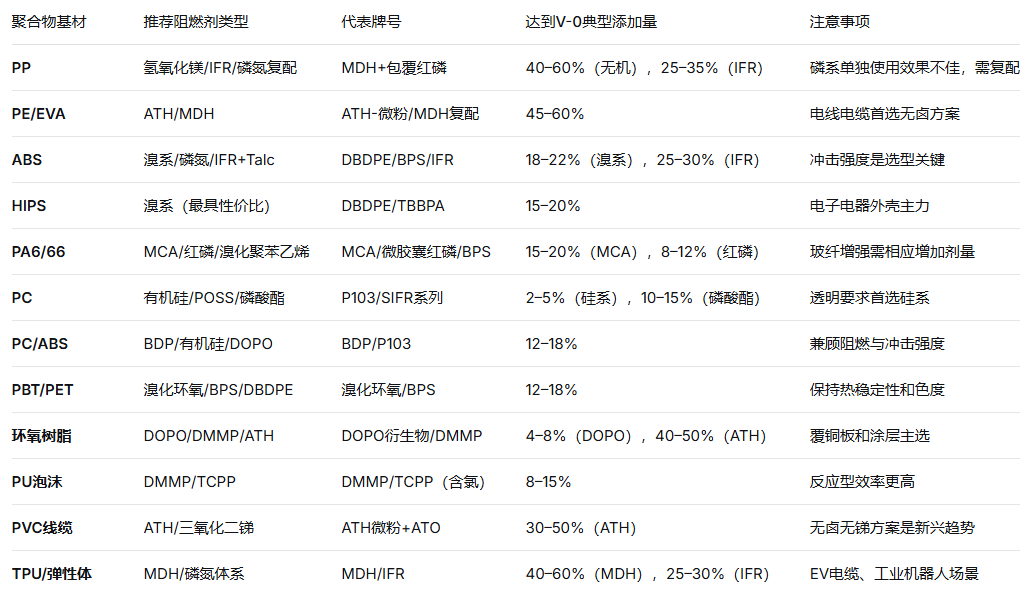
7. Quick Reference Table for Polymer–Flame Retardant Combinations
VIII. Reference for Typical Flame Retardant Formulations
1. Halogen-free flame retardant formulation for polypropylene (PP)
PP: 100 parts
Microencapsulated red phosphorus: 10 parts + magnesium hydroxide: 80 parts → Oxygen index 29%, overall performance is good -22
For V-0 rating, it is recommended to use an IFR system with APP:PER:MA = 3:1:1, at a total loading of 30–35 phr, supplemented with 3–5 phr of compatibilizer MAH-g-PP.
2. ABS Flame-Retardant Formulation (Thin-Wall V-0)
ABS: 100 parts
Phosphorus-nitrogen IFR: 28 parts
Nano clay (OMMT): 3 parts
SEBS-g-MAH compatibilizer: 5 parts → impact strength increased to 9 kJ/m², UL94 V-0 (1.6 mm)
3. PA6 Flame Retardant Formulation (Nitrogen-based Scheme)
PA6: 100 parts
MCA: 15–18 phr → UL94 V-0 (1.6 mm), with self-lubricating properties
If using the red phosphorus solution: microencapsulated red phosphorus 8–10 parts + synergist, V-0 (0.8 mm)
4. PC/ABS Flame-Retardant Formulation (Phosphorus-Silicon Synergy)
PC/ABS: 100 parts
BDP: 12 parts + silicone-based flame retardant POSS series: 2 parts → V-0 (1.5 mm), while maintaining good impact strength

9. Latest R&D Trends in Flame Retardants (2025–2026)
Biobased flame retardants
One-step synthesis of phytic acid ester derivatives from plant-derived phytic acid and phenethylamine for application in bioplastics such as PHA.The addition of 15% selenium-containing/Schiff base bio-based co-curing agent enables the epoxy resin to achieve an LOI of 31.8%, reaching V-0 grade.
2. Metal Coordination and Nano-Composite Flame Retardant Technology
The phosphorus-containing nickel complex enables PA6 to achieve an LOI of 31.5% and reduces the PHRR by 40.3%.Intercalation into layered double hydroxides (LDHs) can reduce the amount of flame retardant added by more than 40%.
3. In Situ Catalytic Charring Technology
Zhejiang University has developed a "self-catalytic interface" double-layer transparent epoxy coating, which generates boron phosphate crystals in situ during combustion, catalyzing the formation of a carbon layer. This strategy decouples carbonization from oxidation, enabling a more efficient flame-retardant effect.
4. Breakthrough Halogen-Free and Antimony-Free Solution
In 2025, Chinese companies developed a completely halogen-free and antimony-free flame retardant, which has been applied in fields such as PVC cables and modified plastics. It achieves halogen-free and antimony-free properties while maintaining flame retardant efficiency and optimizing costs.
5. Breakthrough in the Efficiency of Phosphorus-Nitrogen Synergistic Systems
The DOPO-BZA flame retardant can achieve a V-0 rating for epoxy resin with only 4% addition, while also increasing tensile strength by 43.6%.The new type of phosphonate (BDPIE class) integrates acid sources, carbon sources, and gas sources into the same molecule, with a melting point between 282–288°C and good thermal and hydrolytic stability.
Flame retardants are rapidly shifting from halogen-based systems, once dominant for their high efficiency and low cost, toward environmentally friendly halogen-free, synergistically efficient, and multifunctional solutions. By 2025, China’s halogen-free flame retardant market had exceeded RMB 32 billion, with a compound annual growth rate of over 12%. In core application sectors such as electronics and electrical appliances, automobiles, new energy, and rail transit, halogen-free technology routes represented by phosphorus-based, nitrogen-based, and intumescent flame retardants have become an irreversible mainstream trend.
【Copyright and Disclaimer】The above information is collected and organized by PlastMatch. The copyright belongs to the original author. This article is reprinted for the purpose of providing more information, and it does not imply that PlastMatch endorses the views expressed in the article or guarantees its accuracy. If there are any errors in the source attribution or if your legitimate rights have been infringed, please contact us, and we will promptly correct or remove the content. If other media, websites, or individuals use the aforementioned content, they must clearly indicate the original source and origin of the work and assume legal responsibility on their own.
Most Popular
-

A Look at the Material Suppliers Behind SpaceX
-
Two Major Chemical Giants to Shut Down, Sell Again
-

Global chemical industry shaken again! amsty and plastic energy announce bankruptcy, accelerating plastics sector shake-up
-

$80 Million Hammered Down! TMD Business Acquired By TNJ Ohio After Judicial Ruling
-
BASF, Selling Again!


