



Middle East Conflict Intensifies, Driving Surge in Polyolefins
Recently, the conflict in the Middle East has continued to escalate, spreading from localized confrontations to the vicinity of core petrochemical production areas. Coupled with the rising shipping risks in the Strait of Hormuz, the global polyolefin market has experienced intense volatility. Polyethylene (PE) and polypropylene (PP) futures and spot prices have both surged sharply. On March 9, both PE and PP futures hit the daily limit-up, closing at the upper price limit. On the same day, PP spot prices rose by at least 2,000 yuan/ton, while PE spot prices also jumped by 2,000 yuan/ton, with high-pressure grades even increasing by as much as 3,000 yuan/ton. Both commodities entered a deep backwardation market, with the market trend far exceeding market expectations. This sharp rise was not driven by a single factor, but rather by a triple mechanism of "cost support, supply contraction, and emotional amplification" triggered by the geopolitical conflict.
Polyolefin futures both hit the daily trading limit up, while spot prices surged far beyond futures prices.
Price Trend of PP Raffia Grade in Major Domestic Regions
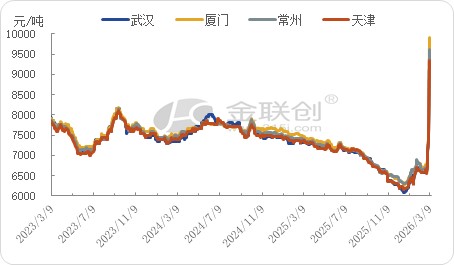
Data Source: JLC
February 28 fell on a Saturday, when the United States and Israel launched military strikes against Iran; Iran immediately retaliated, and both sides exchanged tough rhetoric, escalating the conflict further. Iran, departing markedly from its relatively weak posture in June of last year, struck U.S. military bases across the Middle East—including those in Qatar, Saudi Arabia, the United Arab Emirates, Oman, and Kuwait—destroying the U.S.-deployed missile defense systems in the region and targeting key Israeli cities and military installations. The de facto blockade of the Strait of Hormuz intensified geopolitical tensions far beyond our prior scenario-planning expectations, causing a sharp surge in geopolitical risk premium. From February 27 to March 9—a span of seven trading days—polyolefin futures and spot prices rose continuously. The PP2605 futures contract traded within a range of 6,554–8,034 RMB/ton, posting a gain of 1,376 RMB/ton, or 20.67%, with a range volatility of 1,480 RMB/ton, or 22.23%. The L2605 futures contract traded within a range of 6,553–7,944 RMB/ton, gaining 1,303 RMB/ton, or 19.62%, with a range volatility of 1,391 RMB/ton, or 220.95%.
Price trend of the main PP futures contract
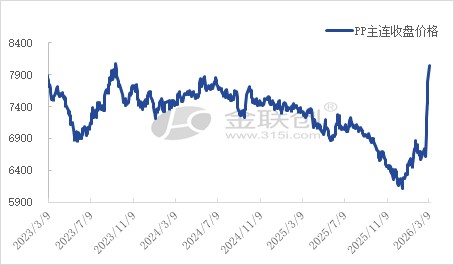
Data source: Golden Alliance
On March 9, PP2605 hit the daily trading limit at 8,034 RMB/ton. On the same day, spot prices of standard homopolymer polypropylene in East and North China surged by at least 2,000 RMB/ton, reaching 9,800 RMB/ton. Similarly, L2605 closed at its daily trading limit of 7,944 RMB/ton, while spot prices of standard linear polyethylene in East and North China also jumped by at least 2,000 RMB/ton, with most traders halting quotations and the few available offers reaching 9,700 RMB/ton. This shows that polyolefin spot prices were trading at a premium of at least 1,500 RMB/ton over futures prices.
Crude oil and raw material prices soar, rigidly lifting the cost end of polyolefins
The sharp surge in crude oil prices is the core starting point of cost transmission. As the world’s primary crude oil producing region, the Middle East has seen escalating conflicts, triggering market concerns over potential disruptions to crude oil supply. Consequently, international oil prices have surged significantly. As of 16:00 Beijing Time on March 9, 2026, during the Asian trading session, WTI April crude oil futures closed at a daily high of USD 119.48 per barrel, while Brent May crude oil futures rose 8.52% to USD 92.69 per barrel. The current geopolitical risk premium on crude oil has reached USD 35–45 per barrel, fully pricing in market expectations of strait blockades and supply disruptions. From February 27 to March 9, 2026 (Asian session, as of 16:00 Beijing Time), WTI April crude oil futures surged by USD 37.27 per barrel, or 57.03%, with volatility reaching USD 54.63 per barrel, or 83.60%; Brent May crude oil futures rose by USD 37.64 per barrel, or 53.18%, with volatility reaching USD 49.08 per barrel, or 69.34%. According to estimates, for every USD 10 per barrel increase in crude oil prices, ethylene production costs rise by USD 80–100 per ton, while polyolefin (PE/PP) production costs increase by approximately CNY 400 per ton. Based on the current oil price increase, polyolefin production costs have already risen by CNY 3,000–6,000 per ton, and cost pressures continue to be passed on to end-product prices.
Domestic and international supply contractions widen the polyolefin supply gap.
The Middle East is the global core supply hub for the polyolefin industry, accounting for over 15% of global PE capacity and approximately 9% of global PP capacity. Iran, Saudi Arabia, and other countries are key producers and exporters. However, the ongoing escalation of conflict has directly constrained polyolefin capacity utilization and disrupted export channels in the region, resulting in a tangible supply contraction—serving as the primary catalyst for the sharp price surge.
Aside from Iran, polyolefin production capacity in Gulf Cooperation Council (GCC) countries has also been significantly impacted. Core petrochemical production zones in countries such as Saudi Arabia and the UAE are predominantly located along the Persian Gulf coast, and retaliatory measures triggered by the conflict could jeopardize asset security in the region. Consequently, multiple petrochemical plants have been forced to reduce operating rates or temporarily halt operations to monitor the situation. Meanwhile, key polymer export hubs in the Middle East have experienced operational disruptions. Jebel Ali Port in the UAE, which handles approximately 65% of polymer exports from the Gulf region, has faced operational delays due to the conflict, while Duqm Port in Oman and Shuaiba Port in Kuwait have also suspended operations, further severing Middle Eastern polyolefin export channels. Collectively, Persian Gulf producers account for roughly 25% of global PE and PP exports, and the paralysis of these export hubs directly threatens nearly 10% of global polyolefin supply routes, amplifying the supply contraction effect.
In addition, the disruption of logistics caused by the conflict has exacerbated the supply shortage. The Strait of Hormuz, as a core passage for the export of polyolefins from the Middle East, is responsible for transporting 20%-30% of the world's maritime crude oil, 20% of LNG, and a large amount of chemical products. Currently, the strait faces the risk of closure, preventing Iran and the countries upstream of the strait from exporting any products, while the exports of other Persian Gulf countries are delayed due to shipping risks. Some companies have been forced to limit production due to storage issues, further widening the global polyolefin supply gap.
In summary, the recent sharp surge in polyolefin prices triggered by the escalating Middle East conflict results from the confluence of three key factors: rising costs, supply contraction, and sentiment-driven speculation. Specifically, disruptions to Middle Eastern polyolefin production capacity and export routes served as the primary catalyst, soaring crude oil and feedstock prices provided cost support, and market panic sentiment coupled with speculative capital inflows acted as significant accelerants.
Looking ahead, the price trend of polyolefins will mainly depend on the evolution of the Middle East conflict: if the conflict eases and the Strait of Hormuz reopens, crude oil and raw material prices are expected to decline, easing the supply pressure on polyolefins, and prices may gradually return to fundamentals; if the conflict escalates and the strait remains completely closed for a long time, oil prices could surge to $130 per barrel, reaching the peak seen in June 2025 when the U.S. jointly attacked Iran with Israel, and could even hit the historical high set during the 2008 financial crisis. The supply gap for polyolefins will further widen, and prices will remain high, possibly even experiencing further sharp increases. At the same time, attention should be paid to the recovery of downstream demand and the effect of cost transmission. If downstream demand shrinks due to high costs, it may limit the upward potential of polyolefin prices. For industry participants, it is necessary to closely monitor changes in the Middle East situation, and reasonably manage inventory and procurement schedules to avoid risks brought by price fluctuations.
【Copyright and Disclaimer】The above information is collected and organized by PlastMatch. The copyright belongs to the original author. This article is reprinted for the purpose of providing more information, and it does not imply that PlastMatch endorses the views expressed in the article or guarantees its accuracy. If there are any errors in the source attribution or if your legitimate rights have been infringed, please contact us, and we will promptly correct or remove the content. If other media, websites, or individuals use the aforementioned content, they must clearly indicate the original source and origin of the work and assume legal responsibility on their own.
Most Popular
-
Middle East Tensions Escalate Sharply: How Polyolefins Respond Amid Soaring Risk Premium
-
Middle East Polymer Export Hub Hit in Sudden Attack, Global Supply Chain Sounds Alarm
-
Huntsman Introduces “War Surcharge” Amid Shipping Disruption and Soaring Energy Costs, Global MDI Prices Continue to Rise
-

Overseas News Highlights: Major Reversal! Iranian Military Says It Has Not Blocked the Strait of Hormuz! BASF, Dow, Polyplastics Announce Price Hikes!
-

Futures Surge Violently, Polyolefin Spot Prices Rise Sharply in Tandem


