



Launch Successful! Zhuque-2 Fully Evolved!
At 11:00 a.m. on May 14, the improved Zhuque-2 Y5 carrier rocket lifted off from the Dongfeng Commercial Space Innovation Test Zone. The rocket flew normally throughout the entire flight, and its second stage entered the predetermined orbit, marking the complete success of the flight test mission. This mission was the second flight of the Zhuque-2 carrier rocket.
According to LandSpace, the developer of the Zhuque-2 Enhanced Variant Yao-5 launch vehicle, this successful launch marks a breakthrough in Zhuque-2’s capability to carry heavy payloads and means it now has the engineering conditions required to undertake one-rocket-multiple-satellites launch missions.
As a core application scenario of commercial aerospace, satellite internet has entered a period of accelerated large-scale deployment. What role will the fifth Yao mission of the improved Zhuque-2 launch vehicle play in this regard? How can commercial aerospace help address the bottleneck of “more satellites, fewer rockets”?
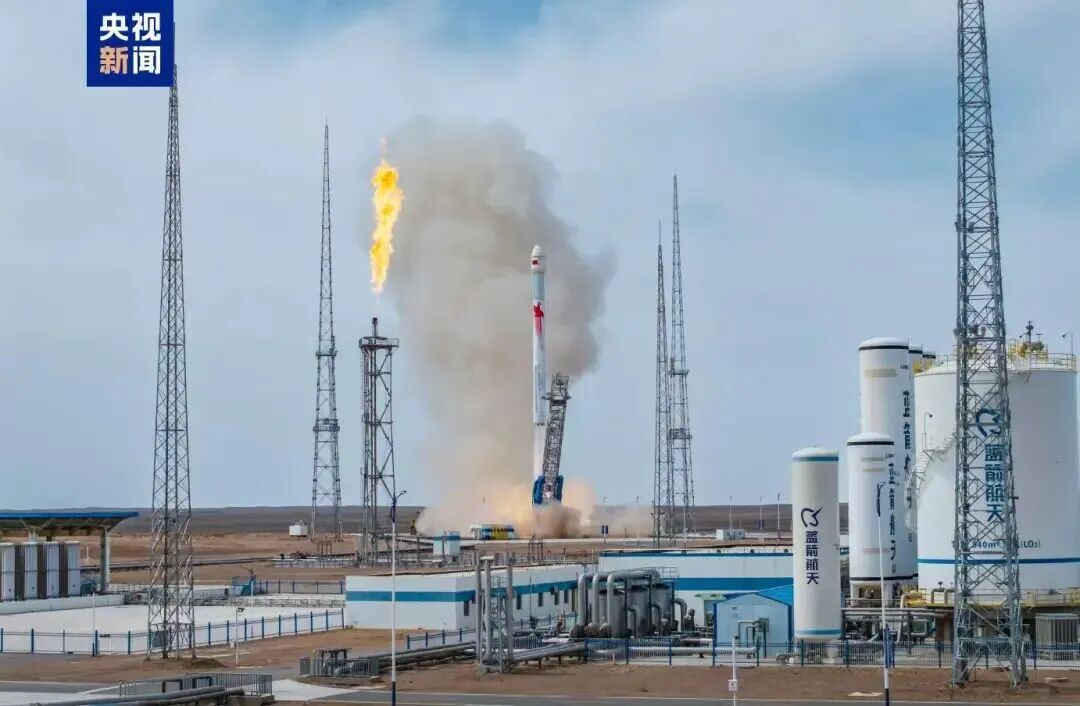
At 11:00 on the 14th, amid a deafening roar, the Zhuque-2 Improved Version Yao-5 launch vehicle successfully lifted off. Qiu Jingyu, chief designer and commander of the Zhuque-2 Improved Version, said that this rocket was developed on the basis of fully inheriting the mature technical solutions of previous rockets, through systematic iterative design, as a two-stage cryogenic extended liquid launch vehicle. The rocket has a diameter of 3.35 meters, a maximum fairing diameter of 4.2 meters, and an overall length of about 55.9 meters; its liftoff mass is 267 tons, and its liftoff thrust is 338 tons. Compared with the previous rockets, this rocket looks significantly different in appearance:
Qiu Jingyu: First, the rocket body has been lengthened, from the original 47.8 meters to the current 55.9 meters. This increase of more than 8 meters is mainly reflected in the first-stage propellant tank section. The larger tank capacity has improved the rocket’s carrying capability. While lengthening the rocket, we removed the tail fins from the first stage. Traditional rocket tail fins are mainly used to stabilize flight attitude, but they also create additional aerodynamic drag and structural weight. After removing the tail fins, we reduced the rocket’s structural weight to some extent while also lowering aerodynamic drag. We also eliminated part of the insulation layer on the first-stage tank and optimized the layout of pipelines and related structures. Through this series of lightweighting measures, we controlled the increase in structural weight.
In addition to these obvious changes in appearance, the first-stage engine thrust of the Zhuque-2 Improved Yao-5 launch vehicle has also been increased to a certain extent, and a thrust self-correction function has been added, further unlocking and optimizing the rocket’s payload capacity, while enhancing its launch service capability for the full mission spectrum of low Earth orbit and sun-synchronous orbit.
Qiu Jingyu: For this mission, the orbital altitude is 900 kilometers, and the orbital inclination is 89 degrees, with a simulated payload of 2.8 tons. The upgraded Zhuque-2 carrier rocket has a payload capacity of 4 tons to a 500-kilometer sun-synchronous orbit, and can flexibly adapt to diversified mission requirements such as small- and medium-sized satellite launches and large-scale satellite constellation deployment. It has particularly significant advantages for one-shot-multiple-satellite deployment in high-orbit constellation networking.
In domestic private space missions, the improved version of the Zhuque-2 rocket, the Yao-5 launch vehicle, pioneered the technical solution of the dual-stage three-time ignition with "box pressure ignition + high-orbit deorbit." This approach utilizes engine box pressure ignition and the deactivation force of the final stage to achieve rapid deorbiting from a high orbit, effectively addressing the traditional challenges of high-orbit deorbiting while ensuring ignition reliability. This responds to the national requirements for the deorbiting of rocket upper stages and the reduction of space debris, protecting valuable orbital resources. What exactly is box pressure ignition technology?
Qiu Jingyu: During the third ignition of the second-stage engine, the propellant is directly delivered to the combustion chamber for ignition by relying on the pressure in the storage tank, while the turbopump does not operate. This ignition method significantly reduces the technical requirements for engine start-up in a space environment and enhances reliability. By fully utilizing the residual propellant in the upper stage, the re-entry time for high-altitude upper stage debris can be shortened to within 5 years, with a perigee altitude reduction of over 500 kilometers. At the same time, the rocket upper stage employs guidance characteristic shutdown technology, greatly improving the orbital precision of debris after passive deorbiting and effectively protecting precious space orbital resources. This technology efficiently balances the rocket's payload capacity and deorbiting effectiveness, providing reliable technical support for the subsequent high-density high-orbit constellation networking.
The success of this mission marks that the improved Zhuque-2 has achieved the capability to launch heavy payloads and now possesses the engineering conditions to undertake one-rocket multi-satellite launch missions, providing mature and reliable launch capability support for building up the emerging pillar industry of aerospace, accelerating the development goals of the satellite internet, and carrying out subsequent large-scale constellation networking projects.
Qiu Jingyu: In the future, the company will continue to focus on tackling core technologies related to liquid oxygen-methane and optimizing product performance, advancing the commercialization of reusable, high-density, and low-cost launch vehicles, and contributing reliable support to the national satellite internet project and space infrastructure development.
【Copyright and Disclaimer】The above information is collected and organized by PlastMatch. The copyright belongs to the original author. This article is reprinted for the purpose of providing more information, and it does not imply that PlastMatch endorses the views expressed in the article or guarantees its accuracy. If there are any errors in the source attribution or if your legitimate rights have been infringed, please contact us, and we will promptly correct or remove the content. If other media, websites, or individuals use the aforementioned content, they must clearly indicate the original source and origin of the work and assume legal responsibility on their own.
Most Popular
-
A Look at the Material Suppliers Behind SpaceX
-
Daily Review: Cost and Supply Support Push Polyester Bottle Film Market Higher
-

【Overseas News】Trump visits china, us auto industry issues collective appeal; china-us economic and trade talks held in south korea; celanese announces price increase
-

Major industry layoffs: BASF, Evonik, Dow, Wacker, and Others Cut 12,550 Jobs
-

【Overseas News】BASF Launches TPU Product Portfolio! Middle East Conflict Sparks Sulfur Price Surge! First Batch of Chinese Electric Vehicles Lands in Canada


