



Hanwha Azdel Launches Recycled Polypropylene (PP) Composite for Automotive Headliners
Hanwha Azdel SuperLite S25 composite material incorporates recycled polypropylene components, offering lightweight performance and providing automakers with a recyclable alternative material for automotive headliners and interior parts.
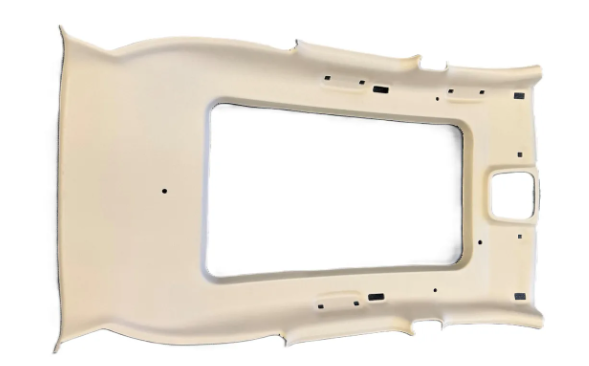
This thermoplastic material enables integrated manufacturing and offers high design flexibility, facilitating the establishment of a closed-loop recycling system for next-generation automotive headliner systems. (Image source: HANWHA AZDEL)
Traditional automotive headliners typically consist of a polyurethane foam core, combined with foam layers, fabrics, and locally assembled functional components. This substrate must be lightweight while maintaining rigidity, retain dimensional stability after thermal and humidity cycling, provide acoustic performance, and accommodate cutouts, edge structures, and assembly points. Additionally, the material requires sufficient flexibility to enable full-vehicle assembly through narrow door openings. Beyond these performance requirements, the industry now places greater emphasis on reducing the material’s carbon footprint and establishing viable recycling pathways.
Hanwha Azdel’s SuperLite S25 polypropylene (PP) composite was developed to meet the industry’s increasingly demanding requirements. As a Tier 2 automotive materials supplier, Hanwha Azdel has seen its products used in more than 60 million vehicle headliners worldwide over the past 18 years. Its commitment to sustainability extends beyond the material itself: Hanwha Azdel’s manufacturing facilities use renewable energy, and production scrap is recycled into EcoLite core materials for the recreational vehicle market, diverting more than 786,000 pounds of waste from landfills each year.
The SuperLite S25 product utilizes a lightweight reinforced thermoplastic (LWRT) substrate, which is based on polypropylene and long-cut glass fibers. By weight, it contains 25% post-consumer recycled (PCR) material while retaining the mechanical properties of the original SuperLite product platform. This polypropylene composite with added recycled components can be applied to various parts beyond just headliners. (Image source: Hanwha Azdel)
Iterative Upgrading of Recycled Materials
SuperLite S25 is not a completely new laboratory formula, but rather an enhancement of an already mature and mass-produced material system by incorporating recycled components. The established materials in this series have been used in automotive headliners, luggage rack trays, trunk trim panels, cargo floor systems, and door interior panels. Compared to traditional polyurethane substrates, the original SuperLite platform already offers advantages in thin-wall molding, design flexibility, thermoplastic welding, and process integration. The S25 retains all these functional benefits while introducing circular recycled raw materials.
The SuperLite S25 also supports a highly integrated manufacturing process. The panels can be heated, formed, and laminated with fabric in a single step to produce finished headliners. By feeding the panels and fabric simultaneously through heating, compression molding, and trimming, the need for a separate lamination stage is eliminated, thereby shortening the production workflow from semi-finished panels to finished headliners.
This thermoplastic structure also facilitates the integration of functional components. Other parts can be assembled using methods such as infrared welding, ultrasonic welding, hot plate welding, and vibration welding. Components like NVH noise reduction pads, head impact protection pieces, reinforcing ribs, and local brackets can all be integrated, eliminating the need to rely solely on hot-melt adhesive bonding.
Greater design freedom
The material’s excellent formability further expands design possibilities, enabling small radii and deep drawing depths exceeding 300 mm, while accommodating complex multi-curved structures such as sunroofs, roof consoles, and air vents. The thermoplastic hemming process achieves clean edge finishing for cutouts and outer edges without the need for hot-melt adhesives.
The thickness design is equally flexible. The SuperLite S25 headliner substrate thickness can be controlled within the range of 2.25–6 mm, adjusted according to component requirements. Compared to traditional thicker headliner solutions, it provides an additional 5–20 mm of headroom inside the vehicle.
Full-chain recycling solution
In addition to its various performance attributes, another major innovation of SuperLite S25 lies in the use of recycled components. The material contains 25% post-consumer recycled content by weight, while maintaining the performance levels of the original SuperLite. Product-level circularity is also achieved: cutouts from sunroof openings and trim waste from product edges can be sorted, crushed, and ground, then re-modified for use in injection-molded interior components such as brackets.
Based on product operating conditions and supply chain capabilities, this material can also be closed-loop recycled and reused in the production of SuperLite S25 products. The platform utilizes recycled materials as inputs, and its output parts are recyclable, allowing waste to flow back into the original industrial chain.
The concept of circularity continues to deepen. Hanwha Azdel is collaborating with partners to develop polypropylene-based fabrics, recycled glass fiber solutions, and adhesive systems containing recycled components, further simplifying material structures and increasing the proportion of recycled materials.
In summary, SuperLite S25 does more than simply incorporate post-consumer recycled materials into the headliner substrate. Building on the proven functional advantages of established products, it integrates circular raw materials and offers a viable physical recycling pathway, establishing a polypropylene material design platform for future automotive interiors. For OEMs and Tier 1 suppliers seeking to reconfigure headliner structures, this composite provides a feasible solution for developing next-generation roof systems that are lighter, highly integrated, and highly recyclable, while also offering potential for expansion to other automotive components.
【Copyright and Disclaimer】This article is the property of PlastMatch. For business cooperation, media interviews, article reprints, or suggestions, please call the PlastMatch customer service hotline at +86-18030158354 or via email at service@zhuansushijie.com. The information and data provided by PlastMatch are for reference only and do not constitute direct advice for client decision-making. Any decisions made by clients based on such information and data, and all resulting direct or indirect losses and legal consequences, shall be borne by the clients themselves and are unrelated to PlastMatch. Unauthorized reprinting is strictly prohibited.
Most Popular
-
又一项“卡脖子”材料被攻克!仁信新材10万吨光学级PMMA剑指日韩垄断
-
2026 Electronic Components Price Increase Notice
-

List Released! Mexico Announces 50% Tariff On 1,371 China Product Categories
-
Faurecia Sells Interior Business For €1.82 Billion
-
One-Time In-Depth Analysis! 25 Flame Retardants Fully Explained: Formulation, Performance, Applications


