



Electric Vehicle Wrap Configuration, No Glass Left Behind
In the early days of the new energy vehicle market, competition revolved around features like refrigerators, large screens, and plush sofas. But as the industry became increasingly competitive, these once "premium" features—originally found in vehicles priced around 300,000 RMB—were brought down to the 100,000 RMB price range. As a result, those features that manufacturers once proudly touted could no longer command a premium price and no longer seemed truly upscale.
So later, automakers kept innovating within the limited space of vehicle interiors. Features like ventilated and massaging seats—once exclusive to luxury cars and available only as optional extras—have now become nearly standard, and are even expanding to include massage, therapeutic functions, and even foot heating and spa-like experiences.
For example, car audio systems used to typically have four speakers—just enough to play the radio. Now, having fewer than 20 speakers feels inadequate, and amplifiers delivering two or three kilowatts of power have become commonplace.
For instance, in, , and , everyone is piling on chips and computing power, competing for rankings, and no one wants to fall behind in this fiercely competitive industry. Regardless of the final experience, at least they win on paper first. Note: "," "," and "" are kept in Chinese as they are specific terms. If you prefer, I can attempt to translate them, but they may lose some of their specific meaning. For a more accurate translation, "" could be "intelligentization," "" as "smart cockpit," and "" as "intelligent driving." Here's the translation with these terms: For instance, in intelligentization, smart cockpits, and intelligent driving, everyone is piling on chips and computing power, competing for rankings, and no one wants to fall behind in this fiercely competitive industry. Regardless of the final experience, at least they win on paper first.
Nowadays, it seems impossible to find configurations that allow for further “rat-racing.” Yet, in the eyes of shrewd merchants, there is always a way—such as a piece of glass.
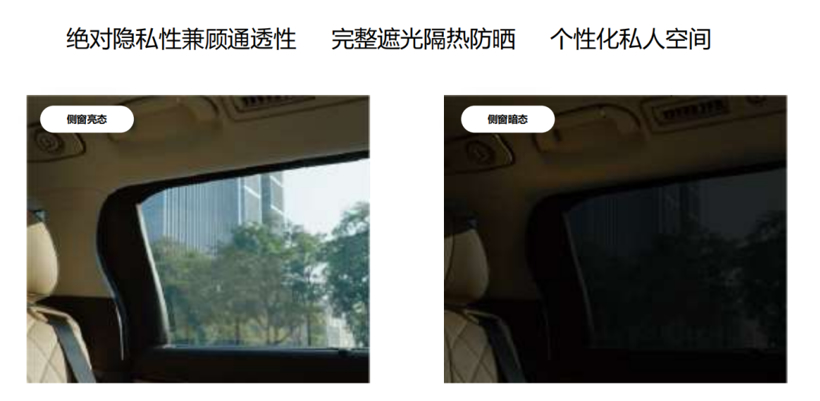
This month, several upcoming models, such as the NIO ES9, Xpeng GX, and the new AITO M9, are all featuring electronically adjustable privacy glass as their core selling point.
From color-changing panoramic roofs to rear side windows instantly transforming into private cabins; from two-stage switching to infinitely variable dimming, zonal control, and simulated blind effects—a piece of glass once tasked only with shielding from wind and rain has now evolved into a “super smart surface” that integrates sun protection, heat insulation, privacy, acoustic quietness, technological sophistication, and emotional value.
Why do many new players consider something as simple as a curtain to be a high-end and advanced selling point? Perhaps ordinary consumers do not understand, or even fail to comprehend, this.
But there are always certain phrases that elevate the narrative—framing it not merely as simple configuration or component stacking, but rather as a century-spanning evolution, a revolution sweeping across the entire industrial chain, and an experience redefined under the leadership of Chinese brands.
Standpoints are different, both sides seem to have some reasoning, but regardless, automotive window film manufacturers and auto tinting shops are really in trouble.
01The Evolution of an Automobile Windshield
Several pieces of seemingly insignificant car glass, which can hardly be called a configuration, often go unnoticed by consumers. However, the history of car glass development is quite intriguing. Over more than a century, it has made a three-step leap from "windshield" to "safety barrier," and then to "smart interactive panel," paralleling the evolution of automotive safety and comfort.
In 1904, automobiles were equipped with windshields for the first time—simple flat glass panels whose sole function was to shield against wind and sand. However, this glass was fragile and hazardous: upon shattering, it produced sharp fragments that flew about, causing secondary injuries during accidents—earning it the grim moniker “killer glass.” During this phase, glass addressed only the question of “existence versus absence,” with absolutely no consideration for safety.
In 1919, Ford’s Model T began mass-producing laminated glass—two layers of glass bonded with a polyvinyl butyral (PVB) interlayer—preventing shards from scattering and causing injury upon breakage, thereby conclusively ending injuries caused by flying glass fragments and laying the foundation for modern automotive safety glass. In 1938, tempered glass was introduced: heat-treated to increase strength several-fold and shatter into small, blunt, sub-5-mm particles, further enhancing safety for side and rear windows.
Thereafter, laminated + tempered glass became the industry standard, and the core mission of glass has always revolved around safety.
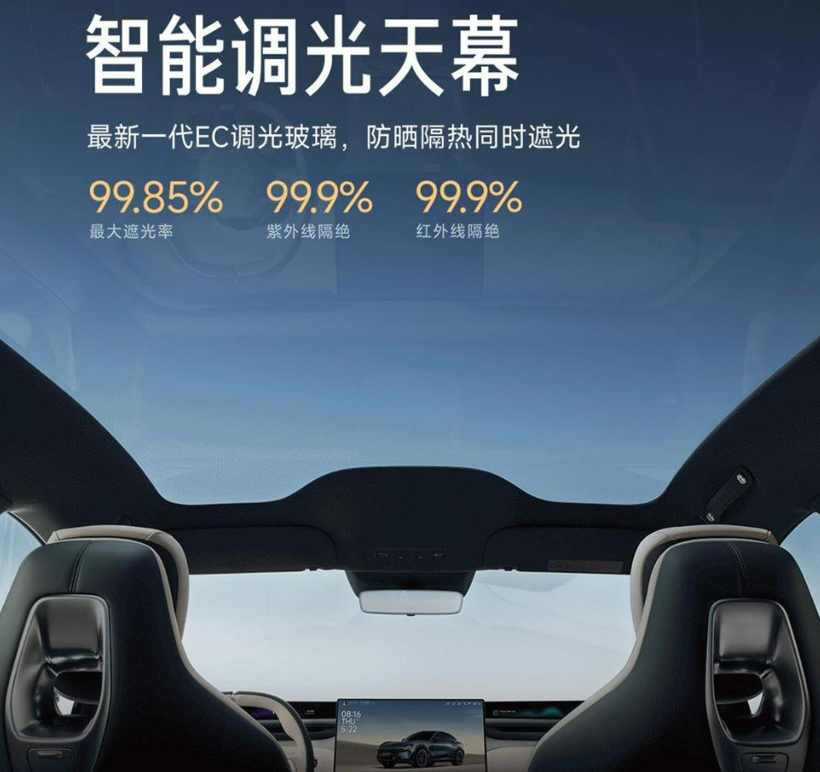
But with the upgrading of consumption, glass has taken on more functions, such as using double-layer laminated glass to improve NVH and in-car quietness, and using coating to achieve heat insulation and ultraviolet ray blocking. Glass has evolved from a so-called "safety component" into a comfort configuration. Just like Xiaomi mentioned in the first generation of the SU7, "no one has solved the car sun protection issue in 140 years," because other vehicles, after being delivered, are prone to sun exposure, and naturally, people will apply a sun protection film to the glass after purchase.
Therefore, whether it's factory-installed configurations or aftermarket-added functionalities, automotive glass remains a passive component in essence and lacks active adjustment capabilities.
What truly transformed car windows was the electrochromic technology, which can adjust light transmittance under an electric field and selectively block thermal radiation. For example, the Ferrari Superamerica convertible sports car in 2005 and the smart windows on the Boeing 787 aircraft that came into service in 2008 are early practical applications of this technology in the industry.
Subsequently, with the iteration of material technologies, this technology gradually became widespread in high-end automotive panoramic sunroofs. In 2016, a research team from the Massachusetts Institute of Technology achieved a key breakthrough in the field of electrochromic new materials, significantly enhancing color-switching response speed, energy efficiency, and light-blocking/thermal insulation performance—laying a technical foundation for the large-scale upgrading of energy-efficient building glass, high-end automotive sunroofs, and other applications.
In 2021, Guangyi Technology supplied the EC (electrochromic) smart-tinting roof for the Zeekr 001, marking the commencement of mass production for smart-tinting glass. By the end of 2025, Guangyi Technology’s EC electrochromic technology had advanced to its third generation and had become the world’s largest supplier of automotive-grade EC tinting roofs/glass, with cumulative shipments exceeding 300,000 units. Its products cover over 20 mainstream vehicle models, including NIO, BYD, Xiaomi SU7, and Audi, and are progressively expanding into side window applications.
To date, LC dye liquid crystal side windows, represented by models like the Xpeng GX and NIO ES9, have also made their debut, with response times reduced to the 0.1-second level, light-shielding rates approaching 100%, and independent control of different zones. The glass has evolved completely into an active intelligent interactive terminal, marking a thorough transformation of a single piece of glass from the mechanical age to the intelligent age.
02Smart cockpit, needs smarter glass
We firmly believe that the existence of things is rational; the emergence and rapid growth of color-changing or smart glass in the automotive industry is an inevitable outcome resonating with the trends of vehicle electrification, cockpit competition, and user pain points.
After all, when it comes to power, range, large screens, sound systems, and seats, car manufacturers have reached the limit of competition. Therefore, they have to focus on more subtle experiences. Glass happens to meet three essential needs, such as sun protection. For example, color-changing sunroofs can solve the problem of overheating in ordinary electric vehicle sunroofs. Privacy is another need, especially in high-end executive cabins, business reception, and rest scenarios, where car glass needs to be transparent but not reveal people inside. Although other cars can use films, original factory quality is safer, more environmentally friendly, more beautiful, and odorless.
Color-changing glass was first applied to glass roofs, as pure electric vehicles have their batteries laid out on the chassis, compressing the vehicle's height. Traditional sunroofs encroach on headroom, making panoramic glass roofs the only solution. They bring many advantages such as a sense of openness, spaciousness, and low wind resistance. However, they also bring a critical issue: they are too exposed to sunlight!
Especially taking Tesla’s large-scale popularization of panoramic glass roofs as an example, early panoramic roofs could only block ultraviolet rays but not infrared rays, resulting in severe interior overheating and scorching heat on the head during summer—this became users’ biggest complaint. Users were thus forced to apply aftermarket window films or install sunshades, which were cumbersome, low-end, and detrimental to the vehicle’s aesthetics.
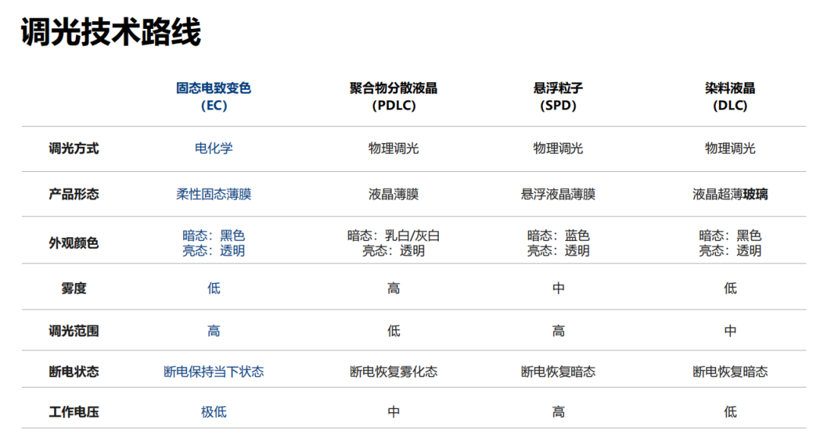
Pain points represent opportunities. Chinese automakers, in collaboration with their supply chains, have identified the opportunity and provided a solution: electrochromic (EC) and liquid crystal (LC) smart glass capable of actively changing color and providing active thermal insulation. These smart glasses are categorized into two major technical camps—EC and LC—based on their distinct technological approaches.
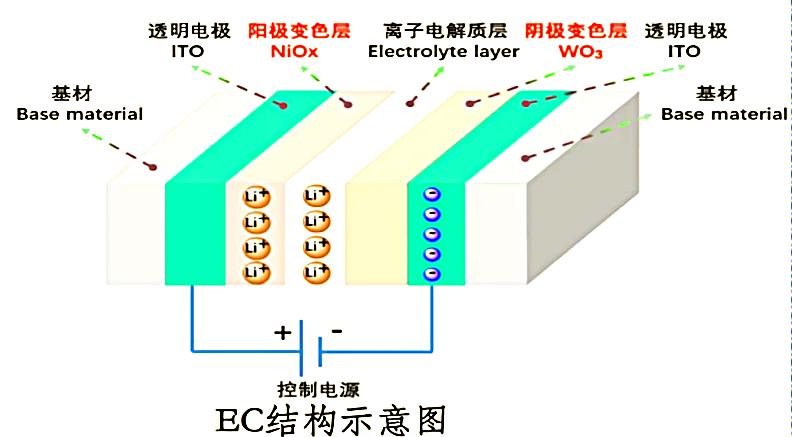
Firstly, EC (electrochromic) smart glass is the optimal solution in the skylight field. Its working principle involves ion migration and redox chemical reactions—similar to the charging/discharging process of a battery—which cause coloration but require a certain amount of time to complete the transition. This type of smart glass features power-off memory (i.e., maintaining its state without power), low power consumption, compatibility with large curved surfaces, and continuous (infinite-step) light transmittance control. In terms of performance, it achieves up to 99.6% light blocking, blocks 99.99% of ultraviolet (UV) radiation, and rejects 97% of infrared (IR) radiation.
The other type is LC dye liquid crystal glass, known as the king of side window privacy. Its principle is to control the arrangement of liquid crystal and dye molecules through an electric field, achieving a pure physical change. Its advantages include switching in 0.1 seconds, full black privacy, and controllable zones. The representative models mentioned at the beginning of the article, such as NIO ES9, Xpeng GX, AITO M9, and Zunjie S800, are examples of this technology. Of course, like the electrochromic roof, the first application was still by Zeekr, which was first equipped on the 009 Radiance model.
So a clear industry trend is emerging, where what used to be mandatory post-installation, modification, and film application needs, are now all being made into standard pre-installed features by car manufacturers. This includes dashcams, electrically operated doors, aviation-style seats, ambient lighting, and also adjustable tint glass.
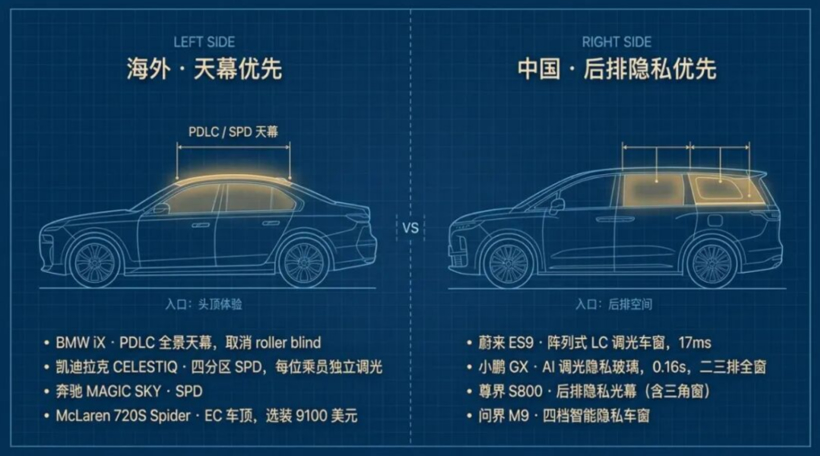
To put it nicely, this is about frontloading the user experience, solving all the costs, store visits, and pitfalls that users would face after buying a car in advance. To put it bluntly, this is about snatching the rice bowl from the downstream industry chain and ecosystem, after all, car manufacturers need profits and have to find ways to increase the car prices.
Nevertheless, Chinese technology and China’s supply chain are transforming China’s automobile manufacturing capability—from simple vehicle production into “space creation.” As a result, the definition authority of intelligent cockpits has undergone a comprehensive shift. Under this intelligent cockpit paradigm, glass is no longer merely glass; it becomes a control switch for cockpit scenarios: it can be transparent and bright during commutes, offering an open, unobstructed view; it can turn completely opaque with a single tap for rest, ensuring quietness and privacy; in business settings, it enables zone-specific dimming to prevent mutual interference; and during summer, it blocks heat sources to reduce air-conditioning load.
From sunroof sun protection to side window privacy; from EC technology to LC solutions; from aftermarket tinting to factory-standard equipment, Chinese brands have redefined the value of automotive glass through an extreme competition, also marking the entry of automotive competition into a higher level.
In the future, smart glass may continue to evolve—for instance, integrating photovoltaic power generation, virtual reality, display functionality, and ubiquitous sensing. Yet, regardless of technological iterations, the underlying principle remains unchanged: user-centric design, delivering an exceptional user experience, and proactively resolving all inconveniences. This is the ultimate answer to the intense competition in China’s automotive industry.
Ultimately, it all comes down to whether consumers are willing to buy it or not.
【Copyright and Disclaimer】The above information is collected and organized by PlastMatch. The copyright belongs to the original author. This article is reprinted for the purpose of providing more information, and it does not imply that PlastMatch endorses the views expressed in the article or guarantees its accuracy. If there are any errors in the source attribution or if your legitimate rights have been infringed, please contact us, and we will promptly correct or remove the content. If other media, websites, or individuals use the aforementioned content, they must clearly indicate the original source and origin of the work and assume legal responsibility on their own.
Most Popular
-
A Look at the Material Suppliers Behind SpaceX
-
Daily Review: Cost and Supply Support Push Polyester Bottle Film Market Higher
-
Dreame Launches All-Solid-State Battery Sedan With Energy Density Exceeding 450Wh/kg
-
【Overseas News Highlights】 SABIC Launches New Products! Amcor Opens New U.S. Headquarters! UPM and BASF Enter Strategic Partnership!
-
Energy Autonomy and Circular Economy Drive Cortec to Redefine Sustainable Corrosion Protection Packaging Standards in Europe


