



Continue Anti-Dumping Investigation Into China-Related PTMEG! USITC Rules Domestic Industry Suffered Injury

May 22, 2026 – The U.S. International Trade Commission (USITC) determined that there is a reasonable indication that the domestic industry in the United States is materially injured by imports of polytetramethylene ether glycol (PTMEG) from China, South Korea, Taiwan, and Vietnam, which are allegedly being sold in the United States at less than fair value.
U.S. International Trade Commission (USITC) Chair Amy A. Karpel and Commissioners David S. Johanson and Jason E. Kearns voted in favor.
In light of the Commission’s affirmative determination, the U.S. Department of Commerce (DOC) will continue its investigations into imports of PTMEG from China, South Korea, Taiwan, and Vietnam.
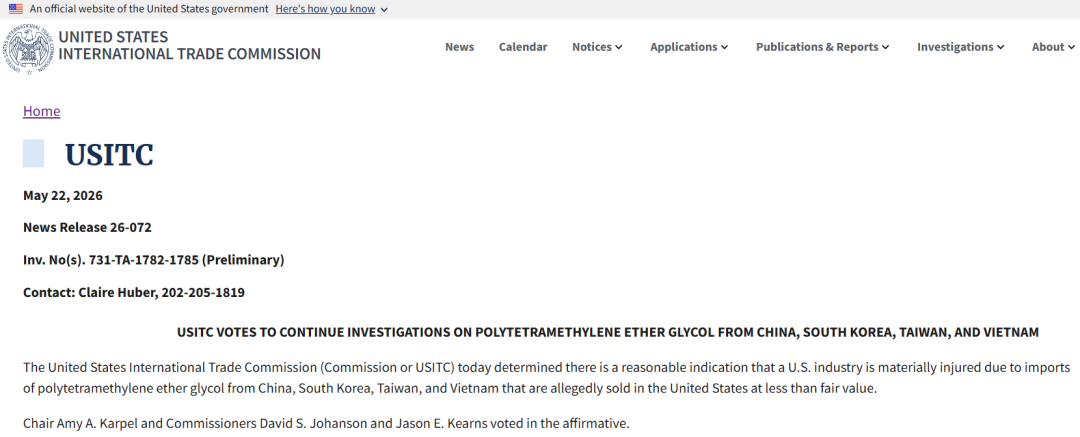
The U.S. International Trade Commission’s public report, *PTMEG Imports from China, Korea, Taiwan, and Vietnam* (Investigation Nos. 731-TA-1782-1785 (Preliminary), USITC Publication 5746, June 2026), will include the Commission’s views and the information gathered during the investigation.
The report will be published on the website of the United States International Trade Commission (USITC) by June 30, 2026.
On April 8, 2026, BASF Corporation submitted a new petition to the U.S. Department of Commerce (DOC) and the U.S. International Trade Commission (USITC), requesting the imposition of anti-dumping duties on PTMEG imported into the United States from China, South Korea, Taiwan, and Vietnam.
The U.S. Department of Commerce (DOC) and the U.S. International Trade Commission (USITC) will conduct parallel investigations. The USITC will first determine whether there is a reasonable indication that the relevant U.S. industry has suffered material injury or is threatened with material injury. Subsequently, the DOC will determine whether the subject imports are being dumped and calculate the corresponding dumping margins.

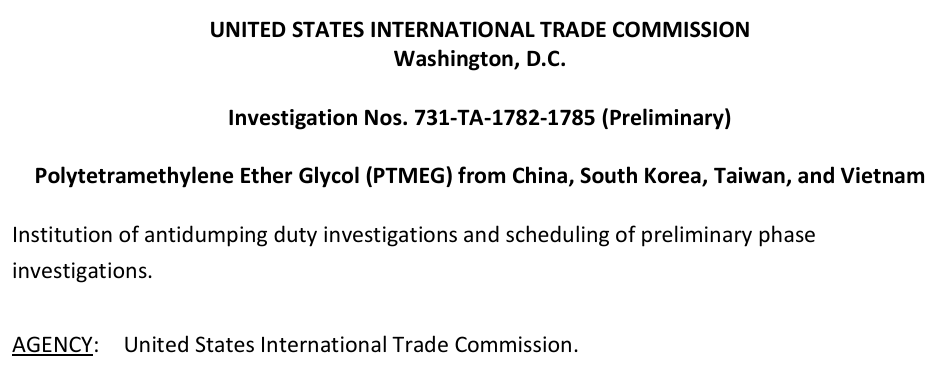
The petitioner, BASF Corporation, alleges that imports of PTMEG from China, Korea, Taiwan, and Vietnam are being dumped in the U.S. market. The petitioner claims that these imports are harming the interests of U.S. domestic producers.
PTMEG is a high-performance polymer derived from tetrahydrofuran. It is a white, waxy solid that melts into a transparent, colorless, viscous liquid at room temperature. PTMEG is an extremely versatile material, commonly used as a reactant in the production of polyurethanes and serving as the soft segment in elastomer formulations. Its excellent properties and processing advantages are attributed to its elasticity, hydrolysis resistance, and low-temperature flexibility.
As a component of polymers, PTMEG possesses numerous excellent properties, including good mechanical performance and outstanding resilience over a wide temperature range, low-temperature flexibility and toughness, excellent hydrolytic stability, superior resistance to microbial and fungal attack, high wear resistance, non-sensitizing characteristics, excellent dynamic properties (very low heat build-up), high reactivity as a difunctional primary alcohol, high tear strength, relatively low viscosity (facilitating processing and handling), and a long shelf life.
The merchandise covered by this investigation is polytetramethylene ether glycol (PTMEG), a polymer composed of linear diols (i.e., organic compounds with two hydroxyl (-OH) functional groups), whose molecular backbone consists of repeating tetramethylene units (-CH₂CH₂CH₂CH₂-) linked by ether bonds (i.e., an oxygen atom bonded to two carbon atoms), with the chemical formula HO{(CH₂)₄}nOH.
PTMEG is also known as polytetrahydrofuran (“PolyTHF” or “PTHF”), polytetrahydrofuran ether glycol, and polytetramethylene ether glycol. PTMEG is typically used in combination with butylated hydroxytoluene (“BHT”) or other stabilizers.
The scope of the investigation includes all forms of PTMEG, regardless of its physical form, purity, molecular weight, hydroxyl number, acid value, color, density, softening point, glass transition temperature, flash point, water content, viscosity, or packaging. PTMEG mixed with other products also falls within the scope of this investigation, provided that the components in such mixture are merely blended with one another and have not undergone a chemical reaction to form a different product. For such mixtures, only the PTMEG component is covered by the scope of this investigation.
The scope of the investigation also includes products that meet the above description and that have been processed in a third country, including but not limited to processing such as blending, dilution, addition or removal of stabilizers, modifiers, or additives, or any other processing that, if performed in the subject country, would not remove the product from the scope of the investigation. In addition, the scope of the investigation includes PTMEG blended or mixed with PTMEG from non-subject countries. In such mixed products, only the PTMEG component originating in the subject country is within the scope of the investigation.
The merchandise at issue is classified under HTSUS subheading 3907.29.00. The merchandise at issue may also be imported under HTSUS subheading 2932.11.00. Although the HTSUS subheadings and CAS registry number are provided solely for the convenience of customs clearance, the written description of the scope of the investigation shall be controlling.
China: The anti-dumping duty rates range from 172.71% to 419.88% ad valorem.
South Korea: The anti-dumping duty rate is 116.39% to 132.36% (ad valorem).
Taiwan, China: The anti-dumping duty rate is 165.84% to 212.90% (ad valorem).
Vietnam: The anti-dumping duty rate ranges from 78.72% to 295.36% (ad valorem).
【Copyright and Disclaimer】The above information is collected and organized by PlastMatch. The copyright belongs to the original author. This article is reprinted for the purpose of providing more information, and it does not imply that PlastMatch endorses the views expressed in the article or guarantees its accuracy. If there are any errors in the source attribution or if your legitimate rights have been infringed, please contact us, and we will promptly correct or remove the content. If other media, websites, or individuals use the aforementioned content, they must clearly indicate the original source and origin of the work and assume legal responsibility on their own.
Most Popular
-

A Look at the Material Suppliers Behind SpaceX
-
Two Major Chemical Giants to Shut Down, Sell Again
-
BASF, Selling Again!
-

BASF Cuts Core Business As It Exits All Non-Core Operations, Triggering A New Round Of Industry Restructuring
-
Two Major Chemical Giants Fell Successively In May, And The Industry As A Whole Turned Cold


