China’s Plastic Machinery Giants Go Global at FEIMEC 2026, with Most Sought-After Models Not Being the Low-Cost Ones
From May 5 to 9, 2026, the 19th Brazil International Machinery and Machine Tool Exhibition (FEIMEC) was held at the São Paulo Exhibition Center. A notable phenomenon appeared at this exhibition:Haitian International, Yizumi, Chen Hsong, Fu QiangxinFour leading Chinese injection molding machine companies were all present. Overall, 104 Chinese companies occupied 2175 square meters of exhibition space.
This is not a random "group check-in," but a systematic layout of China's plastic machinery industry in the South American market.
I. Why Brazil? The Logic Behind the Data
1. China-Pakistan economic and trade ties are becoming increasingly inseparable.
China has been the largest trading partner of Brazil for 15 consecutive years. In 2024, the bilateral trade volume reached 188.169 billion U.S. dollars, an increase of 3.5% compared to the previous year. In the first nine months of 2025, Brazil's imports from China grew by 15.4%, nearly doubling the growth rate of Brazil's total imports (8.2%). China accounts for 25% of Brazil's total imports, far exceeding the 16% of the United States.
More importantly, Brazil has a $22 billion trade surplus with China, while it has a $5.1 billion trade deficit with the United States. This means that Brazil's economic lifeline is increasingly tilting towards Asia. As the chair and a founding member of Mercosur, Brazil serves as a gateway for Chinese enterprises to enter the entire Latin American market—through Brazil, they can reach neighboring countries such as Argentina, Chile, Peru, and Uruguay.
2. How big is the Brazilian plastic market?
In 2023, Brazil’s plastic products output amounted to approximately 7.04 million tons, representing a year-on-year growth of 3%–4%. In the engineering plastics sector, the market size in Brazil is projected to exceed USD 450 million by 2025, with a stable compound annual growth rate (CAGR) of 6.0%–7.0%; the automotive and electronics industries collectively account for over 60% of demand. According to QY Research (QYR), the global all-electric injection molding machinery market achieved sales revenue of USD 3.427 billion in 2024 and is expected to reach USD 5.131 billion by 2031, with Latin America being one of the fastest-growing regions.
More critically, Brazil’s domestic injection molding machine manufacturing capacity is severely insufficient, making the market highly dependent on imported equipment. All-electric models account for less than 10% of the Brazilian market (compared to over 30% in China), indicating substantial potential for replacement of existing machines. Small and medium-sized machines (clamping force ≤ 650 tons) dominate the market, while demand for larger machines (above 450 tons) is rapidly growing—driven by automotive lightweighting and localized production of new energy vehicle components.
II. From Selling Equipment to Taking Root: Chinese Enterprises’ Approach Has Changed
Source: Special Plastic World
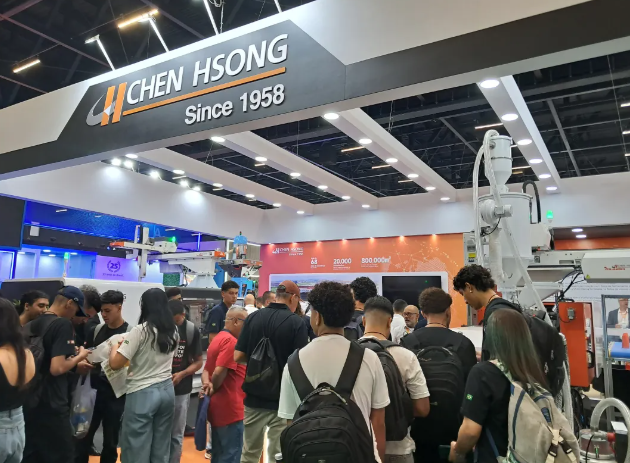
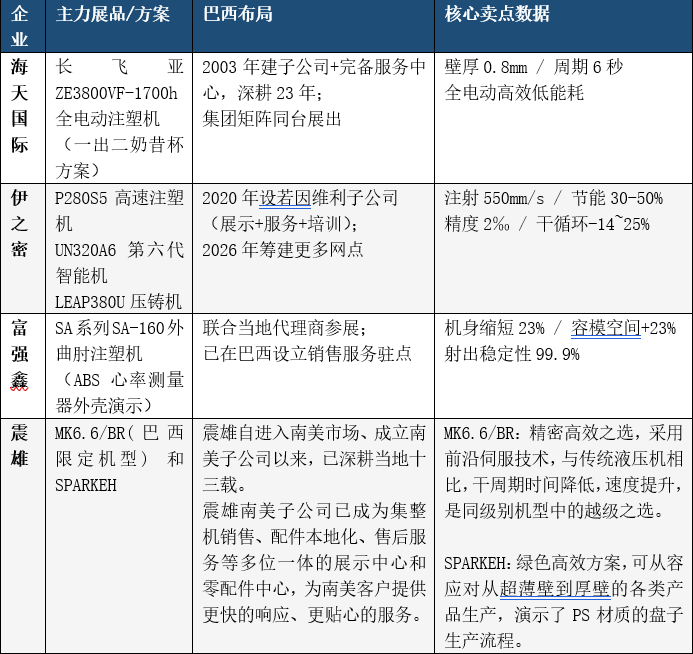
As shown in the table above, a clear evolutionary trajectory is evident: Chinese companies' strategies in Brazil have evolved from early exhibition-based sales to deep local market penetration. Haitian established a network of subsidiaries and service centers over 23 years; Chen Hsong has been deeply rooted in the local market for 13 years; Yizumi set up a subsidiary in Joinville as early as 2020, integrating display, service, and training functions; while FCS adopted a strategy of partnering with local distributors.
There has also been a qualitative change at the product level. These four injection molding machine manufacturers are no longer bringing low-priced, high-volume general models, but specific solutions. Haitian Changfeng demonstrated a two-cavity milkshake cup solution on-site, with a 6-second cycle and 0.8mm thin-wall PP products, directly addressing the needs of the packaging market; Yizumi's P280S5 has a maximum injection speed of 550mm/s, targeting food packaging and medical consumables; UN320A6 saves 30%-50% on melting energy and reduces dry cycle by 14%-25%; LEAP380U die-casting machine saves 40% energy; FCS's SA-160 has a 23% shorter machine body and 99.9% stability in shot weight.
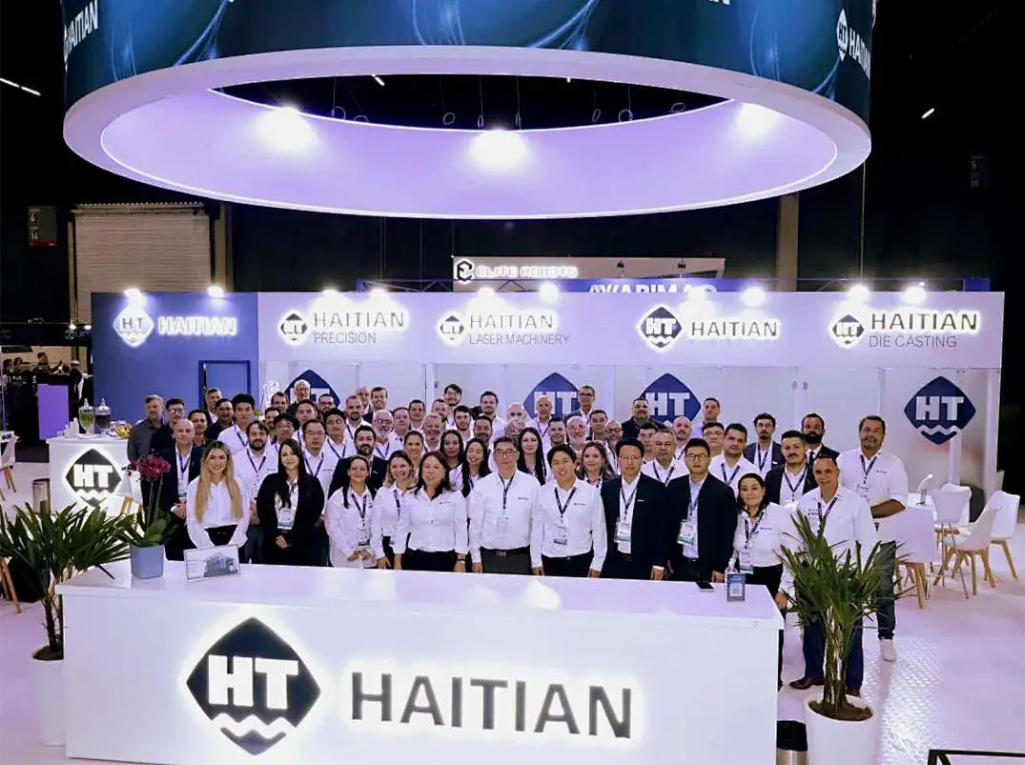
Image source: Haitian Plastics Machinery
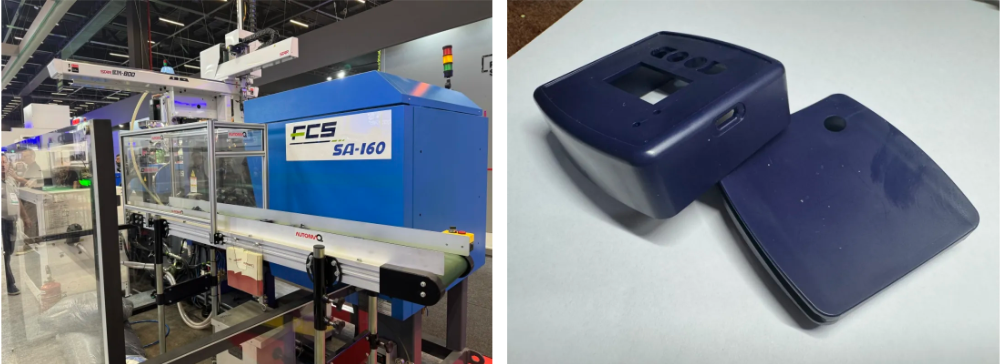
Figure: At the exhibition site, the Fushengxin SA-160 model is producing an ABS heart rate monitor housing. Source: Fushengxin
III. What kind of plastic machinery does Brazil need? Three core directions
Direction One: High-Speed Packaging — The Greatest Immediate Need
Packaging, automotive parts, and daily consumer goods account for more than 60% of the demand for plastic products in Brazil. Among these, packaging is the absolute leader — food and beverages, daily chemical products, and e-commerce logistics are all driving up demand. Thin-wall high-speed injection molding (such as for milkshake cups, bottle caps, and food containers) is currently the most in-demand capability, with stable output within a cycle of 6 seconds being the entry requirement. In addition, the boom in e-commerce has boosted the demand for high-quality transport packaging (such as storage boxes and cushioning components), which is a traditional strength of Chinese companies.
Direction Two: Energy-saving and Intelligent - Policy and Cost-driven
Electricity prices in Brazil are approximately two to three times higher than those in China, making energy-saving measures an urgent necessity—not just a marketing gimmick—for industrial users. The ROI payback period for servo energy-saving injection molding machines in Brazil is significantly shorter than that in the domestic Chinese market. Meanwhile, Brazil is advancing its “Reindustrialization” strategy, under which intelligent upgrades are eligible for policy incentives. For instance, YIZUMI’s sixth-generation machines come standard with electric plasticizing and aerogel insulation, achieving 30–50% energy savings in the plasticizing process compared to hydraulic machines—a compelling advantage when presented to Brazilian customers.Direction Three: Automotive Components—Incremental Blue Ocean
Brazil is a significant global automobile production base (the São Bernardo do Campo industrial zone gathers about 1,200 enterprises and nearly 100,000 jobs), with international giants like Scania setting up large factories here. The trend towards automobile lightweighting has spurred a surge in demand for engineering plastic components, especially battery trays, charging gun casings, and high-voltage connectors for new energy vehicles. Such applications require medium to large-scale injection molding machines and have high demands for precision and consistency—precisely within the technological comfort zone of Chinese brands.
IV. Risks That Cannot Be Avoided
First, logistics and tariffs.
Long shipping cycles and complex customs clearance processes make after-sales service for complete machines the biggest pain point. Without local service network support, relying solely on selling machines makes it difficult to establish sustainable competitiveness.
Second, exchange rate fluctuations. Fluctuations in the BRL/CNY exchange rate directly affect profit margins, requiring effective financial hedging.
Third, brand perception. Several international brands from Europe and Japan still dominate the premium market, particularly in the automotive and medical sectors. Chinese brands offer a clear price advantage (approximately one-third of that of European and American brands), yet they still lag behind in terms of technological trustworthiness.
Fourth, talent shortage. There is a scarcity of composite talents who possess technical expertise, proficiency in Portuguese, and familiarity with local business practices—a common challenge faced by all companies expanding overseas.
V. In Conclusion
The South American market, represented by Brazil, is a "moderately challenging but rewarding" strategic option for Chinese plastic machinery enterprises. It is not as fiercely competitive as Southeast Asia, nor as unattainably high-threshold as Europe and the United States. As the world's tenth largest economy with a population of 213 million, Brazil is currently undergoing a critical phase of manufacturing upgrading, with a real and urgent demand for high cost-performance, high energy efficiency, and intelligent injection molding equipment.
The collective appearance of Chinese enterprises at FEIMEC 2026 sends a clear message: the leading players have already started running. For Chinese plastic machinery companies still hesitating, the window to the South American market is still open — but as Haitian has proven in 23 years, real competition is not about who arrives at the exhibition first, but who can take root.
Editor: Lily
Sources: China Machinery & Equipment Import & Export Corporation (CCCMC), Haitian Plastics Machinery, Yizumi, FCS Group, Chen Hsong Injection Molding Machines, Silk Road Insights
【Copyright and Disclaimer】This article is the property of PlastMatch. For business cooperation, media interviews, article reprints, or suggestions, please call the PlastMatch customer service hotline at +86-18030158354 or via email at service@zhuansushijie.com. The information and data provided by PlastMatch are for reference only and do not constitute direct advice for client decision-making. Any decisions made by clients based on such information and data, and all resulting direct or indirect losses and legal consequences, shall be borne by the clients themselves and are unrelated to PlastMatch. Unauthorized reprinting is strictly prohibited.
Most Popular
-
A Look at the Material Suppliers Behind SpaceX
-

Dreame Launches All-Solid-State Battery Sedan With Energy Density Exceeding 450Wh/kg
-

【Overseas News Highlights】 SABIC Launches New Products! Amcor Opens New U.S. Headquarters! UPM and BASF Enter Strategic Partnership!
-
Energy Autonomy and Circular Economy Drive Cortec to Redefine Sustainable Corrosion Protection Packaging Standards in Europe
-
Daily Review: Cost and Supply Support Push Polyester Bottle Film Market Higher