Byd Unveils Game-Changing Technology! 9-Minute Full Charge, Decoding the Black Tech of Power Batteries From the Material End
On March 5, 2026, Wang Chuanfu, chairman and president of BYD, officially launched this technology in Shenzhen: charging from 10% to 70% at room temperature takes only 5 minutes, and to 97% takes 9 minutes. Under a temperature of -30°C, charging from 20% to 97% takes only 3 minutes longer than at room temperature. This breakthrough directly addresses two long-standing pain points: "slow charging" and "difficulty charging in low temperatures," setting a new world record for charging speed in mass-produced vehicles.
This achievement is not an isolated technology show, but a systematic advancement by BYD in battery materials, electrochemical design, thermal management, and infrastructure layout. The second-generation Blade Battery, while maintaining the safety advantages of lithium iron phosphate, has achieved the compatibility of flash charging and high energy density through material optimization and structural innovation, with energy density improved over the first generation.Over 5%, enabling equipped vehicles to easily achieve a range exceeding 1,000 kilometers.
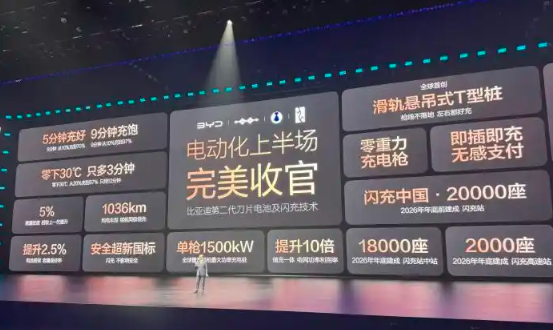
Image source: China News Service
Core Breakthrough of Flash Charging Technology: From Contradiction to Unity
For a long time, the industry has viewed"Flash charging" and "high energy density" are inherently conflicting. High-power charging generates significant heat, causing rapid battery temperature rise, accelerated degradation of battery life, and even potential safety hazards. BYD's second-generation Blade Battery resolves this dilemma through its "lithium-ion high-speed channels" and "full-temperature-range intelligent thermal management system."
The lithium-ion high-speed channel is essentially a synergistic optimization of cathode and anode materials along with the electrolyte: the cathode adopts a lithium manganese iron phosphate system to enhance ion migration rate; the anode incorporates a silicon-carbon composite material to improve capacity and conductivity; and the electrolyte optimizes the solvent ratio to reduce viscosity and enhance low-temperature ion conductivity. These improvements enable lithium ions to perform efficiently under high-rate conditions."Run faster," charging rate reaches more than 10C, without sacrificing stability.
At the thermal management level, the full-temperature-range intelligent thermal management system, combined with liquid cooling, direct cooling, and direct heating technologies, enables precise temperature control. Battery heat generation is reduced, and heat dissipation is more uniform; even during high-power charging, temperature rise remains within the safe range. Launch data shows that flash charging has a negligible impact on battery lifespan. The warranty policy has been further enhanced, and overall capacity retention has improved.2.5%, lifetime warranty for the battery cell.
Improving low-temperature performance is particularly critical. In northern winters, battery internal resistance increases and charging power is limited, often resulting in"Trickle charging" phenomenon. BYD uses low-temperature electrolyte additives and preheating strategies to maintain efficient ion transport at -30°C. In actual tests, after being frozen deeply for 24 hours, the battery can be charged from 20% to 97% in less than 12 minutes, only 3 minutes longer than at normal temperature. This means the era when "electric vehicles cannot pass the Shanhai Pass" may be coming to an end.
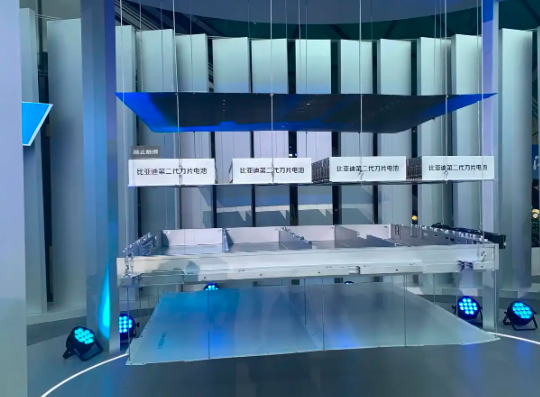
Image source: BYD
The increase rather than decrease in energy density is another highlight. The energy density of the first-generation blade battery system is approximately140Wh/kg, with the second generation improving by more than 5%, the CLTC range of models such as the Tengshi Z9GT reaches 1036 kilometers. The volume utilization is further optimized, with CTB 2.0 technology integrating the battery pack with the body to reduce weight and improve space efficiency.
Infrastructure Loop: The Implementation Pace of Flash Charging China Strategy
Technical breakthroughs require network support. BYD also launches simultaneously.The "Flash Charge China" strategy plans to build 20,000 flash charging stations by the end of 2026. As of the day of the press conference, 4,239 stations have been completed.
20,000 stations are divided into two categories: 18,000 "flash charging stations within stations," which, through cooperation with existing charging operators, are transformed into a "station within a station" model in public stations, without the need for additional grid capacity or land, and can be operational within a week. They cover 3 kilometers within first and second-tier cities, 5 kilometers within third and fourth-tier cities, 6 kilometers within fifth and sixth-tier cities, and 90% of urban areas within 5 kilometers have flash charging services.
A 2000-charging station highway service area layout, with an average interval of more than 100 kilometers. Before this year's May Day holiday, the first 1000 high-speed charging stations will be launched, addressing long-distance travel anxiety. The charging piles use a single gun with 1500kW power and a suspended T-shaped design, with the cable suspended in the air to avoid dragging and tangling. The cable is lightweight, and users can achieve "plug-and-charge" and "touchless payment" through an app. A supporting energy storage system buffers grid pressure and ensures stable high-power output.
This layout forms the character "Che"- Pile-Net Closed Loop. BYD users enjoy 1 year of free flash charging rights, and after the period, the charging will be charged in line with industry standards. Stations are open to the public, and owners of other brands can also use them, improving utilization and reducing costs. In the future, it will also expand overseas, from "Flash Charging China" to "Flash Charging Planet".
Deep Drivers and Future Prospects of the Materials Industry
Each iteration of power batteries profoundly affects the upstream materials industry. The success of the second-generation blade battery relies on the collaboration of high-performance plasticizing materials, thermal conductive materials, and protective materials.
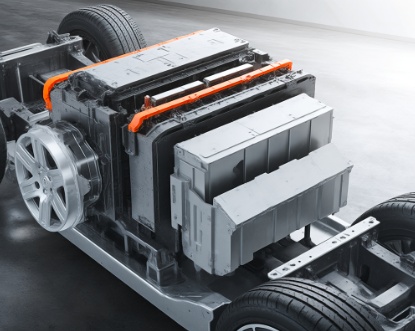
Image source: AI generated
Sealing elements such asPPS (polyphenylene sulfide) sealing rings withstand high temperatures of 220–240°C and resist electrolyte corrosion, ensuring internal module stability. Thermal insulation materials use aerogel composite film or polyimide foam, featuring low thermal conductivity (as low as 0.012 W/(m·K) for aerogel) and temperature resistance up to 1200°C, preventing thermal runaway propagation—typical applications include ceramic thermal barrier pads and honeycomb structures in blade batteries.
Structural support members using modifiedPPO or PC/ABS, which combines strength, toughness, and heat resistance, supports CTP/CTB technology to reduce module levels and improve volumetric efficiency by more than 20%. High-voltage insulation materials such as PPS and PEI have high arc resistance and tracking resistance, meeting requirements of 800V or higher. Thermal management relies on thermally conductive silicone (1-5 W/(m·K)) and phase change materials, which absorb heat and melt at 45°C to achieve temperature uniformity.
Packaging protection such as aluminum-plastic film (nylon)Aluminum foil/PP composite and V0-rated flame-retardant PC ensure puncture resistance and corrosion resistance for pouch and prismatic cells.
Epilogue:
Material innovation will continue to drive battery upgrades. Solid-state batteries with sulfide.Polymer electrolyte ionic conductivity has reached 10⁻³ S/cm, with an energy density target of 500Wh/kg. Although mass production will take 3-5 years, it has the potential to eliminate the risk of thermal runaway in liquid electrolytes. Sodium-ion batteries are 30% cheaper, have good low-temperature stability, and by 2025, CATL's new sodium battery will achieve an energy density of 175Wh/kg, initially used in commercial vehicles and energy storage, alleviating the pressure on lithium resources.
AI high-throughput computing and machine learning accelerate the development of positive electrodes (lithium-rich manganese-based), negative electrodes (hard carbon), and electrolytes, shortening the R&D cycle. Battery recycling and secondary utilization form a circular economy, with CATL's "battery swapping + recycling" model covering 100,000 vehicles.
The release of the second-generation Blade Battery by BYD is not only a leap in charging experience, but also a cross-industry integration of material science and manufacturing processes. The leading position of Chinese enterprises in the global supply chain stems from the dual drive of technological investment and market responsiveness. The arrival of the fast-charging era will further accelerate the adoption of new energy vehicles, promoting the transition of energy toward a more efficient and sustainable direction.
【Copyright and Disclaimer】This article is the property of PlastMatch. For business cooperation, media interviews, article reprints, or suggestions, please call the PlastMatch customer service hotline at +86-18030158354 or via email at service@zhuansushijie.com. The information and data provided by PlastMatch are for reference only and do not constitute direct advice for client decision-making. Any decisions made by clients based on such information and data, and all resulting direct or indirect losses and legal consequences, shall be borne by the clients themselves and are unrelated to PlastMatch. Unauthorized reprinting is strictly prohibited.
Most Popular
-
Middle East Tensions Escalate Sharply: How Polyolefins Respond Amid Soaring Risk Premium
-

Middle East Tension Spikes Global Energy Pattern, Crude Oil and Plastic Industries Face Multiple Challenges
-

Middle East Polymer Export Hub Hit in Sudden Attack, Global Supply Chain Sounds Alarm
-
Huntsman Introduces “War Surcharge” Amid Shipping Disruption and Soaring Energy Costs, Global MDI Prices Continue to Rise
-

Futures Surge Violently, Polyolefin Spot Prices Rise Sharply in Tandem