



Blade Resheathed, Can Wang Chuanfu Break Through the "Headwind"?
“I believe no one understands batteries better than BYD.” At the BYD technology launch event held on March 5, Wang Chuanfu—typically low-key—did not hold back.
That night, BYD released the second-generation blade battery, a new flash charging technology, and showcased 10 models including Yangwang U7, Tang, and Song Ultra.
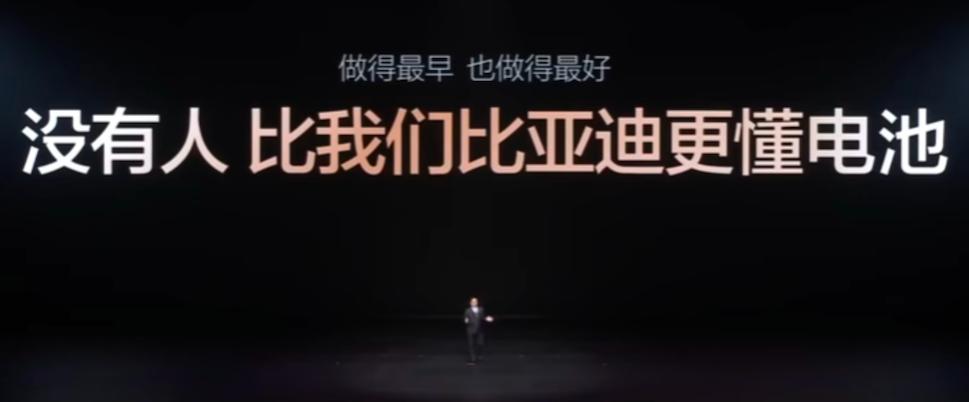
Source: Press Conference
At the press conference, the second-generation blade battery was the first product introduced. Wang Chuanfu did not go into much detail about its technical principles, but instead focused on how this product would improve charging efficiency:
From 10% to 70%, charging time is 5 minutes.
From 10% to 97%, charging time: 9 minutes.
It will only add 3 minutes at -30 degrees Celsius.
Compared to other vehicles in the market, the charging speed of the new battery has increased by about 30% to 50%. Industry opinions suggest that BYD's second-generation blade battery has even challenged NIO's battery-swapping advantage. In comparison, the fastest battery swap time at NIO's fourth-generation swap station is 2 minutes and 24 seconds.
For BYD, the Blade Battery indeed holds special significance.
Six years ago, BYD launched its first-generation Blade Battery, a product that helped propel the company into a period of high growth.
In 2020, BYD's annual sales reached 427,000 vehicles, making it merely "one of the strong competitors" in the industry; by 2025, the company's annual sales soared to 4.602 million vehicles, securing its position as the world's top-selling new energy vehicle manufacturer for four consecutive years and even surpassing Tesla in net profit (for the first three quarters of 2025).

"FuJiang" Blade Battery: Can It Bring Another Surge for BYD? Behind this launch, what hidden threads are there? In this episode of "Auto World Pulse" VOL.19, let's decode it.
The Press Conference in Adversity, What Hidden Threads Lie Behind?
"Everyone used to say 'electric cars don't cross the Shanhai Pass'... From today on, our second-generation blade battery will make this statement a thing of the past!" said Wang Chuanfu at the launch event.
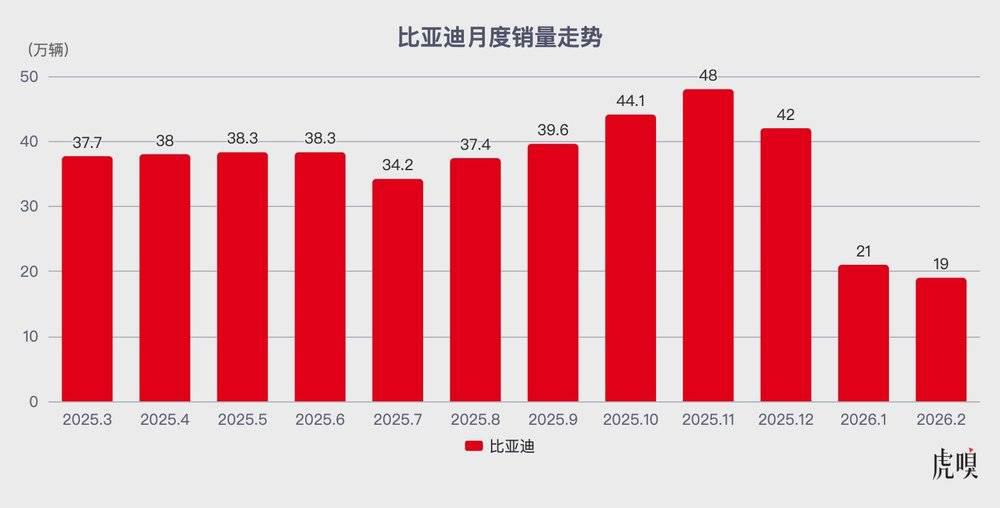
Yet behind the bold statements, BYD is facing an uphill battle. Since last December, its sales have declined for three consecutive months.
In terms of high-end positioning, BYD has achieved certain breakthroughs, but has also failed to meet some targets on schedule.
Denza is one of BYD's three premium brands (the other two are Fangchengbao and Yangwang). Three years ago, Zhao Changjiang, the former general manager of the Denza sales division, said in an interview that by 2025, the monthly sales of the Denza brand would reach a level of 50,000 to 60,000 units.
Last year, Denza sold a total of 157,000 vehicles, an increase of 24.7% year-over-year, averaging just 13,000 units per month. Zhao Changjiang was also reported to have left the company in October and announced in January this year that he had joined Zhijie.
The current difficult situation is due not only to the fact that BYD's technical barriers are not as solid as before, but also to the company's own adjustments.
On December 5th last year, BYD held an extraordinary general meeting. Wang Chuanfu stated at the meeting that the sales of BYD in the domestic market have declined. On one hand, this is due to the fact that BYD's current technological leadership is not as strong as it was in previous years, coupled with an increase in industry homogenization. On the other hand, user pain points, such as slow charging in low temperatures, have not been fully resolved. He also admitted that in the past few years, during a favorable market period, BYD had shown "inertia" in its marketing efforts.
"We may lose one or two months, or even one or two quarters, of growth in performance."
Facing a decline in sales, BYD has started to intentionally scale back its operations to prepare for the next round of offensive. In January this year, BYD sold 210,000 vehicles, being surpassed by Geely (270,000 units), and sales continued to drop to 190,000 units in February.
A research report released by China Merchants Securities in February stated that BYD at that time adopted a strategy of reducing wholesale shipments to control terminal inventory and production rhythm, aiming to alleviate channel inventory pressure and align with the technology launch and the subsequent new product cycle.
Currently, China Securities' assessment appears to be basically correct. In the second half of the press conference, 10 models were presented, all equipped with the second-generation blade battery and the new flash charging technology, which will become the key for BYD's next counterattack.
Can Wang Chuanfu achieve his wish?
“The first half of the new energy vehicle era is electrification, and the second half is intelligentization.” This statement was publicly made by Wang Chuanfu at BYD’s 2021 Annual General Meeting. On March 5, he declared the “first half” concluded: “Today, we launched our second-generation Blade Battery and flash-charging technology… bringing the electrification ‘first half’ to a perfect close.”
However, there wasn't much content related to intelligence at this launch event.
Currently, BYD is still in a catch-up phase regarding intelligent technologies. In February last year, the company launched its “Mass Intelligence Driving” strategy, making the “Eye of the Gods” intelligent driving solution standard across its entire vehicle lineup. However, Dongwu Securities stated in a recent research report that due to suboptimal inventory management and limited demand—and high price sensitivity—among consumers in the mid-to-low price segments, market feedback for BYD’s intelligent driving–equipped models has been generally lukewarm.
In the future, the level of intelligentization will largely determine whether BYD's sales in China can return to a growth trend. However, Huxiu Auto believes that BYD has already secured a substantial scale in the domestic market, and the entire automobile industry has entered a phase of slight growth. Under the combined influence of these two factors, the additional growth that BYD can achieve domestically is limited.
In other words, of course, we must defend and compete for the domestic market share. But the broadercan be translated as "horizons" or "world" in this context, so the sentence could be: But the broader horizons, lie overseas. Or But the broader world, lies overseas.
Currently, BYD's overseas expansion is leading in China. The company's factories in Thailand, Cambodia, Uzbekistan, and Brazil have already started production, and it is planning to start production in Hungary and Malaysia.

Wang Chuanfu and Brazilian President Lula attend the inauguration ceremony of BYD's Brazil factory; Photo source: Visual China
Regarding its overseas targets, BYD Group and Li Yunfei, General Manager of Public Relations, revealed that the company aims to achieve 1.3 million vehicle sales overseas by 2026. Additionally, the Denza brand and the flash-charging stations unveiled at the launch event are also scheduled to expand overseas this year.
Moving forward, unless there is a breakthrough in autonomous driving technology that exceeds expectations, the biggest highlight for BYD will be its overseas production capacity expansion, and whether the already established overseas production can successfully translate into overseas sales.
After all, Wang Chuanfu's goal is to make BYD an international giant like Toyota, not just to be the king in the domestic market.
、
【Copyright and Disclaimer】The above information is collected and organized by PlastMatch. The copyright belongs to the original author. This article is reprinted for the purpose of providing more information, and it does not imply that PlastMatch endorses the views expressed in the article or guarantees its accuracy. If there are any errors in the source attribution or if your legitimate rights have been infringed, please contact us, and we will promptly correct or remove the content. If other media, websites, or individuals use the aforementioned content, they must clearly indicate the original source and origin of the work and assume legal responsibility on their own.
Most Popular
-
Middle East Tensions Escalate Sharply: How Polyolefins Respond Amid Soaring Risk Premium
-

Middle East Polymer Export Hub Hit in Sudden Attack, Global Supply Chain Sounds Alarm
-

Middle East Tension Spikes Global Energy Pattern, Crude Oil and Plastic Industries Face Multiple Challenges
-
Huntsman Introduces “War Surcharge” Amid Shipping Disruption and Soaring Energy Costs, Global MDI Prices Continue to Rise
-

Futures Surge Violently, Polyolefin Spot Prices Rise Sharply in Tandem


