



1.451 billion bet! why the newly installed production line of guofeng new materials has japanese giants uneasy?
On July 27, 2026, Guofeng New Materials disclosed on an investor interaction platform that the G1 line of the company’s project with an annual capacity of 1 billion square meters of optical-grade polyester base film—namely the optical-grade polyester base film production line for MLCC applications—has completed equipment installation and is currently undergoing equipment commissioning and fine-tuning of process parameters as planned. The company will subsequently carry out material-loaded trial runs and validation of full-process steady-state operation.
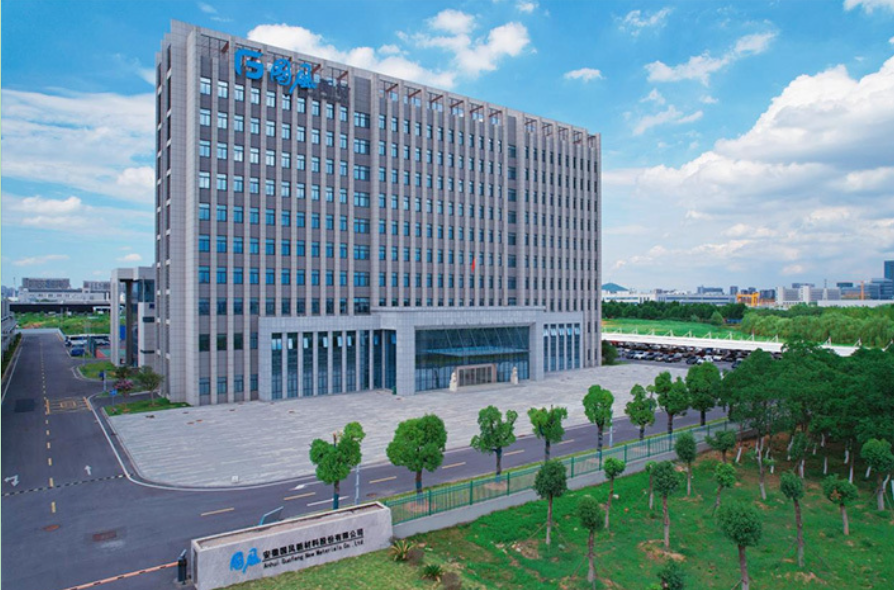
Almost simultaneously, the company also announced that its wholly owned subsidiary, Wuhu Guofeng Plastic Technology, had signed a Relocation Compensation Agreement with the Management Committee of the Wuhu Economic and Technological Development Zone, with compensation amounting to RMB 34.8842 million and a preliminary estimated relocation compensation gain of approximately RMB 32.2618 million.
Two seemingly independent messages actually point to the same thing:A traditionalBOPETThin-film leader is currently revitalizing assets through "asset revitalization +".The combination action of "landing high-end production lines" is making a sprint towards the high-end track of electronic-grade functional films.And the breakthrough point it chose—optical-grade PET base film for MLCC release film—is precisely one of the toughest, yet most worthwhile, hard nuts to crack in China’s electronic materials industry chain.
An underestimated “chokepoint” link
MLCCs are known as the “rice of the electronics industry,” with global demand reaching 4.8 trillion units in 2025. Yet few people realize that each ceramic dielectric layer produced requires a corresponding release film—and the core raw material for release film is optical-grade PET base film.
This is a market worth hundreds of billions and still expanding. According to QYResearch, the global MLCC release film market is expected to reach a sales revenue of 26.5 billion yuan in 2025, with projections of 28.2 billion yuan in 2026 and 41.8 billion yuan by 2032. CITIC Securities estimates that the high-end PET base film market will have a market size of 16 billion yuan in 2025, expected to reach 18 billion yuan by 2027 and exceed 21 billion yuan by 2030.
At the same time as demand is growing rapidly, the supply side remains highly concentrated. The global high-end MLCC release film market is currently dominated by giants represented by Japan’s Toray, Mitsui Chemicals, Lintec, and South Korea’s SKC, which together account for more than 70% of the market share.The top five companies account for nearly87%market shareAt the upstream base-film stage, a small number of companies such as Toray, Teijin, and Mitsubishi Chemical in Japan dominate the high-end market, and the self-sufficiency rate of high-end optical PET base film in China is less than 30%.
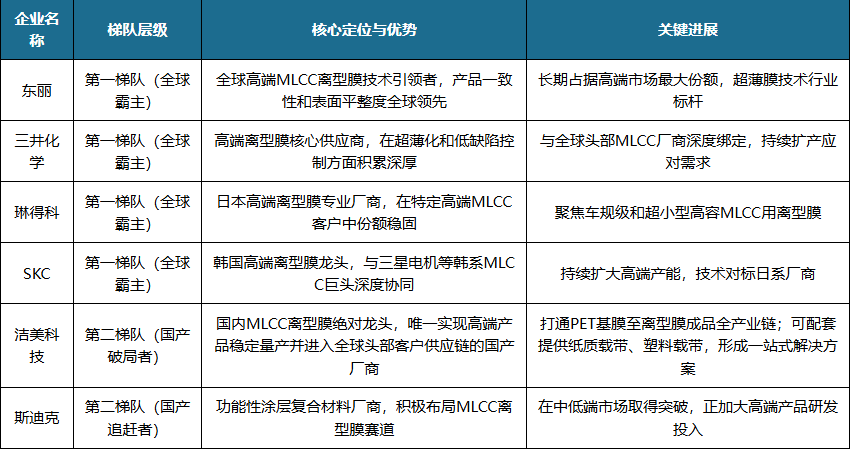
Source: Organized by Guanyan Tianxia.
The "bottleneck" of MLCC release film is not in the coating process, but in the base film stage. The combined cost of the base film and release agent accounts for over 58%. The nano-level surface control, high mechanical strength, and extreme batch stability of the base film directly determine the yield of downstream MLCCs.
How high are the technical barriers, specifically? Optical-grade PET base film for MLCCs requires the film surface roughness to meet nanometer-level standards, as micron-scale impurities or protrusions can damage the ceramic dielectric layer. It must also adapt to the trend toward miniaturized and ultra-thin MLCCs and support high-speed continuous coating. In addition, batch-to-batch variations in thickness and surface properties must be strictly controlled, as even slight fluctuations can lead to the scrapping of large volumes of components. This is the fundamental reason why Japanese and Korean companies have been able to maintain high market shares over the long term.
Guofeng New Materials' Game: 14.51Billion bets on three production lines.
Returning to Guofeng New Materials itself, the company announced in September 2022 that it planned to use its own funds to...14.51 Investing in the construction of a project with an annual production capacity of 1 billion square meters of optical-grade polyester film, including 3 production lines.
- MLCCOptical-grade polyester base film production lineDesigned production capacity: 600 million square meters per year
- Production line for polyester release base film for new display applicationsDesign capacity of 200 million square meters per year.
- PETPolarizer support film production lineDesigned annual capacity: 200 million square meters/year
As one of the leading enterprises in China’s polyester film industry, Guofeng New Materials has traditionally held strong advantages in packaging and industrial BOPET films. This investment marks a landmark project in its strategic upgrade from conventional polyester films to high-end electronic-grade functional films. The G1 line is dedicated to optical-grade PET base film for MLCC applications, and the completion of equipment installation means the production line has entered the countdown to commissioning and trial production.
The subsequent relocation compensation for the Wuhu subsidiary is another strategic move. The compensation amount of RMB 34.8842 million will be paid in two installments (RMB 15 million by December 30, 2026, and RMB 19.8842 million by December 30, 2027). Preliminary estimates indicate that it will contribute approximately RMB 32.2618 million in profit. This funding will not only directly enhance the listed company’s earnings, but, more importantly, will enable the company to further unlock the value of its assets and optimize its asset structure.Provide cash flow support for subsequent investment in high-end production lines.。
Viewed together, the two moves show Guofeng New Materials monetizing existing assets in its traditional business to replenish liquidity, while using that capital to fuel a breakthrough in its incremental electronic-grade functional film business as it advances and commissions high-end production lines.
The Real Progress of Domestic Substitution: The Climb from Usable to Truly User-Friendly
To assess the industrial significance of Guofeng New Materials’ G1 line, it needs to be placed within the broader framework of domestic substitution.
The progress of the first tier (domestic breakthrough leaders) has already become quite substantial.:
🔹 Jiemei TechnologyThe only domestic manufacturer to achieve stable mass production of high-end release film and successfully enter the supply chains of leading global MLCC customers, the company has built a fully integrated industrial chain from PET base film to finished release film products. It can also provide paper carrier tape and plastic carrier tape to deliver a one-stop solution. Its RMB 1.45 billion R&D and production base in Tianjin has entered trial production. MLCC release film-related products are now being supplied in stable batches to major customers including Yageo, Walsin Technology, Fenghua Advanced Technology, and Chaozhou Three-Circle, and the company has completed validation and commenced batch supply to major Korean and Japanese customers.
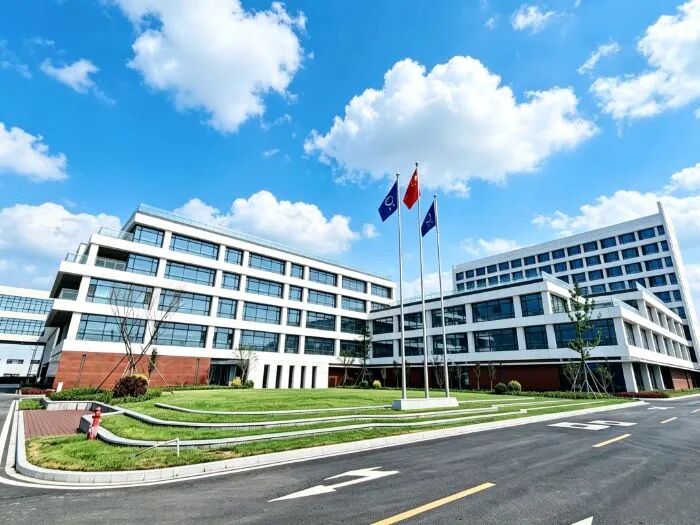
Image source: Jie Mei Technology
🔹 SdikIt has established a full product matrix covering standard, mid-end, and high-end products, and its ultra-high-end products for dielectric thicknesses below 1 μm have been validated by two leading manufacturers. In June, the company announced plans to invest RMB 565 million in the construction of a high-end MLCC release film project with an annual capacity of 1.2 billion square meters, with all additional capacity to be allocated to mid-to-high-end and ultra-high-end products.
🔹 Double Star New MaterialsThe 2025 interim report shows that revenue from MLCC release films surged by 144.4% year-on-year. The first phase is planned to have a production capacity of 500 million square meters, and the total project scale is expected to reach 2 billion square meters in the future.
However, from the perspective of the overall domestic localization rate, high-end breakthroughs are still underway.According to a research report by China Post Securities, the domestic localization rate of high-end MLCC release films has increased to 22%, with industry expectations indicating it may surpass 35% by 2026. Data from Guanyan Tianxia shows that the domestic self-sufficiency rate is expected to exceed 61% by 2025.High-end models still rely on supplies from Japan and South Korea.。
However, it should be noted that the G1 line of Guofeng New Materials has only completed equipment installation and is currently undergoing equipment debugging. Based on industry experience, the ramp-up period from equipment debugging to yield improvement for optical grade PET film production lines typically requires 6 to 12 months, while MLCC manufacturers usually have a validation period of 12 to 18 months for domestically produced base films.From “being able to make it” to “being able to supply it consistently” and then to “customers being willing to place bulk orders,” every step takes time.。
The Real Industrial Logic: The Replacement Window and Volume-Price Opportunities
Why does Guofeng New Materials’ advancement of G1 line commissioning at this point in time hold special significance?
Demand sideDriven by AI servers, new energy vehicles, and 5G communications, demand for high-end MLCCs is surging. The MLCC content per new energy vehicle has increased significantly, AI servers are driving volume growth in high-end release films, and 5G and high-speed communications are boosting demand for high-precision release films. By 2026, global demand for release films is expected to reach 21.5 billion square meters, with mid-to-high-end products accounting for more than half of the total demand.
Supply sideFor high-end ultra-thin release films and optical PET base films used in MLCCs and AI server supporting applications, leading Japanese manufacturers have remained cautious in the pace of capacity expansion. Taking Toray as an example, after the launch of its approximately JPY 8 billion capacity expansion plan at the Gifu plant, production capacity will increase by 1.6 times, but the new capacity has already been secured in advance by capacitor giants such as Murata and Samsung Electro-Mechanics, which together account for more than 60% of the global MLCC market. This means that, apart from major Japanese MLCC manufacturers, supply elasticity for other customers is extremely limited.
Price SideAmid a tight supply-demand balance for high-end release films, domestic substitution is entering a window of opportunity for both volume and price gains. When the supply of high-end base films is tight, industry gross margins may come under pressure, but this also presents a historic opportunity for technically capable domestic manufacturers to enter the supply chains of leading customers.
During this window period,The strategic positioning of Guofeng New Materials is unique.It has not yet established an integrated one-stop solution of “base film + coating + carrier tape” like JieMei Technology, nor has it taken the lead in achieving breakthroughs in ultra-high-end products below 1 μm like Sidike; instead, it has chosen to...Taking the base membrane link as the fulcrum.If the yield ramp-up of G1 line proceeds smoothly and the products pass customer validation, the company will, by leveraging over twenty years of accumulated biaxial stretching process expertise in the BOPET field, simultaneously gain self-supply capability in the two high-end base film segments of MLCC release film and polarizer release film, thereby forming an integrated industrial chain closed loop of “base film + coating.”
Editor: Lily
Source of materials: Guofeng New Materials Announcement, QYResearch, Guanyan Tianxia MLCC Release Film Deep Report, 36Kr, Jiemai Technology, Stik, Shuangxing New Materials Listed Company Financial Reports, etc.
【Copyright and Disclaimer】This article is the property of PlastMatch. For business cooperation, media interviews, article reprints, or suggestions, please call the PlastMatch customer service hotline at +86-18030158354 or via email at service@zhuansushijie.com. The information and data provided by PlastMatch are for reference only and do not constitute direct advice for client decision-making. Any decisions made by clients based on such information and data, and all resulting direct or indirect losses and legal consequences, shall be borne by the clients themselves and are unrelated to PlastMatch. Unauthorized reprinting is strictly prohibited.
Most Popular
-
Strait of Hormuz Blocked Again, Supply-Demand Mismatch in Polyolefin Market Set to Intensify!
-

Raw Material Supply Shortage! INEOS Phenol Declares Force Majeure on Phenol and Acetone Businesses
-
【Overseas News】Shipping traffic in the Strait of Hormuz has sharply declined! South Korea approves the reorganization of Liuzhi Petrochemical; Italy shuts down the PE plant
-
Versalis Shuts Down Polyethylene Plant in Brindisi, Italy
-

[Overseas News] US Senate Approves Bill! SABIC Collaborates with Saudi Automobile Brand! Anti-fog Biodegradable Film Launched


